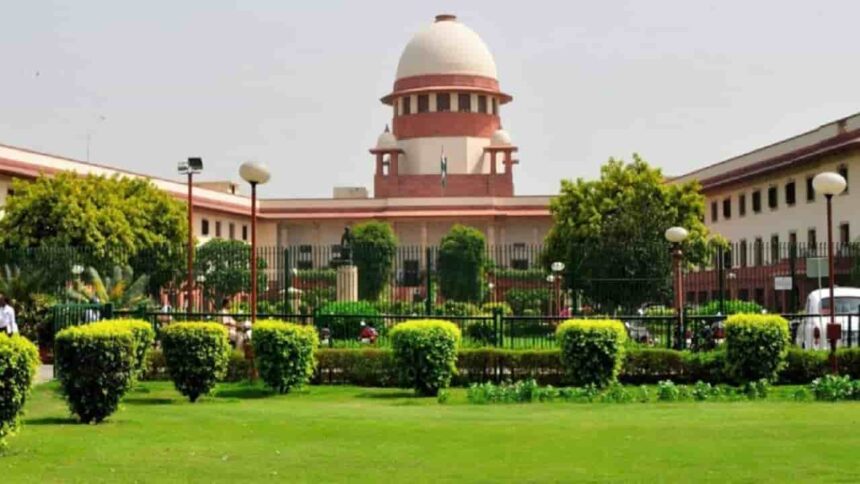
The Supreme Court of India has paused the implementation of its own recent judgment redefining the Aravalli hill range, marking an unusual but significant moment in judicial self-review and environmental governance. The decision comes amid widespread concern that the revised definition could weaken long-standing protections for one of the country’s most fragile ecological systems, prompting the court to reconsider its earlier directions and seek deeper expert scrutiny before allowing any irreversible impact on the ground.
The pause reflects growing unease over how legal interpretations intersect with environmental realities. The Aravalli range, among the oldest mountain systems in the world, plays a critical role in preventing desertification, maintaining groundwater levels and sustaining biodiversity across north-western India. Any change in how this landscape is defined has far-reaching consequences, not only for mining and development activities but also for climate resilience and the livelihoods of millions who depend on the region’s ecological balance.
Court revisits its own ruling amid environmental and public concerns
The decision to keep the earlier judgment in abeyance follows petitions and representations that questioned the implications of the revised definition of the Aravalli hills. In its earlier order, the Supreme Court had accepted a narrower, technical interpretation of what constitutes the Aravalli range, based largely on specific geographical and elevation criteria. Environmentalists, activists and several experts warned that such a definition could exclude large tracts of land traditionally considered part of the Aravalli ecosystem, potentially opening them up to regulated mining and construction.
Responding to these concerns, a bench of the Supreme Court of India acknowledged that critical aspects of the issue required further examination. The court noted that the matter involved complex scientific and environmental questions that could not be resolved solely through legal reasoning. By pausing its own judgment, the court signalled that judicial authority also carries a responsibility to reassess decisions when credible evidence suggests unintended consequences.
The Aravalli hills stretch across multiple States, including Rajasthan, Haryana, Gujarat and parts of the national capital region. Over decades, judicial interventions have played a key role in curbing illegal mining and unchecked development in the area. Earlier rulings treated the Aravalli range as an interconnected ecological system rather than a collection of isolated hill formations. Critics of the revised definition argued that breaking this continuity could undermine years of conservation efforts.
In keeping the order on hold, the court indicated that it would consider constituting or relying on a high-powered expert committee to examine the scientific basis of defining the Aravalli range. Such a committee is expected to include environmental scientists, geologists and other specialists capable of assessing how geological formations, forest cover and ecological functions interact across the region. The court’s emphasis on expert input reflects a broader trend in environmental jurisprudence, where scientific evidence increasingly shapes legal outcomes.
The move has been widely interpreted as an assertion that environmental protection cannot be treated as a purely administrative or technical issue. By reopening the debate, the court has effectively acknowledged that definitions on paper can translate into irreversible changes on the ground, especially in ecologically sensitive zones.
Wider implications for environmental governance and rule of law
The Supreme Court’s decision to pause its own judgment has implications that extend beyond the Aravalli hills. It raises important questions about how courts balance development needs with environmental safeguards, and how flexible judicial processes can be when confronted with new information or public concern. In recent years, courts in India have increasingly been called upon to adjudicate disputes where environmental degradation intersects with economic growth and regulatory frameworks.
The Aravalli case highlights the tension between regulatory clarity and ecological complexity. While governments and industries often seek clear definitions to facilitate planning and compliance, ecosystems rarely conform to neat boundaries. Forests, hill ranges and water systems function as interconnected networks, and fragmenting them through narrow definitions can weaken overall protection. The court’s decision to revisit its ruling suggests a recognition of this complexity.
Environmental experts have welcomed the pause as an opportunity to strengthen conservation mechanisms. They argue that the Aravalli range acts as a natural barrier against the spread of the Thar desert and plays a crucial role in recharging groundwater aquifers in an increasingly water-stressed region. Any dilution of protections could exacerbate climate vulnerabilities, especially as extreme weather events become more frequent.
At the same time, the case underscores the challenges faced by the judiciary in navigating scientific uncertainty. Courts rely on expert reports and submissions, but differing methodologies and interpretations can lead to conflicting conclusions. By seeking a more comprehensive review, the Supreme Court appears to be attempting to bridge this gap and ensure that its final directions are informed by the best available knowledge.
The decision also resonates with broader debates about judicial accountability and adaptability. While courts are often seen as final arbiters, the willingness to pause and reconsider a judgment demonstrates that the legal system retains mechanisms for correction and refinement. In environmental matters, where the costs of error can be irreversible, such caution assumes added significance.
As the matter proceeds, stakeholders across government, civil society and industry will be closely watching the court’s next steps. The outcome could set a precedent for how environmental definitions are framed and interpreted in future cases, not only for the Aravalli range but for other sensitive regions across the country.
The pause on the Aravalli definition ruling thus represents more than a procedural development. It reflects an evolving judicial approach that recognises the dynamic relationship between law, science and society, and the need for constant vigilance when decisions affect shared natural heritage.