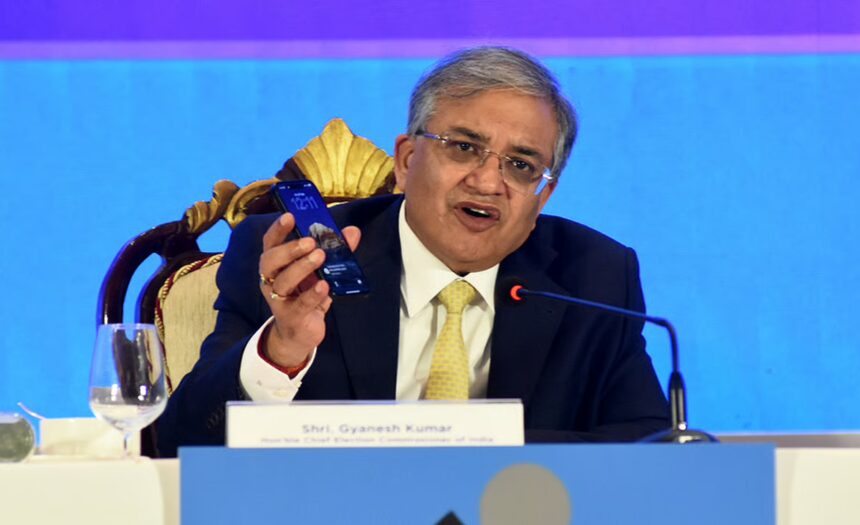
India’s political landscape has witnessed a significant development as opposition parties have reportedly gathered the required support to introduce a motion seeking the removal of Chief Election Commissioner (CEC) Gyanesh Kumar. According to parliamentary sources, the opposition alliance has completed the process of collecting signatures from Members of Parliament and is preparing to present the proposal in both houses of Parliament.
The notice seeking the removal of the Chief Election Commissioner is expected to be submitted either on Thursday or Friday during the ongoing session of Parliament. If formally introduced, it would mark a rare and historically significant step in India’s parliamentary history, as such proceedings against a Chief Election Commissioner are extremely uncommon.
Sources indicate that the notice has already been signed by approximately 120 Members of Parliament in the Lok Sabha and around 60 MPs in the Rajya Sabha. These numbers exceed the minimum requirement needed to initiate the process under parliamentary rules.
The development comes amid rising tensions between the opposition parties and the Election Commission of India over allegations related to electoral processes, voter list revisions and the functioning of the constitutional body responsible for conducting elections in the country.
Signature requirement and constitutional procedure
The removal of the Chief Election Commissioner in India follows a strict constitutional process similar to the procedure used for removing a judge of the Supreme Court. The process is designed to ensure the independence of the Election Commission while also providing a mechanism for accountability.
Under the existing parliamentary rules, a motion seeking the removal of the Chief Election Commissioner must be supported by a minimum number of MPs before it can be introduced in Parliament.
In the Lok Sabha, at least 100 Members of Parliament must sign the notice proposing the motion. In the Rajya Sabha, the motion requires the support of at least 50 MPs.
According to sources, the opposition alliance has comfortably crossed these thresholds. The signatures collected so far include those of MPs from multiple parties belonging to the INDIA alliance, indicating a coordinated effort among opposition parties to pursue the proposal.
Once the notice is submitted, the Speaker of the Lok Sabha or the Chairman of the Rajya Sabha will examine whether the motion meets the procedural requirements before deciding whether it can be admitted for discussion.
If the motion is admitted in both houses, the next step involves the formation of an inquiry committee to examine the allegations mentioned in the proposal.
According to the Judges (Inquiry) Act, 1968, if notices are submitted simultaneously in both houses of Parliament, the investigation committee is formed only after the motion is formally accepted.
In such cases, the Lok Sabha Speaker and the Rajya Sabha Chairman jointly constitute a three-member inquiry committee. This committee examines the allegations made against the constitutional authority and submits its findings to Parliament.
If the committee concludes that the allegations are valid, the motion can then be taken up for discussion and voting in both houses of Parliament.
For the removal of the Chief Election Commissioner to succeed, the resolution must be passed in both houses by a special majority, meaning a majority of the total membership of the house and at least two-thirds of the members present and voting.
Only after this process is completed can the Chief Election Commissioner be removed from office.
Opposition allegations and political context
The opposition parties have alleged that the Chief Election Commissioner has acted in a manner that benefits the ruling government in certain situations. These allegations have intensified in recent months following controversies related to electoral roll revisions and voter list verification processes.
One of the key issues raised by opposition leaders relates to the Special Intensive Revision (SIR) of voter lists conducted by the Election Commission. The opposition claims that the process is being used to manipulate voter rolls and remove legitimate voters in certain states.
According to opposition leaders, the revision process may disproportionately affect specific communities and political constituencies. They argue that such actions could potentially influence election outcomes and undermine the credibility of the electoral process.
Concerns about the voter list revision process have been particularly strong in West Bengal, where political tensions between the state government and the central government have remained high.
West Bengal Chief Minister Mamata Banerjee has publicly accused the Election Commission of removing the names of genuine voters from electoral rolls. She has alleged that the process could benefit the ruling party at the national level.
Opposition leaders across several states have echoed similar concerns, arguing that the Election Commission must remain completely impartial and transparent in its functioning.
The Election Commission of India, however, has consistently maintained that its procedures follow established rules and are carried out to ensure the accuracy and integrity of voter lists.
Officials from the commission have stated in the past that voter list revisions are routine administrative exercises aimed at removing duplicate entries, correcting inaccuracies and ensuring that electoral rolls remain updated.
Despite these clarifications, the controversy has continued to escalate, leading opposition parties to consider parliamentary action.
Political analysts say the move to introduce a removal motion may also be part of a broader strategy by opposition parties to highlight concerns about democratic institutions and electoral transparency.
At the same time, experts note that the process of removing a Chief Election Commissioner is extremely complex and requires broad parliamentary consensus, making the outcome uncertain.
Even if the motion is formally introduced, it would have to pass several procedural stages and secure strong support in both houses of Parliament before any final decision could be taken.
A rare constitutional development
The proposed motion has drawn attention because attempts to remove a Chief Election Commissioner are rare in India’s political history.
The Election Commission is a constitutionally protected body responsible for conducting elections to Parliament, state legislatures and the offices of the President and Vice President.
Because of its critical role in safeguarding democracy, the Constitution provides strong protection to the Chief Election Commissioner to ensure independence from political influence.
At the same time, the provision allowing removal through a parliamentary process ensures that the office remains accountable if serious allegations arise.
If the motion is formally presented in Parliament, it is likely to trigger intense debate on the functioning of the Election Commission, electoral reforms and the role of constitutional institutions in India’s democracy.
The coming days may therefore witness significant political and parliamentary developments as the opposition prepares to move forward with its proposal.