Prime Minister Narendra Modi inaugurated and laid the foundation stone for development projects worth approximately ₹10,800 crore in Kochi, Kerala, during his visit to the state on Wednesday. The visit combined major infrastructure announcements with strong political messaging as the Prime Minister addressed a large gathering of National Democratic Alliance (NDA) supporters.
During his speech, Modi highlighted the role of young Indians in driving innovation, entrepreneurship and technological advancement. At the same time, he criticised the leadership of the Indian National Congress, particularly referring to Rahul Gandhi as the party’s “yuvraj”, and accused the opposition of failing to recognise the achievements of India’s youth.
The Prime Minister’s visit included several events such as the inauguration of infrastructure projects, participation in community celebrations, a roadshow in Kochi and later a trip to Tiruchirappalli in Tamil Nadu where additional development projects were launched.
The visit comes at a time when political activity in southern India is intensifying, with both the ruling Bharatiya Janata Party (BJP) and opposition parties preparing for upcoming electoral battles in the region.
Development projects and focus on youth innovation
During the programme in Kochi, Prime Minister Modi inaugurated and laid the foundation stone for projects across multiple sectors including energy, transport, infrastructure, railways and rural development. These projects are expected to improve connectivity, boost economic activity and strengthen Kerala’s infrastructure.
While addressing the gathering, Modi emphasised the role of young Indians in emerging sectors such as drone technology, artificial intelligence and digital innovation.
He said that many young people in Kerala are establishing startups focused on drone manufacturing and advanced technologies, contributing to India’s growing reputation as a global innovation hub.
According to Modi, India’s youth are capable of achieving remarkable progress when provided with the right opportunities and support.
The Prime Minister also criticised what he described as a “narrow political mindset” among some opposition leaders, arguing that such thinking prevents them from recognising the scale of development taking place across the country.
He said India’s young innovators are creating new opportunities not only for themselves but also for the country’s economy and technological growth.
Modi reiterated that the government’s policies are aimed at encouraging entrepreneurship, innovation and skill development among young Indians.
He pointed to initiatives such as Startup India, Digital India and Atmanirbhar Bharat as key pillars supporting the country’s technological transformation.
According to the Prime Minister, these initiatives are helping India reduce dependence on foreign technologies while building domestic capabilities in emerging industries.
Political remarks and criticism of opposition
Along with discussing development initiatives, the Prime Minister used the platform to criticise opposition parties, including the Congress and the Left parties in Kerala.
Referring to Rahul Gandhi as the “yuvraj” of the Congress party, Modi said the opposition leadership fails to understand the aspirations and achievements of India’s youth.
He said that while young entrepreneurs across the country are building cutting-edge technologies and launching startups, some political leaders remain disconnected from these developments.
Modi also criticised Kerala’s two major political alliances — the Left Democratic Front (LDF) and the United Democratic Front (UDF) — accusing them of failing to fully utilise the state’s potential.
According to the Prime Minister, Kerala possesses significant advantages including a highly educated population, strong cultural traditions, natural beauty and access to vast coastal resources.
However, he said the state has not progressed at the pace it could have due to the policies and governance of previous administrations.
Modi urged the people of Kerala to consider giving the BJP-led NDA an opportunity to govern the state.
He pointed out that both the Congress-led UDF and the Left-led LDF have governed Kerala for decades and argued that it is time for a change in leadership.
The Prime Minister said that if given the opportunity, the NDA would focus on creating employment opportunities and expanding sectors such as tourism, technology and entrepreneurship.
India-First approach and West Asia crisis
The Prime Minister also addressed concerns regarding the ongoing geopolitical tensions in West Asia and the Gulf region.
He acknowledged that many Indians living and working abroad, particularly in Gulf countries, may be affected by developments in the region.
Modi assured citizens that the Indian government is taking all necessary measures to ensure the safety and welfare of Indian nationals abroad.
He emphasised that whenever Indians face difficulties overseas, the government acts swiftly to protect them.
To illustrate this commitment, Modi referred to earlier rescue operations conducted by the Indian government.
These included the evacuation of Indian nurses from Iraq during periods of conflict and the rescue of Father Tom Uzhunnalil, an Indian priest who had been held captive in Yemen.
The Prime Minister said such examples demonstrate that the government prioritises the safety of Indian citizens regardless of where they are located.
Modi also urged people not to panic or spread rumours regarding the situation in West Asia.
According to him, India’s foreign policy decisions are guided by an “India First” approach, which places national interests and the welfare of citizens at the centre of decision-making.
He also emphasised the importance of self-reliance in times of global crisis.
Modi noted that India has learned valuable lessons from recent global disruptions including the COVID-19 pandemic, the Russia-Ukraine conflict and other geopolitical challenges.
These experiences, he said, highlighted the importance of strengthening domestic manufacturing, supply chains and technological capabilities.
Events during Kerala visit and Tamil Nadu projects
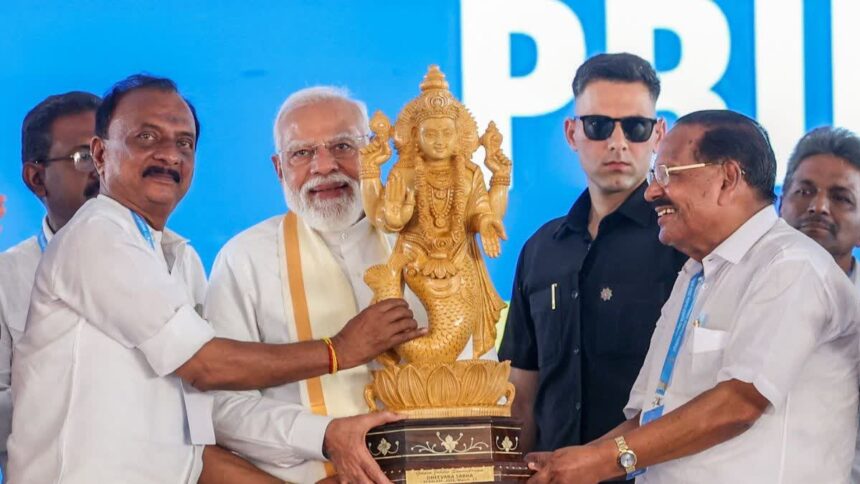
Before addressing the political rally, the Prime Minister attended the Golden Jubilee celebrations of the Akhil Kerala Dhiwar Sabha, an organisation dedicated to the welfare of the fishing community.
During the event, Modi praised the organisation’s work in supporting fishermen and coastal communities.
He also mentioned that the central government had approved the proposal to officially rename the state as “Kerala”, describing it as a moment of pride for the people of the state.
Later, the Prime Minister held a roadshow in Kochi, greeting supporters during a short procession near the Jawaharlal Nehru International Stadium.
Following his engagements in Kerala, Modi travelled to Tiruchirappalli in Tamil Nadu, where he inaugurated and laid the foundation stone for additional projects worth around ₹5,650 crore.
He also flagged off five new trains, which are expected to improve regional connectivity and transportation infrastructure.
During his address in Tamil Nadu, Modi highlighted the government’s initiatives aimed at improving women’s participation in politics and society.
He referred to legislative measures designed to increase women’s representation in Parliament and emphasised various welfare schemes launched for women.
At the same time, he criticised the Dravida Munnetra Kazhagam (DMK) government in the state, alleging that incidents of crime against women had increased.
Modi said that if the NDA comes to power in Tamil Nadu, ensuring women’s safety and strengthening governance would be among its top priorities.
The Prime Minister’s visit also coincided with a significant policy announcement from the Union Cabinet.
Ahead of the visit, the government approved a proposal granting international airport status to Madurai Airport.
Union Minister Ashwini Vaishnaw said the decision reflects long-standing public demand and will significantly enhance connectivity and economic development in the region.
Overall, Modi’s visit to Kerala and Tamil Nadu combined infrastructure announcements with strong political messaging aimed at highlighting development, youth empowerment and national self-reliance.