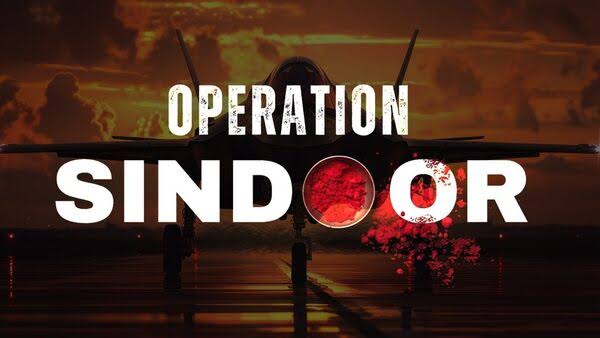
India’s response to the Pahalgam massacre of April 2025 has now been enshrined in educational resources, as the National Council of Educational Research and Training (NCERT) has introduced a detailed module on Operation Sindoor, describing it as a “military success, a technological breakthrough, and a political message all rolled into one.” Released in the form of conversational modules for schoolchildren across different stages, the publication goes beyond battlefield details, exploring how India responded to Pakistan-backed terrorism with precision strikes, diplomatic outreach, and indigenous technological innovation. The module situates Operation Sindoor within a larger historical and political context, making it not merely a record of events but a narrative of national resilience, self-reliance, and strategic resolve.
From Pulwama to Pahalgam: Framing Terrorism, Peace, and India’s Response
The NCERT module introduces students to Operation Sindoor through a conversation-based format between teachers and learners, ensuring accessibility while retaining seriousness. It begins by tracing the broader history of Pakistan’s attempts to destabilize India, whether through conventional wars, insurgencies, or terrorist attacks. By highlighting the Pulwama attack of 2019 and India’s retaliatory Balakot air strike, the text establishes continuity between past and present challenges. It emphasizes that India’s military choices have consistently distinguished between targeting terrorist infrastructures while sparing civilian populations—a principle underscoring both legality and morality in counterterrorism efforts.
The narrative then shifts to Jammu and Kashmir after the abrogation of Article 370 in 2019. NCERT’s module paints a vivid picture of a transformed region: new infrastructure projects, modernized schools, improved connectivity, and a record-breaking surge of tourism by 2023. This backdrop of peace and development, however, was violently interrupted in April 2025, when terrorists struck at Pahalgam, killing 26 innocent tourists. According to the module, the attack was not random but calculated—intended to sow fear, disrupt intercommunal harmony, and tarnish the perception of stability in the Valley.
Initially, The Resistance Front (TRF) claimed responsibility but quickly retracted its statement within four days, attempting to blur accountability. India’s National Investigation Agency (NIA), however, pieced together conclusive evidence, supported by eyewitness accounts, proving TRF’s involvement. Investigations revealed deeper complicity: the operation was masterminded by Pakistan’s Inter-Services Intelligence (ISI) and Lashkar-e-Taiba (LeT), sanctioned directly by Pakistan’s military and political leadership. In this sense, the module asserts that the Pahalgam massacre was not an isolated act of terrorism but a state-sponsored offensive against India.
Faced with this provocation, India launched Operation Sindoor—a campaign designed not only as retaliation but also as a demonstration of strategic foresight, technological independence, and diplomatic strength. The module makes clear that Operation Sindoor’s planning involved more than battlefield decisions: it was about restoring national confidence, ensuring justice, and signaling to the world that India would not allow terror to dictate its future.
Operation Sindoor: Planning, Precision, and the Message to the World
In its description of Operation Sindoor, NCERT’s secondary-stage module—aptly titled “Operation Sindoor – A Mission of Honour and Bravery”—portrays the campaign as a meticulously orchestrated exercise. The Indian Armed Forces were tasked with identifying multiple terrorist-linked targets, selecting weapons for precision strikes, and ensuring civilian casualties were minimized. Strikes were planned with clarity of purpose, targeting infrastructure directly tied to terror operations: command and control centres, radars, surface-to-air missile systems, runways, and hangars. The Indian Air Force’s operations penetrated Pakistani air defenses, leaving behind visible vulnerabilities that “the world saw.” The text emphasizes how this success restored public confidence in India’s military capability and reassured citizens that justice had not only been promised but delivered.
The module further explores Pakistan’s escalatory behavior in response to the strikes. Ceasefire violations were reported along the Line of Control, accompanied by attacks on military bases, logistic nodes, and formation headquarters. Pakistan also employed Unmanned Aerial Systems (UAS) in its offensives, attempting to destabilize India’s defenses. However, India’s integrated air defense grid proved formidable. The use of S-400, Medium Range Surface-to-Air Missiles (MRSAM), AKASH systems, and traditional air defense guns such as Pechora, L-70, ZU-23, and OSA-AK, provided a layered protection shield. Counter-UAS grids, too, functioned effectively, neutralizing aerial threats.
India’s responses were not limited to defense. On May 8, precision air-launched munitions targeted select Pakistani air defense installations and sensor networks, deliberately avoiding civilian areas. It was a calibrated message—firm yet measured—demonstrating India’s ability to punish without indiscriminate escalation. Even when Pakistan intensified attacks on May 9 and 10, striking schools, religious sites, and civilian infrastructure, killing 14 civilians, India’s resilience held firm. The Indian Army retaliated, neutralizing 35–40 Pakistani soldiers, while ensuring that critical Indian assets remained untouched despite sustained targeting of cantonments, ammo depots, and Air Force bases.
The Indian Navy, too, asserted its dominance by deploying its Carrier Battle Group in the North Arabian Sea. Equipped with MiG-29K fighter jets, early warning helicopters, and advanced surveillance systems, the naval forces safeguarded India’s maritime interests and deterred potential Pakistani misadventures in the region. The inclusion of naval operations underscores the multidimensional nature of Operation Sindoor, which was not confined to land and air but extended to securing maritime boundaries.
What sets the operation apart, the module underlines, is its reliance on indigenous defense technologies. Indian-built systems were deployed not as experiments but as decisive tools of warfare. The success of systems like MRSAM and AKASH, alongside sophisticated integration with legacy platforms, showcased that India had reached a point of technological self-reliance in matters of defense. The module frames this as not just a matter of military pride but a civilizational milestone—India, once dependent on foreign defense imports, now capable of crafting and deploying its own tools of security.
Yet Operation Sindoor was not restricted to the battlefield alone. The NCERT text highlights India’s diplomatic offensive: missions abroad worked tirelessly to explain the rationale behind the strikes, share evidence of Pakistan’s complicity, and mobilize international understanding. This outreach ensured that the global narrative framed India’s actions as legitimate self-defense rather than reckless aggression. By connecting military power with diplomatic persuasion, Operation Sindoor became a holistic campaign of national assertion.
The NCERT module thus frames Operation Sindoor as a turning point—an episode where military precision, political will, technological independence, and diplomatic clarity converged. For students, the narrative functions as both a historical lesson and a civic message: that India’s security and dignity rest on preparedness, unity, and resolve.