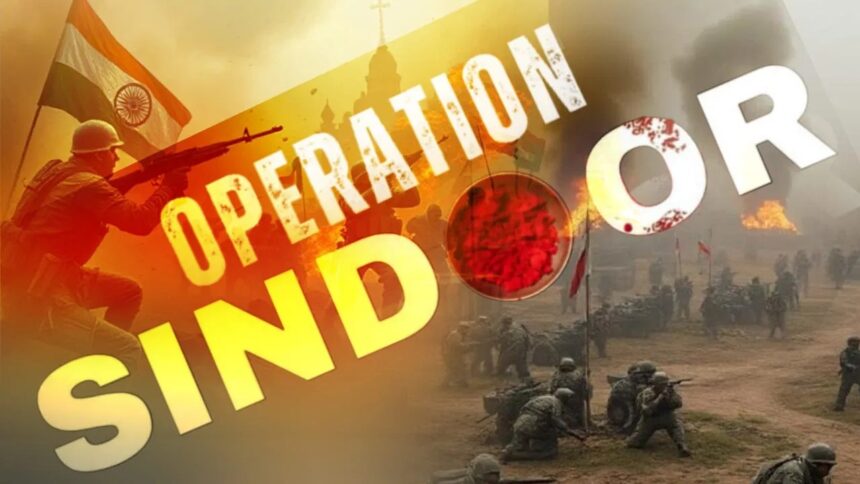
In the early hours of May 7, 2025, India launched its most daring and coordinated military strikes under the codename Operation Sindoor, targeting terrorist infrastructure deep inside Pakistan and Pakistan-occupied Kashmir (PoK). This operation, carried out by the Indian Army, Air Force, and Navy, has been hailed as one of the most significant cross-border precision strikes since the Balakot airstrikes in 2019.
The operation was a direct military response to the Pahalgam terror attack of April 22, which resulted in the tragic loss of 26 lives, including an Indian Navy officer and a Nepali national. The attack was attributed to Pakistan-based terrorist outfit Lashkar-e-Taiba (LeT).
Destruction of 21 Terror Camps
Operation Sindoor targeted a total of 21 terror camps across nine locations in Pakistan and PoK, which were associated with three major terror groups: LeT, Jaish-e-Mohammed (JeM), and Hizbul Mujahideen (HM). Key sites, such as Bahawalpur (JeM HQ), Muridke (LeT HQ), and other locations like Muzaffarabad, Kotli, Sialkot, and Gulpur, were hit with pinpoint precision.
The Indian Ministry of Defence issued a statement confirming that no Pakistani military facilities were targeted, emphasizing that the strikes were precise and focused, with minimal collateral damage. “Our actions have been focused, measured and non-escalatory in nature,” the statement clarified.
The Impact on Terror Infrastructure
The strikes have significantly crippled the terror infrastructure in these areas. According to satellite imagery and field reports, the damage to key terror camps in Bahawalpur and Muridke is substantial. Bahawalpur, where the JeM operates, and Muridke, home to LeT’s headquarters, were severely impacted. Muridke is notorious for being a “terror nursery” and has been the site of training for several high-profile terrorists, including those involved in the 26/11 attacks in Mumbai.
India’s missile strikes, including precision-guided munitions and loitering munitions, were synchronized to ensure maximum damage while avoiding civilian casualties. The strikes were also timed to avoid detection and to maintain the element of surprise.
Pakistan has reacted with defiance, with Prime Minister Shehbaz Sharif condemning the attacks as a “cowardly” move and warning of further consequences. Despite Pakistan’s claims, there have been no confirmed civilian casualties in the targeted camps. However, Masood Azhar, the leader of JeM, claimed that ten of his family members were killed in the strikes, though no verification has been provided.
Operation’s Strategic Message
The broader message of Operation Sindoor extends beyond the strikes themselves. India has sent a strong signal that it will not tolerate cross-border terrorism and will take swift and targeted actions against terror groups operating in Pakistan and PoK.
This operation, marking a significant escalation in India’s counterterrorism tactics, was conducted with strategic restraint, ensuring that military targets were hit while avoiding unnecessary escalation with Pakistan’s military forces. The operation has already led to widespread discussions on its long-term impact on the relationship between India and Pakistan, with experts believing that it marks the end of any hopes for normalizing relations between the two nations in the near future.
The world has watched closely as India demonstrated its increasing military prowess and strategic restraint. While Pakistan denounced the strikes, the international community has largely remained silent on the specific details of the operation. Experts, however, agree that the strikes have solidified India’s position as a nation willing to take tough military actions when necessary while maintaining a focused response.
Operation Sindoor has demonstrated India’s evolving military strategy, where precision strikes are increasingly replacing traditional large-scale warfare. The operation sends a clear message that India is willing to take proactive steps to protect its sovereignty and its people from the scourge of cross-border terrorism.
This operation, which has crippled multiple terror networks in Pakistan and PoK, signifies a new era in India’s military response to threats, reaffirming its resolve to hold those responsible for terrorism accountable, while ensuring minimal collateral damage in the process.