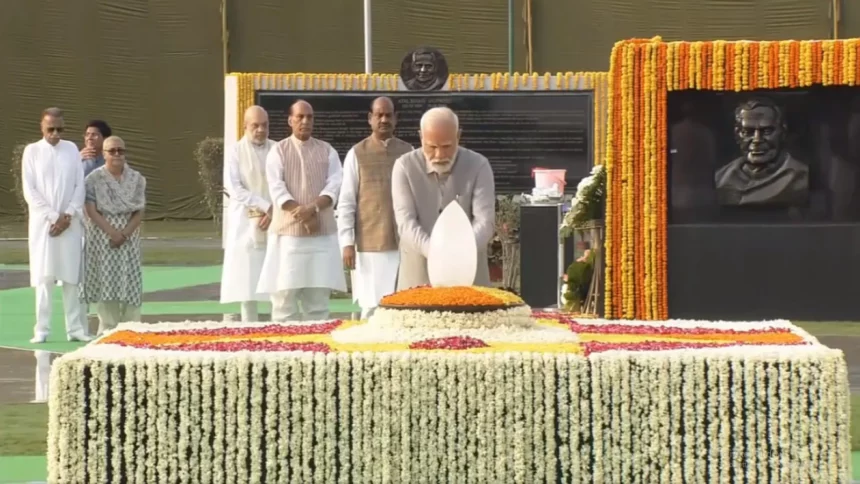
On the solemn occasion of former Prime Minister Atal Bihari Vajpayee’s death anniversary, Prime Minister Narendra Modi, along with several dignitaries, paid rich tributes to the iconic leader, hailing his statesmanship, dedication, and lifelong service to the nation. Modi lauded Atal Bihari Vajpayee’s unwavering vision of a developed and self-reliant India, describing it as a constant source of inspiration for citizens to actively participate in building the nation’s future. The commemorations, held at ‘Sadaiv Atal’ in New Delhi, were marked by floral tributes, deep respect, and a reflection on Atal Bihari Vajpayee’s monumental contributions to Indian politics, governance, and national identity. The day not only honored his memory but also underscored the enduring relevance of his leadership in shaping India’s growth trajectory.
PM Modi’s Tribute and National Commemoration
Prime Minister Narendra Modi took to X, formerly known as Twitter, to express his heartfelt tribute to Bharat Ratna Atal Bihari Vajpayee. His message resonated with the sentiment of millions of Indians who admired Atal Bihari Vajpayee’s leadership style and his ability to combine political pragmatism with a deep commitment to national interest. “On behalf of all countrymen, heartfelt tributes to former Prime Minister Bharat Ratna Atal Bihari Vajpayee ji on his death anniversary. His dedication and spirit of service towards the all-round development of the nation inspire everyone to contribute to the building of a developed and self-reliant India,” Modi wrote.
The tribute was more than a ceremonial acknowledgment; it reflected the Prime Minister’s personal admiration for Atal Bihari Vajpayee’s legacy and his belief that Atal Bihari Vajpayee’s ideals continue to guide India’s present and future. President Droupadi Murmu, senior cabinet ministers, and leaders from various political backgrounds gathered at ‘Sadaiv Atal,’ Atal Bihari Vajpayee’s memorial, to offer floral tributes. The solemn event brought together leaders across party lines, a testament to the respect Vajpayee commanded across India’s political spectrum.
Atal Bihari Vajpayee’s political career was marked by his exceptional ability to maintain dignity in political discourse, even amidst intense ideological battles. His statesmanlike approach often transcended political divides, enabling him to form consensus on critical national issues. This spirit was visibly present during the commemoration, as leaders from differing political ideologies came together to honor him.
The memorial ceremony was a reminder of Atal Bihari Vajpayee’s enduring appeal to the Indian public, not just as a political figure but as a poet, thinker, and visionary who understood the pulse of the nation. For many, his death anniversary serves not just as a day of remembrance, but also as a call to revisit and uphold the values he championed throughout his life.
Atal Bihari Vajpayee’s Legacy of Leadership and Vision for India
Atal Bihari Vajpayee’s life and political journey embody the transformation of modern India. Born on December 25, 1924, in Gwalior, he entered public life with a passion for national service and quickly rose through the ranks to become one of the most influential leaders in India’s post-independence era. As a founding member of the Bharatiya Janata Party (BJP), Atal Bihari Vajpayee played a pivotal role in shaping the party’s ideology and expanding its reach across the nation.
His tenure as Prime Minister, first briefly in 1996 and then from 1998 to 2004, was marked by significant milestones in governance, economic reforms, and foreign policy. One of the defining moments of his leadership came in 1998, when his government conducted the Pokhran-II nuclear tests, firmly asserting India’s place on the global stage as a nuclear power. This bold move, despite international criticism and sanctions, was celebrated domestically as a declaration of India’s strategic autonomy.
Atal Bihari Vajpayee also recognized the critical role of infrastructure in nation-building. His ambitious Golden Quadrilateral project, aimed at connecting major cities through a network of highways, revolutionized road transport in India and laid the foundation for economic growth in the decades to follow. His government also pushed forward initiatives in telecommunications, rural connectivity, and education, setting the stage for India’s emergence as a rising economic power.
Beyond infrastructure and strategic defense, Atal Bihari Vajpayee’s efforts toward peace and diplomacy stood out. His historic bus journey to Lahore in 1999 was a bold gesture aimed at fostering peace with Pakistan. Though the Kargil War later tested bilateral relations, Atal Bihari Vajpayee’s emphasis on dialogue and diplomacy left a lasting impression as a leader committed to peaceful coexistence.
His oratory skills, poetic sensibility, and ability to connect with people across diverse backgrounds made him a beloved figure among citizens. He was known for his ability to weave poetry into politics, delivering speeches that were as inspiring as they were substantive. Even his political opponents acknowledged his rare combination of charm, intellect, and principled leadership.
In recognition of his unparalleled service to the nation, Atal Bihari Vajpayee was awarded the Bharat Ratna in 2015, India’s highest civilian honor. His passing on August 16, 2018, marked the end of an era in Indian politics, but his vision for a self-reliant India continues to influence policies and inspire leaders.
Today, as India navigates complex challenges in the global arena, Atal Bihari Vajpayee’s emphasis on national strength, economic resilience, and inclusive governance remains strikingly relevant. Prime Minister Modi’s tribute on his death anniversary serves as both a homage to the past and a reaffirmation of those values for the future.