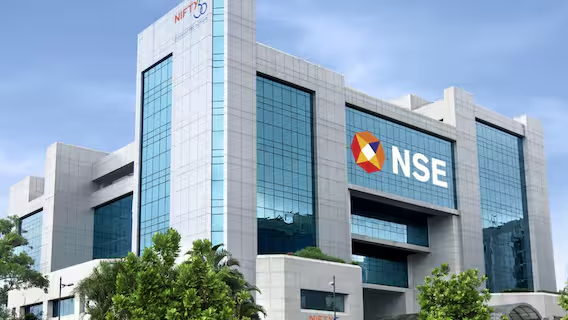
New Delhi: The board of the National Stock Exchange (NSE) is scheduled to meet on Friday, February 6, to formally initiate the process for its long-awaited initial public offering (IPO), following regulatory clearance from the capital markets regulator Securities and Exchange Board of India (SEBI).
According to market sources, the NSE board is expected to constitute a specialised IPO committee during the meeting. This committee will act as the central authority overseeing all aspects of the listing process, including defining procedures, timelines and governance structures related to the IPO.
Role of the proposed IPO committee
The proposed committee will be tasked with framing the listing roadmap and laying down the criteria for appointing key intermediaries such as merchant bankers and legal advisors. These intermediaries will be responsible for preparing the Draft Red Herring Prospectus (DRHP), a key regulatory document that outlines the company’s financials, risks and offer structure.
In addition to IPO-related matters, the board will also review and approve NSE’s unaudited financial results for the quarter and nine-month period ended December 2025.
Regulatory clearance after years of delay
The board meeting follows SEBI’s decision last week to grant a no-objection certificate (NOC) to NSE, clearing a major regulatory hurdle that had stalled the exchange’s listing plans for nearly a decade.
NSE had first filed draft offer documents in 2016, proposing to raise around ₹10,000 crore through an offer for sale by existing shareholders. However, SEBI withheld approval due to governance concerns and issues related to the co-location controversy, which alleged that certain brokers received preferential access to the exchange’s trading systems.
Since then, NSE has approached the regulator multiple times seeking clearance to proceed with its IPO.
Co-location case and settlement
A major breakthrough came last month when SEBI Chairman Tuhin Kanta Pandey said the regulator had granted “in-principle” approval to NSE’s settlement application in the unfair market access case. This development was widely seen as paving the way for the exchange’s IPO.
NSE had filed its settlement plea in June 2025. Under the proposed settlement, the exchange offered to pay ₹1,388 crore to resolve charges linked to the co-location and dark fibre matters. The case had been one of the primary reasons behind the prolonged delay in NSE’s listing plans.
Timeline for the IPO
Earlier, NSE Managing Director and Chief Executive Officer Ashish Kumar Chauhan described SEBI’s in-principle approval as a positive signal for the exchange.
He had indicated that once the formal NOC is received, NSE would begin preparations to file the DRHP. According to him, it could take up to four months after receiving the NOC to submit the DRHP, which would then require regulatory review and approval.
Based on this timeline, the IPO could potentially hit the markets seven to eight months after the issuance of SEBI’s NOC, subject to regulatory clearances and market conditions.
In March 2025, SEBI had also constituted an internal committee to examine NSE’s listing proposal, further indicating progress on the regulatory front.
Size and valuation expectations
The proposed NSE IPO is expected to be among the largest listings in India’s capital markets. Market participants estimate that NSE, which has approximately 1.77 lakh shareholders, is valued at over ₹5 lakh crore in the grey market, though official valuation details will only emerge once the DRHP is filed.
Financial performance
On the financial front, NSE reported a 33 per cent year-on-year decline in consolidated profit after tax (PAT) to ₹2,098 crore for the September quarter (Q2 FY26), compared with ₹3,137 crore in the same quarter of the previous year.
However, excluding a provision of ₹1,297 crore made towards settlement applications filed with SEBI, the exchange’s adjusted PAT stood at ₹3,396 crore, reflecting a 16 per cent sequential increase.
NSE stated that the provision includes interest and relates to settlement applications under SEBI’s Settlement Regulations, 2018, with respect to co-location and dark fibre matters. The outcome of these applications remains uncertain pending SEBI’s final decision.
The exchange’s consolidated total income for Q2 FY26 declined 17 per cent year-on-year to ₹4,160 crore, compared with ₹5,023 crore in the corresponding quarter of FY25.
During the first half of FY26, NSE’s contribution to the exchequer stood at ₹28,308 crore. This included Securities Transaction Tax (STT) and Commodities Transaction Tax (CTT) of ₹23,451 crore, stamp duty of ₹1,651 crore, SEBI fees of ₹496 crore, income tax of ₹1,809 crore and GST of ₹901 crore.
Overall, the upcoming board meeting is seen as a critical step toward unlocking one of India’s most anticipated IPOs, potentially reshaping the domestic capital markets landscape.