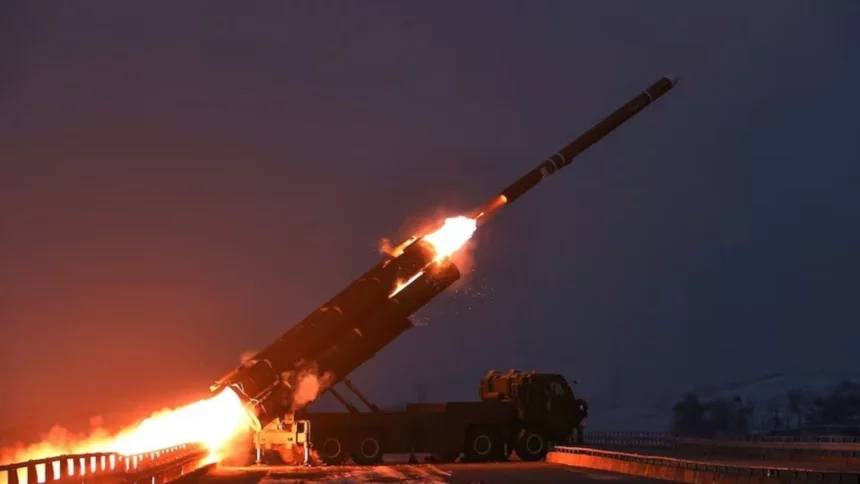
North korea’s latest missile launch intensifies regional security anxieties as east asia navigates delicate diplomatic realignments.
A sudden missile alert from japan has once again drawn global attention to the fragile security environment in east asia, after north korea allegedly launched ballistic missiles that triggered emergency instructions from the japanese prime minister’s office. The launch, reported just hours before south korean president Lee Jae Myung began a high-profile visit to china, has underscored the persistent volatility of the korean peninsula and the wider region. While the missiles reportedly landed outside japan’s exclusive economic zone, the timing, trajectory, and scale of the launch have raised serious concerns among regional governments and security analysts.
Missile launch and japan’s emergency response
The alert was first issued through the official account of Prime Minister’s Office of Japan, which posted that a ballistic missile had been launched by north korea. Within minutes, the same channel released instructions advising caution, reflecting the seriousness with which tokyo viewed the development. Such alerts have become an established part of japan’s civil defence response in recent years, yet each instance continues to unsettle the public and reinforce the perception of a persistent external threat.
According to statements attributed to japan’s defence minister Shinjiro Koizumi, at least two missiles were launched during the incident. Both are believed to have landed in the sea of japan, outside japan’s exclusive economic zone, which extends roughly 200 nautical miles from its coastline. Although no immediate damage was reported, the launches were described as a clear provocation and a violation of international norms governing missile testing.
Koizumi characterised north korea’s actions as a threat not only to japan but to regional and international peace. He pointed to the pattern of repeated missile launches, arguing that such behaviour destabilises an already tense security environment. The japanese government has lodged strong protests in similar cases in the past, and the latest incident is expected to reinforce calls for tighter coordination with allies and partners, particularly the united states and south korea.
What made this launch particularly notable was the reported flight pattern of the missiles. Officials said they followed irregular trajectories, complicating detection and interception efforts. Such manoeuvres are widely interpreted as attempts to test and potentially evade missile defence systems. The missiles are believed to have travelled approximately 950 kilometres, placing large parts of southern japan within theoretical striking distance. This range includes areas hosting key united states military installations and japanese self-defence force bases, heightening the strategic implications of the test.
The japanese authorities responded by closely monitoring the situation and sharing information with allies. While civil aviation and maritime traffic were not reported to be disrupted, the issuance of public instructions highlighted the seriousness of the perceived threat. For japan, which has invested heavily in missile defence capabilities, each such launch renews domestic debate over defence preparedness, constitutional constraints, and the scope of its security policies.
Regional implications and north korea’s strategic signalling
The missile launch occurred against a backdrop of active diplomacy in the region, adding a layer of complexity to already sensitive engagements. South korean president lee jae myung’s visit to china was widely seen as an effort to stabilise and rebalance relations amid growing regional tensions. Reports have suggested that lee and chinese leader Xi Jinping may discuss peace and stability on the korean peninsula, making the timing of the launch particularly striking.
Analysts often view north korea’s missile tests as carefully calibrated signals rather than isolated military exercises. The leadership in pyongyang has historically used such launches to assert strategic relevance, demonstrate technological progress, and influence diplomatic agendas. By conducting a missile test as regional leaders engage in high-level talks, north korea reinforces its centrality to security discussions and reminds neighbouring states that any dialogue on regional stability must account for its capabilities and intentions.
North korean leader Kim Jong Un has repeatedly emphasised the expansion of the country’s nuclear and missile programmes as core national priorities. According to reports in international media, kim has called for more than doubling the production capacity of tactical guided weapons during recent inspections of munitions factories. These visits, often highlighted by state media, serve to project an image of momentum and resolve, both domestically and internationally.
In recent weeks, kim has been seen touring weapons manufacturing facilities, inspecting missile production lines, and visiting a nuclear-powered submarine project. Such activities are widely interpreted as part of preparations ahead of the ninth party congress of the workers’ party, where major policy goals and strategic directions are expected to be outlined. Missile tests conducted in this period are often intended to showcase achievements and bolster internal legitimacy.
The irregular trajectories reported in the latest launch suggest continued experimentation with missile technology. By deviating from predictable flight paths, north korea may be seeking to demonstrate advances that complicate missile defence calculations for adversaries. This has direct implications for japan and south korea, both of which rely on layered missile defence systems developed in close cooperation with the united states.
For japan, the incident reinforces longstanding concerns about its vulnerability to missile threats. Although the missiles did not enter japanese territorial waters, their range and trajectory highlight the proximity of potential danger. This reality continues to shape japan’s defence debates, including discussions about counterstrike capabilities, increased defence spending, and closer integration with allied forces.
For south korea, the launch adds pressure to an already delicate diplomatic balancing act. As a united states ally with deep economic ties to china, seoul must navigate security threats from the north while engaging in dialogue aimed at reducing regional tensions. Lee jae myung’s visit to beijing was intended to address economic cooperation and strategic stability, but developments like the missile launch underline how quickly security concerns can overshadow diplomatic efforts.
China’s position adds another layer of complexity. Beijing has traditionally called for restraint and dialogue on the korean peninsula, opposing both north korean provocations and what it views as excessive military responses by the united states and its allies. The coincidence of the missile launch with lee’s visit places china in a sensitive position, as it seeks to maintain influence over pyongyang while managing relations with seoul, tokyo, and washington.
More broadly, the incident highlights the interconnected nature of security and diplomacy in east asia. Missile launches, diplomatic visits, alliance coordination, and domestic political considerations all intersect, creating a volatile mix in which actions by one actor reverberate across the region. Each test by north korea not only demonstrates military capability but also tests the cohesion and resolve of regional responses.
As emergency alerts fade and immediate assessments are completed, attention is likely to shift to the diplomatic fallout. Japan is expected to raise the issue in international forums and coordinate with allies on possible responses. South korea will have to incorporate the development into its discussions with china, while also reassuring domestic audiences of its security posture. For north korea, the launch achieves its familiar objectives of visibility and leverage, even as it invites renewed criticism and concern.
The episode serves as a reminder that despite ongoing diplomatic engagements, the underlying security dynamics of the korean peninsula remain unresolved. Missile tests, alerts, and emergency instructions have become recurring features of the regional landscape, shaping public perception and policy choices alike. In this environment, each launch carries significance beyond its immediate technical details, influencing the broader trajectory of east asia’s strategic future.