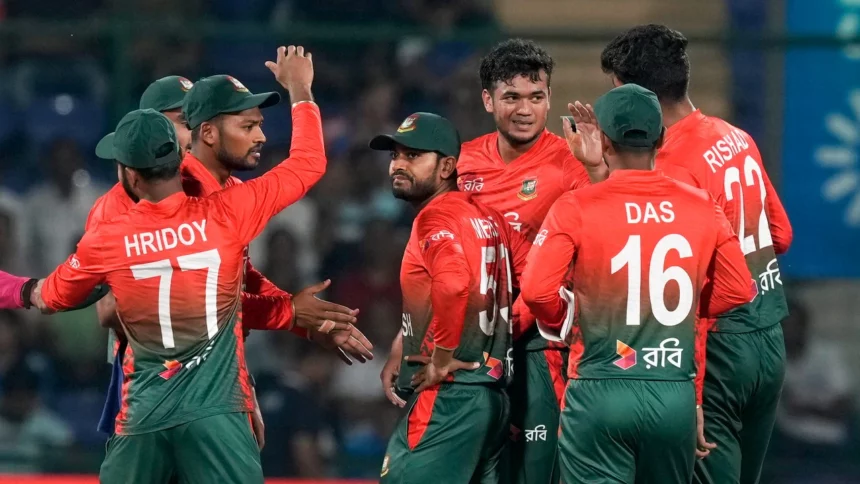
Bangladesh has escalated its standoff with the ICC, citing security concerns and fairness while refusing to play T20 World Cup matches in India.
BCB Holds Firm as Talks with ICC Continue Over T20 World Cup Relocation
The Bangladesh Cricket Board has taken a resolute stand in its ongoing disagreement with the International Cricket Council over Bangladesh’s participation in the upcoming ICC Men’s T20 World Cup, insisting that the safety of its players and supporters cannot be compromised. Senior officials of the Bangladesh Cricket Board recently held a detailed video conference with the International Cricket Council, seeking a reconsideration of the venue for Bangladesh’s scheduled matches. The meeting was attended by BCB President Aminul Islam, Vice Presidents Shakawath Hossain and Faruque Ahmed, Cricket Operations Committee Chairman Nazmul Abedeen, and Chief Executive Officer Nizam Uddin Chowdhury, reflecting the seriousness with which the board is treating the issue.
During the discussions, the BCB reiterated its decision not to travel to India for the tournament, maintaining that prevailing circumstances present security challenges that cannot be ignored. The board urged the ICC to relocate Bangladesh’s matches to a neutral venue, with Sri Lanka emerging as a preferred alternative. However, the ICC reportedly maintained that the tournament schedule and venues have already been finalised and asked Bangladesh to reconsider its position. Despite this, the BCB remained unmoved, making it clear that its primary responsibility is to safeguard its players, officials, and staff. Both sides agreed to continue discussions in the hope of finding a mutually acceptable solution, but the immediate deadlock remains.
This impasse has placed the spotlight on the broader governance of international cricket and the balance of power within global tournaments. Bangladesh’s stance is not merely about logistics but about asserting its voice within the international cricketing framework. By refusing to accept assurances at face value, the BCB has signalled that participation in global events must come with conditions that respect national concerns and sensitivities. The board has also emphasised that its engagement with the ICC remains constructive, even as it continues to press for changes it believes are necessary.
The situation is further complicated by Bangladesh’s placement in Group C of the T20 World Cup. The team is scheduled to begin its campaign on 7 February against West Indies, followed by matches against Italy, England, and Nepal, all slated to be played in Kolkata. One of the key venues for these fixtures is Eden Gardens, a historic ground but one that the BCB believes may pose heightened risks given the current political and social climate. With the tournament set to begin soon, uncertainty continues to loom over Bangladesh’s participation unless a breakthrough is achieved.
‘No One Should Have a Monopoly on Cricket,’ Says Sports Minister Amid Growing Row
Adding a strong political dimension to the dispute, Bangladesh’s Sports Minister Asif Nazrul publicly criticised the ICC, arguing that no single country or market should dominate the game of cricket. Speaking to the media at the Bangladesh Football Federation headquarters, Nazrul said the government’s security assessment had identified multiple risk factors associated with Bangladesh playing in India. He described what he termed “unrealistic expectations” placed on Bangladesh, questioning whether a nation should be asked to compromise player safety, fan expression, or even domestic political processes for the sake of participating in a cricket tournament.
According to Nazrul, one of the key concerns outlined in the security assessment relates to the potential inclusion of star fast bowler Mustafizur Rahman in the national squad. The minister suggested that Mustafizur’s presence could heighten security risks, particularly given recent controversies and protests linked to him in India. Another concern highlighted was the safety of Bangladeshi supporters wearing their national team’s jersey in public, which authorities fear could expose them to hostility. The proximity of national elections in Bangladesh was also cited as a factor that could further increase security vulnerabilities for the team abroad.
Nazrul’s remarks underscored a broader critique of how international cricket is administered. He argued that decisions about major tournaments should not be driven solely by commercial interests or market considerations. In his view, if the ICC genuinely functions as a global governing body, it must accommodate the legitimate concerns of all member nations, regardless of their market size or influence. He made it clear that Bangladesh would not accept concessions that undermine its position and reiterated the demand for matches to be moved to Sri Lanka.
The controversy has its roots in developments surrounding Mustafizur Rahman’s involvement in the Indian Premier League. In December, the Kolkata Knight Riders acquired the Bangladeshi bowler at the IPL mini-auction for a significant sum, but his signing sparked protests in parts of India following reports of communal violence in Bangladesh. Amid growing tension, the Board of Control for Cricket in India did not permit Mustafizur to participate in the IPL, and he was subsequently released by KKR in early January. This episode further strained cricketing relations between the two countries and became a catalyst for Bangladesh’s broader concerns about security and fair treatment.
In response to Mustafizur’s release and the surrounding events, Bangladesh took the unusual step of banning the broadcast of the IPL domestically. The decision signalled the depth of dissatisfaction within both the BCB and the government, and it was followed by a formal communication to the ICC requesting a change in T20 World Cup venues. While the ICC has publicly stated that it does not perceive a security threat to the Bangladeshi team in India, Bangladesh has continued to press its case, arguing that on-ground realities and public sentiment cannot be overlooked.
As discussions continue, the dispute has sparked debate across the cricketing world about equity, safety, and governance. For Bangladesh, the issue goes beyond a single tournament and touches on principles of respect and representation within international sport. For the ICC, the challenge lies in balancing established schedules and commercial commitments with the concerns of a member nation that feels its voice is being marginalised. With the T20 World Cup fast approaching, the outcome of these talks could set an important precedent for how similar disputes are handled in the future.