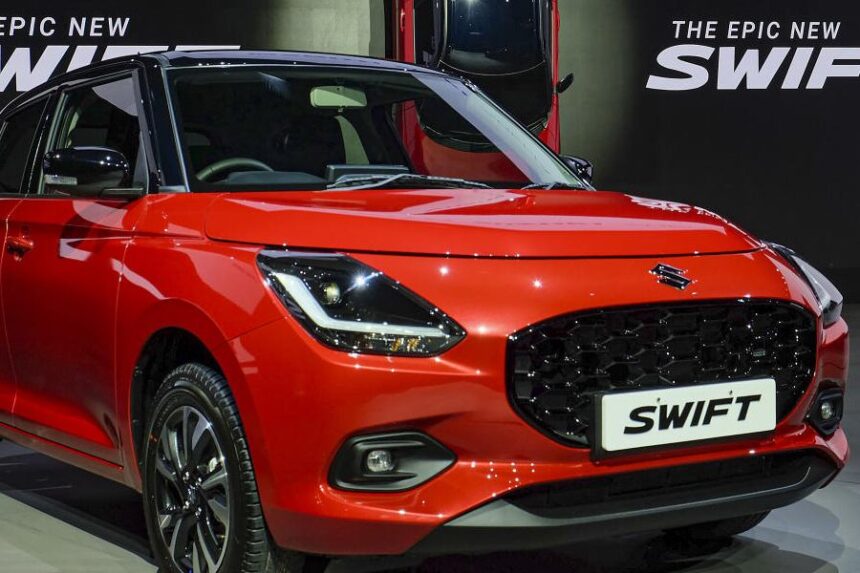
Maruti Suzuki India is weighing a possible increase in vehicle prices as rising commodity costs begin to strain margins, even as the country’s largest carmaker continues to witness strong demand momentum following recent GST reductions and sustained consumer interest in the passenger vehicle market.
The country’s market leader in passenger cars finds itself navigating a complex phase where robust bookings and record sales coexist with mounting cost pressures driven by global commodity trends and geopolitical uncertainty. Speaking at a virtual conference, Partho Banerjee, senior executive officer for marketing and sales at Maruti Suzuki India, said the company is closely monitoring input costs and market conditions before taking any final decision on revising prices. His remarks reflect the cautious approach being adopted by the automaker as it seeks to protect customers from sharp increases while acknowledging the limits of cost absorption in a volatile global environment.
Commodity pressures and pricing considerations
Commodity prices have emerged as a key concern for the automotive industry, with increases across metals and other raw materials directly impacting manufacturing costs. According to Banerjee, the rise in prices, particularly in precious metals, has been significant and is being compounded by global geopolitical developments. While Maruti Suzuki has historically focused on minimising the impact of such increases on customers, the current scale of cost escalation has prompted a reassessment.
Banerjee explained that the company’s supply chain and production teams are actively working to absorb as much of the additional cost as possible through efficiency measures and internal optimisation. As a market leader with a large base of first-time buyers, Maruti Suzuki is conscious of price sensitivity and the importance of maintaining affordability, especially in the entry-level and compact segments that form the backbone of its sales volumes.
At the same time, Banerjee made it clear that there is a practical limit to how much cost pressure the company can absorb. If commodity prices continue to rise and internal measures prove insufficient, part of the burden may have to be passed on to consumers. While no specific timeline has been indicated for a potential price hike, the company has signalled that such a move remains under consideration if the situation persists.
The discussion on pricing comes against the backdrop of significant price cuts implemented by Maruti Suzuki after the rollout of GST 2.0 in September last year. Several entry-level models saw substantial reductions, with cuts running into tens of thousands of rupees. These reductions helped stimulate demand, particularly among first-time buyers and value-conscious consumers, reinforcing Maruti Suzuki’s dominant position in the mass market.
To protect customers affected by delivery delays, the company has also introduced a price protection scheme. Under this initiative, customers who booked vehicles earlier will not be impacted by any future price increases, a move aimed at preserving trust and goodwill at a time when waiting periods remain extended due to production constraints.
Strong demand, capacity expansion and future outlook
Despite the challenges on the cost front, demand conditions remain firmly in Maruti Suzuki’s favour. The company is currently carrying a backlog of around 1.75 lakh pending orders, reflecting sustained interest across its portfolio. January proved to be a record-breaking month, with total sales reaching an all-time high of 2,36,963 units. Bookings during the month crossed 2.78 lakh units, marking a year-on-year growth of 25 percent and translating into roughly 9,000 to 10,000 bookings every day.
Exports have also shown strong momentum, with shipments touching a new monthly peak of over 51,000 units in January. Banerjee highlighted the success of the company’s newly launched SUV, which crossed the 50,000-unit sales milestone within five months of its introduction, underlining the growing importance of the utility vehicle segment in Maruti Suzuki’s overall strategy.
However, production constraints continue to pose short-term challenges. Limited capacity has contributed to longer waiting periods for several models, and Banerjee acknowledged that these constraints are likely to persist for a few more months. Relief is expected from planned capacity expansions, including the commissioning of Maruti Suzuki’s second plant at Kharkhoda in Haryana, scheduled to become operational by April 2026. This will be followed by the addition of a fourth production line at the company’s Gujarat facility, together adding an annual capacity of around five lakh units.
Looking at the broader industry, Banerjee expressed cautious optimism about the passenger vehicle segment. He said the auto industry could return to a compound annual growth rate of 6 to 7 percent, though much will depend on how global commodity prices and geopolitical conditions evolve. Policy support, he noted, is likely to play a positive role. The momentum provided by GST 2.0 and the Union Budget 2026–27’s emphasis on higher capital expenditure in infrastructure are expected to support demand and improve overall sentiment in the sector.
Maruti Suzuki is also preparing to strengthen its presence in the electric vehicle space. Banerjee confirmed that the company’s electric SUV, the e Vitara, is set to enter the domestic market this month, with dispatches already underway. The launch marks an important step in the company’s transition toward electrification, even as it continues to rely on its strong internal combustion engine portfolio to drive volumes in the near term.
As Maruti Suzuki balances strong demand with rising costs and ongoing capacity expansion, its pricing strategy will remain under close watch. The company’s next steps are likely to be shaped by how commodity markets behave in the coming months and how effectively internal efficiencies can offset external pressures, all while maintaining its long-standing focus on affordability and market leadership.