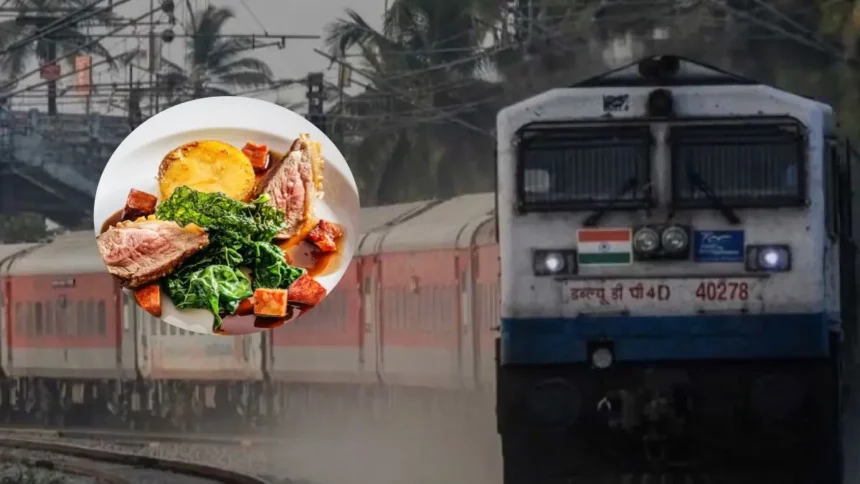
The National Human Rights Commission has stepped into a growing public debate over food transparency on Indian trains, questioning how non-vegetarian meals are sourced and labelled and whether passengers are given adequate information and choice regarding halal and jhatka meat. The issue has drawn national attention after the commission found the response of railway authorities unsatisfactory, raising broader concerns about inclusivity, informed consent, and the responsibility of public institutions to respect India’s diverse cultural and dietary practices while delivering essential services.
Passenger rights, food transparency and the role of public institutions
The intervention by the National Human Rights Commission highlights a sensitive intersection between individual choice, religious freedom, and the obligations of public service providers. Indian Railways, as one of the world’s largest transport networks, serves millions of passengers daily from varied social, cultural, and religious backgrounds. For many travellers, food consumed during long journeys is not merely a matter of taste or convenience but is closely tied to personal beliefs and ethical considerations. Against this backdrop, the question of how non-vegetarian food is prepared and presented takes on significance beyond routine catering practices.
Complaints received by the commission alleged that non-vegetarian meals served on trains are predominantly prepared using halal methods, without clear disclosure or the availability of alternatives such as jhatka meat. Petitioners argued that this lack of transparency restricts passengers’ ability to make informed choices, particularly for those whose beliefs or traditions discourage the consumption of halal meat. The NHRC noted that freedom of choice is an integral part of the right to life and personal liberty, especially when services are provided by state-run or state-regulated entities.
In response to these concerns, the commission sought an explanation from the Railway Board, which oversees policy and administrative decisions for the railways. However, the initial report submitted was found lacking in detail. According to the NHRC, the response did not clearly specify whether there is any formal or informal policy guiding the use of halal or jhatka meat, nor did it provide a comprehensive list of vendors supplying non-vegetarian food across trains, stations, and railway-linked hospitality units.
The commission emphasised that transparency is a core expectation from public institutions, particularly those catering to such a vast and diverse population. It observed that simply stating compliance with food safety standards does not address concerns related to informed choice. While food safety regulations ensure hygiene and quality, they do not substitute for clear labelling and disclosure about preparation methods that hold cultural or religious significance for many citizens.
This issue also reflects a broader societal expectation that public services should remain neutral and inclusive. In a pluralistic society, the absence of information or alternatives can be perceived as privileging one practice over others, even if unintentionally. The NHRC’s observations suggest that neutrality in public provisioning is not achieved merely by avoiding explicit mandates, but by actively ensuring that citizens are informed and, where feasible, offered choices that respect diversity.
Railways, vendors and the challenge of accountability in catering services
At the centre of the controversy is the complex structure of catering within the railways, involving multiple contractors, suppliers, and service providers. The Indian Railways does not prepare food directly in most cases; instead, catering services are managed through a network coordinated largely by the Indian Railway Catering and Tourism Corporation. This arrangement, while operationally efficient, also creates layers of responsibility that can obscure accountability.
The NHRC has pointed out that the lack of vendor-specific information in the railway response is a significant gap. Without knowing which contractors supply halal meat, jhatka meat, or both, it becomes difficult to assess whether passengers are being given meaningful choice or whether certain practices dominate by default. The commission has therefore sought a fresh and detailed action-taken report that clearly maps out catering contracts, food sourcing practices, and the availability of different preparation methods across the railway network.
Beyond trains, the issue extends to railway stations and associated hotels, many of which serve large numbers of travellers and tourists. The commission has also drawn attention to the role of the Ministry of Tourism, questioning why existing hotel classification and rating guidelines do not require disclosure of meat preparation methods. This broader inquiry suggests that the NHRC views transparency in food practices as a systemic issue, not confined to railways alone but relevant to public hospitality services more generally.
From an administrative perspective, ensuring such transparency poses challenges. Catering operations span thousands of trains and locations, and introducing detailed labelling or multiple preparation streams would require coordination, monitoring, and potential cost implications. However, supporters of the NHRC’s stance argue that logistical complexity cannot override fundamental rights. They contend that simple measures, such as clear labelling on menus or basic disclosures at the point of service, could go a long way in addressing concerns without disrupting operations.
The debate has also sparked wider public discussion about secularism and neutrality in state services. Some view the issue as an attempt to politicise food practices, while others see it as a legitimate demand for respect and choice in a diverse society. The NHRC’s approach, however, remains anchored in rights-based reasoning rather than political alignment. By framing the matter around transparency and informed consent, the commission has sought to shift the focus from ideological debate to institutional responsibility.
As the railways prepare a more detailed response, the outcome could influence how public catering services across India handle disclosure and choice in the future. A clearer framework for food transparency may set a precedent for other public institutions, reinforcing the principle that diversity must be acknowledged not only in policy statements but also in everyday service delivery. The issue, while centred on food, ultimately reflects deeper questions about how a large, multicultural democracy balances efficiency with sensitivity, and how public institutions can evolve to meet the expectations of an increasingly aware and vocal citizenry.