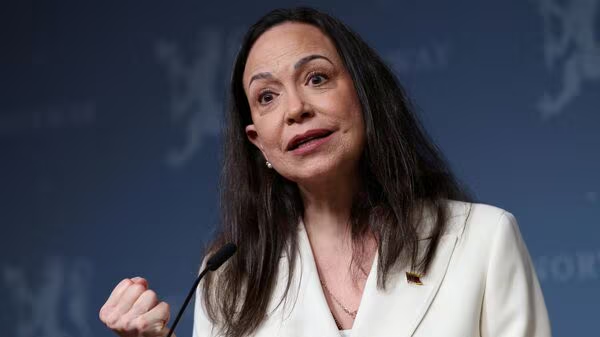
The White House is set to witness a politically significant meeting as former United States president Donald Trump hosts Venezuelan opposition leader María Corina Machado, an encounter that signals renewed international focus on Venezuela’s fragile political landscape and the evolving posture of the United States toward democratic change in Latin America. The meeting comes at a moment of deep uncertainty for Venezuela, where years of political turmoil, economic hardship, and institutional erosion have reshaped governance and intensified debates over legitimacy, leadership, and the country’s future direction.
The political symbolism of the white house meeting and venezuela’s democratic struggle
The decision to welcome María Corina Machado to the White House carries symbolic and strategic weight, reflecting the United States’ continued engagement with Venezuela’s opposition movement. Machado has emerged over the years as one of the most prominent and uncompromising voices advocating democratic reform in Venezuela. Her political journey has been defined by sustained opposition to authoritarian governance, repeated confrontations with state institutions, and persistent calls for free elections, judicial independence, and the restoration of civil liberties.
Venezuela’s political crisis did not emerge overnight. It is the result of prolonged economic mismanagement, institutional weakening, and deep political polarisation that has left millions of citizens facing hardship and uncertainty. In this environment, opposition leaders like Machado have sought to mobilise public support while also appealing to the international community for diplomatic pressure and recognition. Her presence at the White House underscores her status as a key representative of these democratic aspirations, even as internal divisions within the opposition continue to complicate the path forward.
For Washington, the meeting represents more than a diplomatic courtesy. It signals a willingness to engage directly with opposition figures at a time when Venezuela’s political order remains unsettled. The United States has long positioned itself as a supporter of democratic norms in the region, but its approach toward Venezuela has evolved, shaped by strategic interests, regional stability concerns, and changing leadership dynamics within Caracas. Hosting Machado allows U.S. policymakers to reaffirm rhetorical support for democratic principles while assessing the practical realities of Venezuela’s opposition landscape.
The symbolism of the meeting is also amplified by Machado’s international profile. Recognised globally for her advocacy, she has become a familiar figure in diplomatic and policy circles, often framing Venezuela’s crisis as not only a national tragedy but also a regional and humanitarian concern. Her engagement with Trump offers her a platform to articulate the opposition’s vision for political transition, institutional reform, and national reconciliation, even as questions remain about the mechanisms through which such a transition could realistically occur.
At the same time, the meeting highlights the complexities of opposition politics in Venezuela. While Machado commands respect and visibility, critics have questioned the cohesion and organisational strength of the broader opposition movement. Years of repression, exile, and internal disagreement have weakened collective action, making it difficult to translate international support into tangible political change on the ground. This context adds nuance to the White House engagement, positioning it as both a gesture of solidarity and a reminder of the limits of external influence.
U.s. foreign policy calculations and regional implications
From the perspective of the United States, the Trump–Machado meeting fits into a broader recalibration of policy toward Venezuela and Latin America. U.S. engagement with the region has often oscillated between ideological commitments and pragmatic considerations, particularly in countries facing political instability. Venezuela, with its vast energy resources and strategic location, has remained a focal point of these calculations, influencing how Washington balances democratic advocacy with geopolitical interests.
Trump’s approach to foreign policy has historically emphasised assertive diplomacy, public symbolism, and transactional decision-making. Hosting a high-profile opposition leader aligns with this style, offering a visible signal of engagement without immediately committing to specific policy outcomes. The meeting allows the U.S. to project influence and leadership while maintaining flexibility in its dealings with various political actors connected to Venezuela’s future.
The regional implications of the meeting extend beyond Venezuela itself. Latin American governments and political movements closely observe U.S. interactions with opposition figures, interpreting them as indicators of Washington’s broader priorities. Engagement with Machado may be read as a reaffirmation of democratic advocacy, but it may also raise concerns among neighbouring states wary of external intervention or heightened political pressure. These dynamics underscore the delicate balance the U.S. must maintain in a region marked by diverse political systems and sensitivities around sovereignty.
For Venezuela’s population, the meeting carries emotional and symbolic resonance. Years of economic decline, migration, and social disruption have left many citizens searching for signs of international attention and support. Machado’s appearance at the White House may be perceived by supporters as validation of their struggle and a reminder that Venezuela’s crisis has not faded from global consciousness. At the same time, skepticism remains among those who have seen previous diplomatic gestures fail to translate into meaningful improvements in daily life.
The encounter also invites reflection on the broader challenges of promoting democratic change through external engagement. While international recognition can bolster opposition leaders and apply pressure on entrenched power structures, sustainable transformation ultimately depends on internal political processes, institutional reform, and social consensus. The Trump–Machado meeting, therefore, sits at the intersection of hope and realism, highlighting both the possibilities and limitations of diplomacy in deeply polarised political environments.
As discussions unfold behind closed doors, expectations remain measured. Observers anticipate conversations around democratic transition, humanitarian concerns, sanctions policy, and the role of international actors in supporting peaceful change. Whether the meeting leads to concrete policy shifts or remains largely symbolic, it reinforces the enduring relevance of Venezuela’s political crisis in global affairs and the continued search for pathways toward stability, democracy, and national recovery.