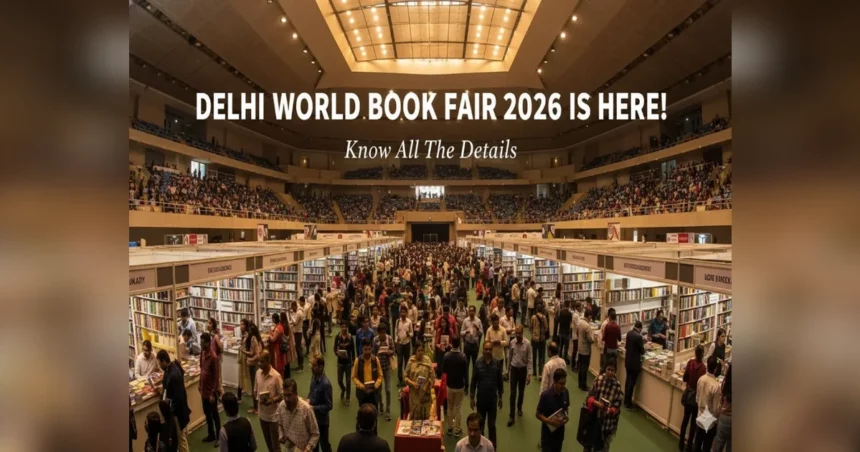
The 53rd edition of the New Delhi World Book Fair opened today at Bharat Mandapam, marking a significant milestone in India’s literary calendar by offering free entry to all visitors for the first time. Organised by the National Book Trust under the Ministry of Education, with the India Trade Promotion Organisation as co-organiser, the fair will run from January 10 to January 18. Billed as the world’s largest business-to-consumer book fair, the event is expected to attract more than two million visitors over nine days, reflecting the enduring public appetite for books, ideas, and cultural exchange.
This year’s edition stands out not only for its scale but also for its inclusivity. By removing entry fees, the organisers aim to make the fair accessible to a wider audience, including students, young readers, educators, and families. With participation from over 1,000 publishers representing more than 35 countries, the fair positions itself as a global platform for literature, publishing, and dialogue, while reaffirming Delhi’s role as a major hub in the international literary ecosystem.
A global literary marketplace showcasing publishers, authors, and cultural dialogue
The New Delhi World Book Fair has long been regarded as a cornerstone event for the publishing industry, and the 2026 edition reinforces this reputation with its expansive international presence. Publishers from across Asia, Europe, the Americas, and the Middle East have converged at Bharat Mandapam, bringing with them a diverse range of books spanning fiction, non-fiction, academic works, children’s literature, and regional languages. This breadth reflects the fair’s dual identity as both a commercial marketplace and a cultural festival.
With more than 1,000 publishers participating, the fair offers readers a rare opportunity to explore books from across linguistic and cultural traditions in one space. International pavilions highlight global publishing trends, translations, and cross-cultural collaborations, while Indian publishers showcase the depth and diversity of the country’s literary output. For emerging writers and smaller publishing houses, the fair provides visibility alongside established names, fostering a more inclusive publishing environment.
Beyond book stalls, the fair’s programming plays a central role in shaping its character. More than 600 events are scheduled over the nine days, featuring panel discussions, book launches, readings, workshops, and interactive sessions. Over 1,000 speakers, including authors, scholars, translators, educators, and industry professionals, are expected to participate. These sessions are designed to engage readers not just as consumers of books but as active participants in conversations around literature, education, society, and culture.
The inauguration of the fair by Union Education Minister Dharmendra Pradhan, along with dignitaries from Qatar and Spain, underscores its international stature. The presence of foreign representatives highlights the fair’s role in cultural diplomacy, using books and ideas as bridges between nations. Such engagement reflects the growing recognition of literature as a soft-power tool and a medium for mutual understanding in an interconnected world.
Free entry, mass participation, and the evolving role of the book fair
One of the most significant changes in the 2026 edition is the introduction of free entry for all visitors. Organisers have described this decision as a step toward democratising access to knowledge and culture. By removing financial barriers, the fair aims to encourage greater participation from students, first-time visitors, and readers from diverse socio-economic backgrounds. This move is expected to contribute to the projected footfall of over two million visitors, making the event one of the most widely attended cultural gatherings in the country.
The venue, Bharat Mandapam, offers modern infrastructure capable of accommodating large crowds while hosting multiple events simultaneously. Its central location and scale make it well suited to an event of this magnitude, allowing publishers, visitors, and speakers to interact in a structured yet vibrant environment. Organisers have emphasised crowd management, accessibility, and visitor experience, recognising that the success of a fair of this size depends as much on logistics as on content.
The New Delhi World Book Fair’s positioning as the world’s largest B2C book fair highlights its focus on direct engagement between publishers and readers. Unlike trade-only fairs, this format allows readers to interact with publishers, discover new titles, and participate in discussions, creating a dynamic ecosystem where ideas circulate freely. For publishers, it offers immediate feedback from readers and an opportunity to test new markets and genres.
The fair also reflects broader shifts in reading culture and the publishing industry. While digital platforms and e-books have transformed how people access content, the sustained popularity of the book fair suggests that physical books and in-person literary events retain strong appeal. The fair’s emphasis on events, discussions, and community interaction points to an understanding that readers increasingly value experiences alongside products.
As the fair continues until January 18, it is expected to serve multiple purposes simultaneously: a marketplace for books, a forum for intellectual exchange, and a public celebration of reading. By combining global participation, extensive programming, and free access, the 53rd New Delhi World Book Fair positions itself as both a reflection of India’s literary diversity and a statement about the importance of inclusive cultural spaces in the contemporary world.