Nepal is witnessing an escalating period of political, social, and security instability marked by rising street violence, intensifying clashes between youth groups and party workers, and a governance structure struggling to maintain order. The atmosphere has further charged after former Prime Minister KP Sharma Oli announced the creation of a dedicated party-based security unit, while the interim government simultaneously moves toward deploying the national army for the upcoming parliamentary elections. These developments reflect a country grappling with volatile tensions, weakening state authority, and growing apprehensions about the path ahead.
Oli’s Allegations of Failing Security and the Formation of the National Volunteer Service
Nepal’s political climate has entered a new phase of confrontation following the strong accusations made by KP Sharma Oli, chairman of the CPN-UML and one of the country’s most influential leaders. Oli argues that the nation’s security environment has deteriorated at an alarming speed, leaving citizens, journalists, students, and political workers increasingly vulnerable to targeted attacks. According to him, the government has failed to preserve law and order, and the existing security institutions are struggling to maintain public safety.
Oli has insisted that violent attacks on UML members have increased in number and intensity over the past few months. He has highlighted cases in which party workers were allegedly assaulted during political rallies, public gatherings, and even routine organizational activities. His remarks have come at a time when Nepal has witnessed several clashes between youth groups and UML supporters, adding to fears of rising political polarization.
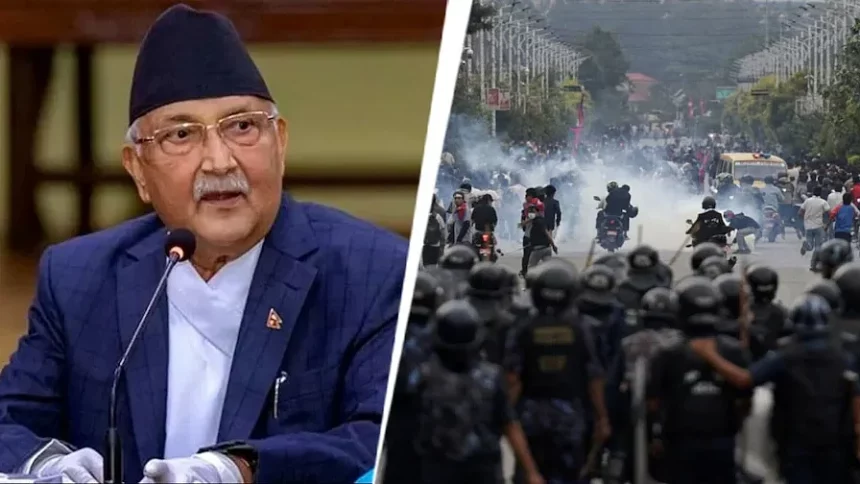
Since stepping down in September amid widespread protests, Oli has remained a central figure in Nepal’s political discourse. His resignation was followed almost immediately by demonstrations across several regions, and confrontations between UML supporters and youth collectives became increasingly common. In southern Nepal, a recent violent confrontation between Gen-Z youth groups and UML workers underscored how quickly political disputes can escalate into physical clashes. Vehicles were damaged, several individuals were injured, and the unrest continued for nearly two days.
Oli maintains that such incidents demonstrate the government’s inability or unwillingness to safeguard citizens. His argument is that the state, instead of curbing violent actors, has been selectively lenient toward groups that target political opponents. According to him, this selective inaction has created a climate in which political violence can flourish. As a result, he says that the responsibility for safety has now shifted back to the political community itself.
It is against this backdrop that Oli announced the formation of a new party-based security organization known as the National Volunteer Service. The unit, as described by Oli, will consist of trained party members who can offer security assistance during UML programs, leader visits, and moments of political unrest. He clarified that the group will be nonviolent by design, focusing on peaceful resistance and coordination rather than force.
The establishment of such a unit marks a historic shift in Nepal’s political culture. Never before has a major national party formed its own structured security wing parallel to the state’s system. While Oli argues that the measure is necessary for protection and stability, critics have expressed concerns that it may trigger the emergence of rival security formations by other parties, potentially heightening political tensions and risking further polarization.
Oli has framed his decision as a response to government negligence, insisting that the security of political figures and ordinary citizens cannot depend on state institutions alone. He says that attacks on UML members are rising without any meaningful investigations or arrests, reinforcing the perception that law enforcement agencies are either overwhelmed or politically influenced. He also accuses the interim government of fostering an environment where opposition actors are intimidated through indirect means, including disruption of party meetings, harassment of workers, and tolerance of vandalism.
Opposition parties and civil society observers have warned that such developments may set dangerous precedents. The creation of parallel security structures, they argue, can weaken the state’s authority, complicate law enforcement’s autonomy, and make political confrontation more unpredictable. Yet Oli continues to defend his decision as a necessary safeguard in extraordinary circumstances. His stance has intensified the national political debate, drawing both criticism and support from different segments of society.
Growing Violence Ahead of Elections and Government Readiness to Deploy the Army
As Nepal edges closer to the parliamentary elections scheduled for March 2026, the atmosphere has become increasingly volatile. Violent confrontations between political groups have risen sharply, leading the interim government to consider deploying the national army to ensure peaceful voting. The move comes after the National Security Council (NSC) assessed the security situation and recommended the involvement of the army to prevent disruptions, protect polling stations, and maintain order in tense regions.
Senior officials within the NSC, including member secretary and defense secretary Suman Raj Aryal, have emphasized that the primary objective is to conduct elections in an environment free of fear, coercion, and violence. The decision to explore military deployment reflects rising concerns that traditional security forces—local police and armed police units—may be insufficient to manage widespread unrest and political clashes.
The Ministry of Home Affairs has already approved a joint security strategy for all 77 districts of Nepal. This plan incorporates close coordination among local law enforcement, armed police forces, and army personnel during the electoral period. The framework is designed to respond quickly to emerging threats, maintain order in sensitive constituencies, and deter attempts to influence voters through intimidation or violence.
Tensions escalated further after a violent confrontation on 19 November in Bara district of Madhesh Province. The incident involved a large group of Gen-Z youth activists and UML workers, who clashed shortly before UML leaders Shankar Pokharel and Mahesh Basnet were scheduled to arrive for a youth-oriented campaign event. Social media posts calling for protests had already mobilized many young people, and by mid-morning, 100 to 150 individuals had gathered at Simra Chowk.
What began as a verbal argument quickly descended into physical confrontation. Stones were thrown, injuries were reported, and vehicles belonging to UML supporters were damaged. The tension grew to such an extent that local authorities imposed a curfew to restore order. Yet even under curfew, groups of youths remained on the streets, burning tires and accusing the police of siding with UML. Multiple complaints were filed at local police stations, though no significant arrests were made.
Incidents like this have raised alarms about whether Nepal’s current security framework is capable of ensuring safe elections. The rise of Gen-Z political activism—characterized by decentralized mobilization and strong online coordination—has introduced a new challenge for state security agencies, as protests can form rapidly and disperse unpredictably. Meanwhile, UML leaders argue that their workers are being unfairly targeted and that the government has failed to neutralize violent elements.
The interim government believes that military deployment may be the only reliable option to avoid election-day unrest. Officials argue that the presence of the army has historically helped stabilize situations during national emergencies, and similar measures were taken during earlier periods of conflict. While the decision has not yet been finalized, preparations and internal discussions indicate that the government views this step as increasingly necessary.
Yet there is concern among political analysts that deploying the army during elections may contribute to perceptions of democratic backsliding. They warn that significant military involvement in civil processes could set a dangerous precedent and heighten the perception that Nepal’s democracy is entering a period of fragility. Others argue that the exceptional degree of violence and political hostility leaves the government with limited alternatives.
Within all this, Nepal’s political environment continues to fracture along generational, ideological, and party-based lines. Rising youth activism, declining public trust in state institutions, internal divisions within major parties, and economic pressures have collectively contributed to a volatile national mood. The rapid escalation of confrontations—even over relatively small triggers—shows how sensitive the current moment has become.
As both Oli’s party and the government prepare for the months ahead, Nepal faces a challenging and uncertain landscape. The creation of party-led security wings, the possibility of army deployment for elections, and the intensifying clashes across provinces all underscore the deep instability shaping the country’s present political chapter.