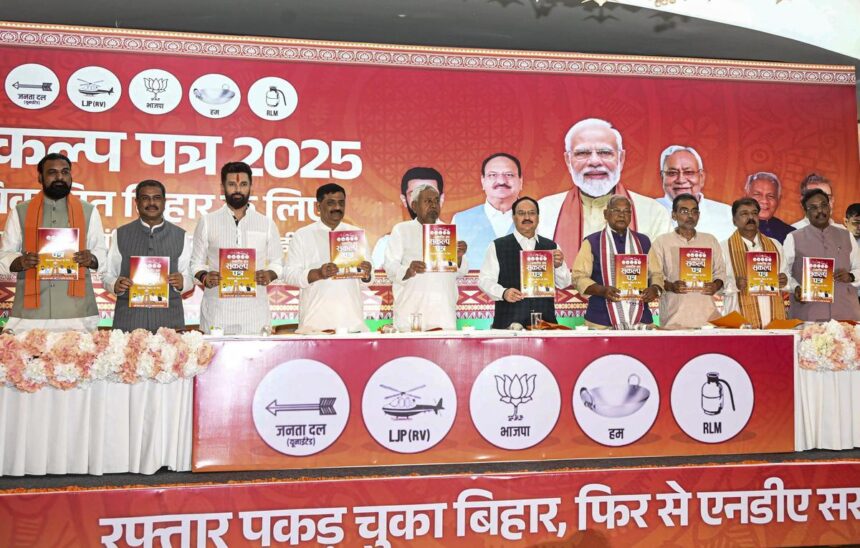
The Bihar Assembly Election 2025 entered a decisive phase on Friday morning as vote counting began amid intense political anticipation, with the National Democratic Alliance (NDA) taking an early statewide lead. The close contest between the Bharatiya Janata Party (BJP) and the Janata Dal (United) for the position of the single largest party added a dramatic layer to the unfolding results. As election officials opened postal ballots and prepared to count Electronic Voting Machine (EVM) votes, Bihar found itself at the center of national political attention, waiting to see whether the ruling coalition would retain its hold on the state or whether the Opposition-led Mahagathbandhan could mount a comeback.
The early trends indicated a significant tilt toward the NDA, driven by the political momentum generated by Prime Minister Narendra Modi’s campaign rallies and Chief Minister Nitish Kumar’s consistent pitch for development and stability. Both leaders had invested heavily in the campaign narrative, focusing on governance, infrastructure, welfare policies, and regional aspirations. Their combined influence—often seen as the BJP’s national appeal paired with the JD(U)’s strong grassroots network—appeared to resonate with voters across Bihar’s diverse constituencies. At the same time, the Mahagathbandhan, led by the Rashtriya Janata Dal (RJD), remained confident that the mandates from crucial rural segments and urban pockets might turn in their favor once subsequent rounds of counting unfolded.
By 11:15 a.m., the Election Commission of India’s update showed that the BJP had taken a slight numerical advantage with leads in 83 constituencies, while the JD(U) was ahead in 79. Together, these figures placed the NDA comfortably ahead in 188 seats, whereas the Mahagathbandhan lagged behind with 44. Although the numbers were still provisional at that stage, they painted a clear picture of the election’s direction. The NDA’s early sweep across multiple regions suggested strong voter endorsement of its governance model and campaign promises.
At the ground level, the counting process began under stringent security arrangements designed to ensure a transparent and disturbance-free environment. Counting for all 243 constituencies commenced at 8 a.m. under the supervision of 243 Returning Officers and an equal number of Counting Observers appointed by the Election Commission. Security layers included the Central Armed Police Forces securing the inner cordons while the state police maintained vigilance around the perimeters. Only personnel with valid authorization were allowed entry into counting centers, and mobile phones were strictly prohibited inside the halls. More than 18,000 counting agents representing various political candidates and parties attended the sessions to oversee the unfolding process.
The atmosphere across party headquarters in Patna was charged with competing emotions—confidence, anxiety, and anticipation. Leaders from the NDA publicly attributed their encouraging numbers to the electorate’s support for what they termed “Prime Minister Narendra Modi’s guarantees” and Nitish Kumar’s emphasis on governance continuity. In contrast, Mahagathbandhan leaders claimed that deeper counting rounds would reveal a different picture that aligned more closely with the public’s demand for political change. They reiterated their belief that the people of Bihar had voted with the expectation of new leadership and that Tejashwi Yadav could still emerge as a frontrunner based on late-counting segments.
The political dynamics surrounding this election have been shaped significantly by the rivalry between the BJP and JD(U), despite their partnership under the NDA umbrella. This internal competition for greater legislative strength has quietly influenced campaign rhetoric, candidate selection, and public messaging. While both parties aim to consolidate the NDA’s rule, each also seeks to emerge as the leading force within the alliance, thereby gaining greater influence in shaping government formation and policymaking. The nearly neck-and-neck early leads for both parties captured this underlying tension and integrated it into the broader electoral narrative.
The Mahagathbandhan, seeking to revive its political fortunes, had centered its campaign on issues such as unemployment, inflation, and the need for structural reforms. Tejashwi Yadav projected himself as the face of a youthful, energetic leadership alternative. His campaign rallies drew significant crowds, particularly among young voters and economically marginalized groups. The RJD, Congress, and Left parties positioned their alliance as a counterweight to what they described as the NDA’s “fatigue factor” after years in power. However, as early trends favored the NDA, questions began to emerge about whether this narrative had resonated widely enough to shift electoral outcomes.
The scale of voter participation also played a critical role in shaping expectations. More than 7 crore voters exercised their democratic rights in the two-phase election held on November 6 and 11, reflecting a robust engagement across caste, class, gender, and regional lines. Booth turnout patterns suggested significant enthusiasm in both rural and urban constituencies, though analysts observed that the NDA’s organizational strength may have translated more efficiently into mobilized voting. In contrast, some segments of Mahagathbandhan support may have been more dispersed, complicating their ability to convert sentiment into votes.
Media networks, political observers, and the general public tracked every update with intensity. Bihar’s political history—marked by shifting alliances, personality-driven leadership battles, and evolving social coalitions—ensured that even small swings in constituency trends could carry enormous implications. The BJP and JD(U) rivalry added a new dimension to the story: a coalition whose internal arithmetic could influence the eventual power distribution even if the alliance attained a majority. The prospect of either party emerging as the larger partner set the stage for potential negotiations within the NDA bloc that could shape the appointment of key ministers, policy direction, and long-term political strategies.
Nitish Kumar’s role in particular remained a focal point. Having led multiple coalition governments and switched alliances across different electoral cycles, his political maneuvering has historically influenced Bihar’s power equilibrium. A stronger JD(U) showing could reinforce his leadership position within the ruling coalition, while a dominant BJP performance might shift decision-making balance toward the national leadership. As the counting progressed, certain constituencies where JD(U) traditionally held ground showed mixed trends, indicating a possible recalibration of voter loyalty.
Meanwhile, the BJP’s campaign strategy heavily emphasized Prime Minister Modi’s national leadership and welfare schemes. The promise of development, infrastructure projects, enhanced law-and-order mechanisms, and welfare assurances had a strong presence in BJP campaign speeches. The party presented itself as a stable and transformative force capable of accelerating Bihar’s aspirations. The early lead gained by the BJP suggested that its messaging may have resonated with significant sections of the electorate, particularly those eager for large-scale economic and structural progress.
Mahagathbandhan leaders, while maintaining optimism, faced the challenge of countering this narrative as the numbers unfolded. They argued that deeper concerns relating to unemployment and rural distress would ultimately surface in later counting phases. They also raised questions about whether early leads reflected urban voting patterns more than rural ones. Nonetheless, their optimism was increasingly overshadowed by the steady upward trajectory of NDA’s numbers, which crossed multiple safe margins as the morning progressed.
Election officers at the counting centers continued to monitor each round meticulously. The multi-layer security system functioned without major incidents, ensuring a peaceful and transparent counting environment. Every EVM was verified, sealed, and opened under strict procedures, with representatives from political parties closely observing the process. Election Commission observers ensured adherence to protocol, and periodic updates from the Commission helped maintain clarity in public communication.
For Bihar’s citizens, the evolving trends evoked a mixture of anticipation and reflection. While some viewed the early results as a validation of the ruling alliance’s governance, others awaited the later phases of counting that might realign the numbers. Markets, business communities, and rural groups all watched keenly, aware that the outcome of this election would influence policy priorities for years to come. From welfare provisions and agricultural reforms to infrastructure expansion and employment schemes, the new government’s direction would directly impact daily life across the state.
As the hours progressed, the political narrative deepened. Party cadres intensified celebrations or maintained cautious optimism depending on the shifting leads. Newsrooms analyzed constituency-level patterns, comparing historical data, demographic factors, and booth-level responses. Political analysts debated possible outcomes, including the degree of majority the NDA might secure, the Mahagathbandhan’s chances of narrowing the gap, and the internal dynamics that could shape Bihar’s next government.
In many ways, the 2025 Bihar Assembly Election symbolized the evolving structure of Indian state politics—a combination of national influence, regional leadership, alliance politics, and grassroots mobilization. Whether the NDA’s early lead would solidify into a decisive mandate or whether late-counting constituencies would offer a twist remained to be seen, but the magnitude of voter participation and the intensity of political engagement underscored the central role Bihar continues to play in shaping India’s democratic landscape