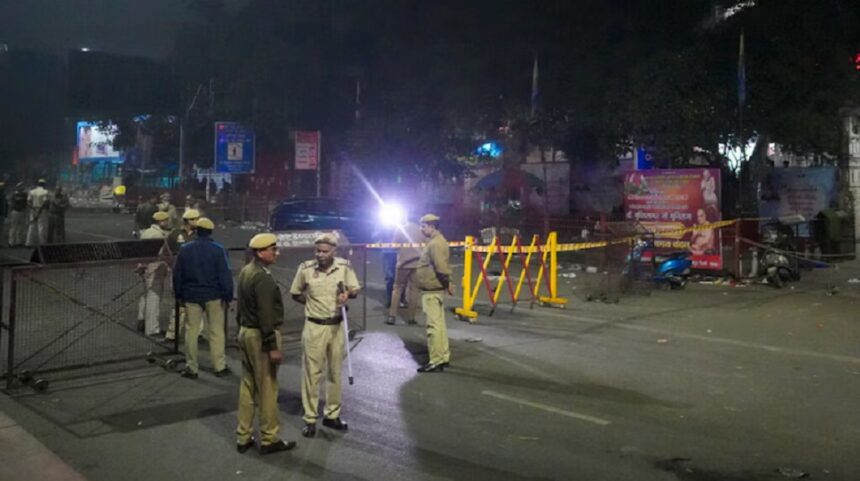
A day after a devastating explosion near Delhi’s Red Fort left the nation in shock, the government has issued a high alert across 11 major states, including Delhi-NCR, Uttar Pradesh, Haryana, Punjab, Maharashtra, Madhya Pradesh, Rajasthan, Bihar, Gujarat, Uttarakhand, and Chhattisgarh. Security has been intensified at sensitive locations such as Ayodhya, Kashi, and Mathura, while police presence has been increased at airports, metro stations, temples, and crowded marketplaces. The unprecedented nationwide alert follows fears of a coordinated conspiracy, as authorities continue to investigate the Red Fort blast that claimed 13 lives and injured more than 25 people.
The Ministry of Home Affairs has directed all states to remain on maximum alert, deploy bomb disposal units, and enhance surveillance in public places. Central forces, including the CISF, have been instructed to increase security at key transport hubs like the Indira Gandhi International Airport and metro stations. Across India, state police units are on standby, monitoring every possible threat in real time to prevent any further incident.
Heightened Security Measures Across States Following Red Fort Blast
In the aftermath of the Red Fort explosion, police forces across the country have been mobilized at an unprecedented level. In the national capital and adjoining NCR regions, the CISF has intensified checks at metro stations, airports, and government buildings. In Maharashtra, heightened security was reported across major cities, including Mumbai and Nagpur, where the RSS headquarters has come under strict protection. Police patrols and checkpoints have been established at key entry and exit routes, while surveillance cameras are being actively monitored.
In Uttar Pradesh, Chief Minister Yogi Adityanath ordered a state-wide high alert, particularly in sensitive cities like Ayodhya, Kashi (Varanasi), and Mathura. These locations, being of religious and cultural significance, are receiving special attention. Police units have been deployed outside temples, railway stations, and marketplaces, with the Anti-Terrorist Squad (ATS) and Quick Response Teams (QRT) placed on standby. Tragically, one victim of the Delhi blast, identified as Ashok Singh from Amroha, lost his life, while three others from Agra, Ghaziabad, and Deoria were injured.
In Haryana, all police leaves have been canceled. Security checks have intensified in Gurugram and along the Delhi-Haryana border, where vehicles are being screened before entry. Public transport hubs, including metro stations, hotels, and parking lots, are being inspected regularly. Police presence has been doubled in areas such as Sonipat and Jhajjar, with senior officers supervising round-the-clock operations.
In Uttarakhand, the government has directed all 13 districts to remain on high alert. Special focus is being given to cities like Dehradun, Haridwar, Rudrapur, and Udham Singh Nagar. Security forces have enhanced patrolling around temples, markets, and railway stations. Bomb detection squads and sniffer dogs are working in coordination with local units, while mobile patrols and “Cheetah” units are maintaining a visible presence. Reports confirm that a youth from Udham Singh Nagar, Harshul Sethi, was among those injured in the Delhi blast.
Punjab Police have also launched night-long search operations across major districts. Commissioners and SSPs have been instructed to stay vigilant, especially in crowded areas. In Chandigarh and Himachal Pradesh, which share close proximity with Punjab, additional measures have been enforced to prevent infiltration or movement of suspicious elements. Authorities have urged citizens to immediately report any suspicious activity to the police to maintain public safety.
Chhattisgarh has ramped up its own security network, focusing on crowd-heavy areas such as Raipur, Bilaspur, and Durg. Police officers are conducting continuous foot patrols at railway stations, bus terminals, malls, and markets. Security personnel have been stationed near sensitive installations like the High Court and government offices, while online monitoring of social media channels has been initiated to detect misinformation or signs of unrest.
In Madhya Pradesh, the government has increased vigilance across major cities including Bhopal, Indore, Gwalior, and Ujjain. State police chief Kailash Makwana held a high-level video conference with senior officers, instructing them to conduct comprehensive checks at public places. Ujjain’s iconic Mahakal Temple is now under enhanced protection, with bomb detection and dog squads carrying out detailed searches around nearby hotels and lodges. Security in pilgrimage sites and tourist zones remains at its highest level.
Rajasthan too has declared a state-wide alert. All police personnel have been called back from leave, and officers have been directed to maintain maximum vigilance. Jaipur, Ajmer, and Udaipur are under close watch, with the Khwaja Moinuddin Chishti Dargah in Ajmer receiving additional RAC deployment. Major transit points such as railway stations, airports, and malls are under intensified security checks, and special teams are monitoring CCTV footage across city centers to detect anomalies.
In Bihar, which shares an open border with Nepal, security has been tightened at seven key border points. The state is simultaneously preparing for its second phase of assembly elections, prompting authorities to double security across all districts. Checkpoints have been established at Patna, Muzaffarpur, Gaya, and Samastipur, where police are inspecting buses and incoming vehicles from neighboring states. The Anti-Terrorism Squad (ATS) has also joined the operation, particularly focusing on Patna Junction and inter-state bus terminals.
Gujarat, meanwhile, has placed all major cities—Ahmedabad, Vadodara, Surat, and Rajkot—under strict surveillance. Search operations are underway in crowded zones such as railway stations, shopping areas, and industrial hubs. The state’s Home Department has directed the police to maintain constant coordination with central intelligence agencies and report any suspicious movement immediately.
Central Agencies Intensify Investigation and National Coordination
As the investigation into the Red Fort explosion continues, coordination between state and central security agencies has reached a critical phase. The Ministry of Home Affairs, led by Union Home Minister Amit Shah, is overseeing the operations in close collaboration with the National Investigation Agency (NIA), the Intelligence Bureau (IB), and the Delhi Police’s Special Cell. Each agency has been assigned specific responsibilities, including forensic analysis, data tracking, and field intelligence gathering.
The blast, which occurred near Gate No. 1 of the Lal Qila Metro Station around 6:50 p.m. on November 10, involved a white Hyundai i20 that exploded suddenly while halting at a traffic light. The intensity of the blast left the vehicle completely charred, killing all three occupants instantly and causing significant damage to nearby vehicles. Early reports suggested that the car had been parked for nearly two hours at the Sunehri Masjid parking lot before moving toward the Red Fort area. Forensic teams are analyzing fragments recovered from the site to determine whether the explosion was caused by explosives or a mechanical trigger.
The blast’s impact was so severe that debris was found scattered several meters away, with shop windows shattered and vehicles damaged in the vicinity. Witnesses described scenes of panic as bystanders rushed to help victims amid smoke and chaos. Emergency services, including fire units and ambulances, responded within minutes, while police cordoned off the area to prevent civilian access.
Officials have confirmed that the car carried a Haryana registration number and had changed hands several times, making ownership verification complex. The registered owner has been detained, but investigators believe the vehicle may have been resold multiple times informally, possibly to conceal its current user’s identity.
The NIA has taken over key aspects of the probe, with inputs from IB and Delhi Police suggesting that the explosion might have been premeditated. However, no organization has yet claimed responsibility. Teams are also scanning CCTV footage from across Delhi to trace the car’s movements before the blast, including potential refueling stops or interactions with other vehicles.
Amid the ongoing investigation, national security agencies have been ordered to coordinate seamlessly to prevent any follow-up attacks or diversionary incidents. Intelligence-sharing protocols between states have been activated, and surveillance at airports, ports, and highways has been heightened to prevent escape routes for suspects.
The aftermath of the Red Fort blast has once again underscored India’s vulnerability to urban security challenges. With the festive and election seasons overlapping in several states, authorities are balancing public access with maximum security readiness. The alert in 11 states, combined with heightened coordination between central and state agencies, reflects a nationwide determination to ensure that no similar tragedy occurs again.
As the investigation deepens and security measures intensify, India stands united in resilience, reaffirming its commitment to protect its citizens and uphold national security in the wake of one of the most shocking incidents in recent memory.