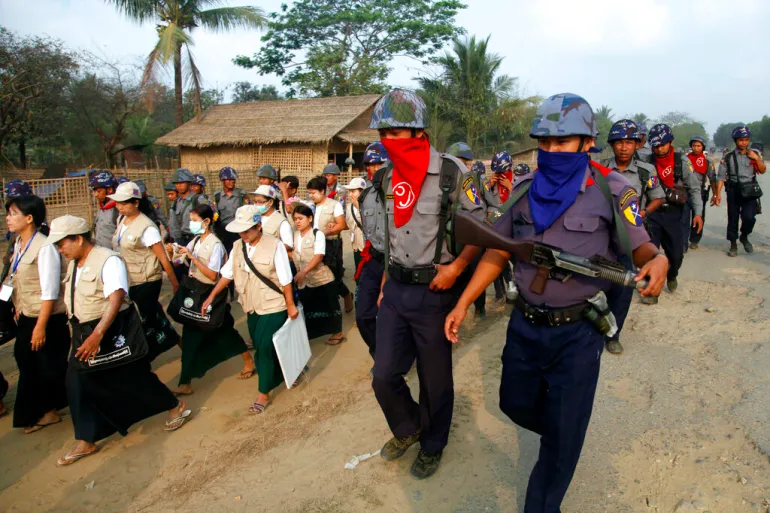
Myanmar’s military regime is facing mounting pressure to conduct national elections, four years after overthrowing the democratically elected government. The upcoming elections, which opposition forces have vowed to disrupt, come in the wake of a failed and violent attempt at conducting a national census between October and December 2023. Opposition groups repeatedly attacked census enumerators and their heavily armed security escorts, making it one of the deadliest censuses in the country’s history.
Incidents of violence were widespread, with seven soldiers killed in Mandalay Region and three more in Kayin State when resistance forces targeted their vehicles. Despite these attacks, the military declared the census a success, despite only managing to count the population in 145 out of 330 townships, indicating that it controls less than half the country. Critics, including human rights activist Khin Ohmar, argue that the census was conducted under coercion, with many civilians forced to participate at gunpoint. The National Unity Government (NUG), a government-in-exile formed by ousted lawmakers, dismissed the military’s efforts as an attempt to legitimize its rule through sham elections.
Myanmar has been in turmoil since February 1, 2021, when the military, led by Senior General Min Aung Hlaing, staged a coup against the National League for Democracy (NLD) government after it won a landslide victory in the 2020 elections. Alleging voter fraud without evidence, the military annulled the results, detained Aung San Suu Kyi, and imposed a state of emergency, which has since been extended multiple times, most recently until July 31, 2024. Since the coup, armed resistance has intensified, with both pro-democracy groups and ethnic armed organizations waging an increasingly coordinated fight against the military.
The military has suffered its worst territorial and personnel losses in decades. In October 2023, the Three Brotherhood Alliance, a coalition of ethnic armed groups, launched a major offensive in Shan State, seizing significant military-controlled territory. By early 2024, 91 towns and 167 military battalions had fallen to resistance forces, marking a crisis of an unprecedented scale. The United States Institute of Peace has noted that the military is weaker than ever, with resistance groups believing its collapse is imminent.
Despite these setbacks, the military regime insists on holding elections, though its Election Commission has acknowledged that polls may only be conducted in less than half of Myanmar’s townships. Opposition groups have vowed to disrupt the process, warning of severe consequences for those who willingly collaborate. Resistance forces, including the People’s Defense Force (PDF), have stated that while some civilians may be coerced into participating, those who actively support the election process will be treated as collaborators and could face prosecution under counterterrorism laws.
As Myanmar inches toward its first elections since the coup, the country remains deeply divided, with the military desperate to maintain control and opposition forces determined to see its downfall. The NUG remains firm in its stance that military rule must be eradicated completely, rejecting any possibility of returning to the pre-coup status quo. The situation continues to escalate, with experts warning that the elections will likely trigger more instability and violence rather than restore order. Whether the military can sustain its grip on power or succumbs to growing resistance remains an open question, but opposition forces are confident that its downfall is inevitable.