In the quiet village of Marottichal, nestled at the foot of the Western Ghats in Kerala’s Thrissur district, a transformation took place that turned a community gripped by alcoholism and gambling into India’s celebrated “Chess Village.” Today, chess is not just a game here—it is a way of life, a tool of redemption, and a source of inspiration.
At the heart of this transformation is 67-year-old Charaliyil Unnikrishnan, a former Maoist rebel who returned to his village in the late 1980s, disturbed by the rampant alcohol addiction destroying families. The problem had escalated to the point where Marottichal had become a regional hub for illicit liquor production, leaving farming families in poverty, with neglected children and declining agricultural activity. Determined to put an end to the crisis, Unnikrishnan formed a network of like-minded villagers, collaborating with women whose families were suffering due to alcoholism. Together, they raided illegal liquor dens, destroyed brewing equipment, and successfully forced the trade to collapse.
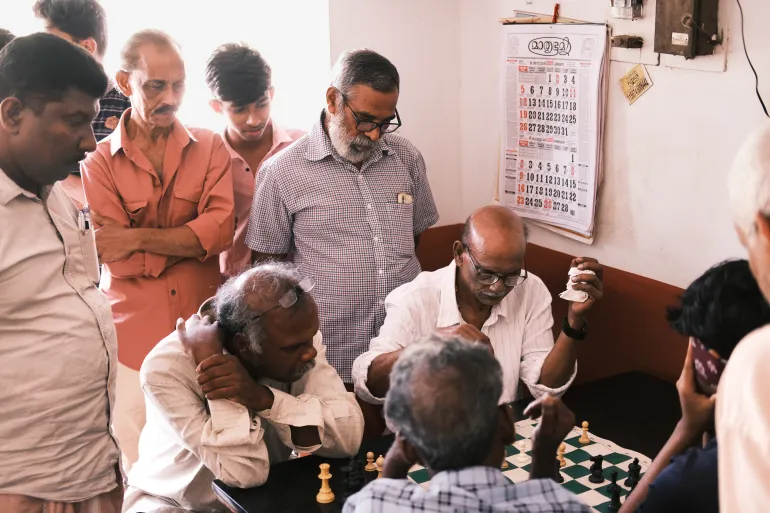
But his intervention did not stop there. To keep the village engaged in a healthier pursuit, Unnikrishnan introduced chess. What started as small gatherings around chessboards at his teahouse soon became a village-wide obsession. As the game spread, more people chose strategy over substance, and addiction rates dwindled. Today, more than 4,500 of the village’s 6,000 residents are proficient chess players, and competitive matches are held in bus stops, grocery shops, and playgrounds.
One of the biggest success stories of Marottichal’s chess revolution is 15-year-old Gowrishankar Jayaraj, a prodigy ranked among India’s top 600 chess players. With a FIDE rating of 2012, he aspires to follow in the footsteps of Indian chess legends like Viswanathan Anand and Dommaraju Gukesh. His skill was on full display in a recent match at Unnikrishnan’s teahouse, where he played blindfolded and defeated a much older opponent, Baby John, within minutes.
The village’s commitment to chess has earned it international recognition. In 2016, it set a Universal Asian Record with 1,001 amateur players competing simultaneously. Several of its players have gone on to participate in international tournaments. The impact of chess extends beyond addiction recovery; for many, it has been a tool for cognitive rehabilitation. Jayem Vallur, vice president of Marottichal’s Chess Association, credits chess for his recovery from a near-fatal motorcycle accident that left him paralyzed. Through continuous play, he regained much of his cognitive function and movement, reinforcing the village’s belief in the transformative power of the game.
Marottichal’s extraordinary journey has even attracted filmmakers. In 2023, Kabeer Khurana directed The Pawn of Marottichal, a 35-minute film documenting the village’s struggle with addiction and its revival through chess. As matches continue to be played daily at Unnikrishnan’s teahouse, the legacy of Marottichal stands as a testament to how a simple game saved an entire community.