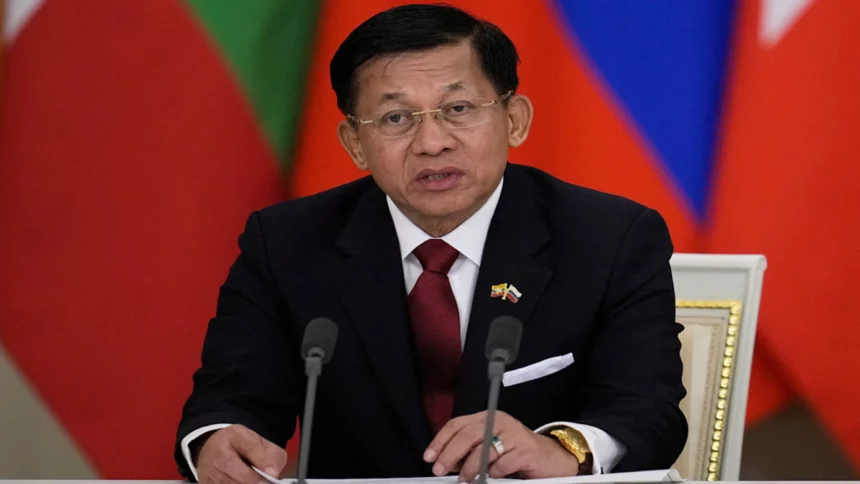
Myanmar’s military leader, Min Aung Hlaing, will attend the BIMSTEC summit in Bangkok this Thursday, despite his country’s ongoing crisis following the devastating 7.7-magnitude earthquake. The disaster, which struck Myanmar last Friday, has claimed nearly 3,000 lives and left widespread destruction, further complicating the country’s internal conflict. Min Aung Hlaing’s participation marks a notable diplomatic shift for Myanmar’s junta government, which has faced regional isolation since the 2021 coup. His attendance at this BIMSTEC summit highlights Myanmar’s ongoing efforts to secure regional support amidst the combined threats of natural disasters and civil unrest.
Min Aung Hlaing will join the heads of state from Bangladesh, Bhutan, India, Nepal, Sri Lanka, Thailand, and Myanmar at the summit in Bangkok. Among the key topics of discussion will be the devastating impact of the earthquake on Myanmar and the need for coordinated international relief efforts. Thailand, the host nation, has proposed issuing a joint statement at the summit to address the disaster’s aftermath and the immediate need for enhanced humanitarian aid. This diplomatic move comes at a pivotal moment, as Myanmar grapples with both the catastrophic earthquake and its ongoing civil conflict.
Challenges in Myanmar’s Earthquake Relief Efforts
Since the earthquake, international aid organizations and several countries have sent relief supplies and rescue teams to Myanmar. However, Myanmar’s civil war and damaged infrastructure have significantly hindered these efforts. Communication systems remain unreliable, and ongoing fighting between the junta and resistance groups has complicated relief operations. The city of Sagaing, one of the worst-hit regions, is experiencing chaotic scenes, with residents lining up for emergency aid. Approximately one in three houses in Sagaing have collapsed, exacerbating the humanitarian crisis.
Survivors continue to face severe shortages of essential supplies, including food, electricity, and clean water. A 63-year-old nun, Aye Thikar, helping distribute aid, described the dire conditions in Sagaing. She noted that people are relying on donations and basic supplies, such as mosquito nets and blankets, which remain in short supply, leaving many survivors to sleep outside in unsafe conditions.
Thailand’s Earthquake Damage and Ongoing Rescue Operations
While the earthquake severely impacted Myanmar, neighboring Thailand also experienced damage. In Bangkok, a building collapse resulted in 22 deaths, with over 70 individuals still unaccounted for. A 30-story skyscraper under construction in the city collapsed in seconds, trapping numerous workers beneath the debris. Rescue teams continue to search for survivors, although hopes for finding more are dwindling. Bangkok Governor Chadchart Sittipunt has expressed hope for miracles but emphasized that expectations must be tempered due to the extent of the destruction.
Despite the ongoing civil conflict and international condemnation, Min Aung Hlaing’s attendance at the BIMSTEC summit signals Myanmar’s efforts to engage diplomatically with its regional neighbors. The summit provides an opportunity for Myanmar’s military government to seek regional support for disaster management and post-earthquake recovery, even as its political crisis continues unresolved. The international community is closely monitoring the summit, as its outcome could influence the direction of future aid, regional cooperation, and Myanmar’s recovery efforts.