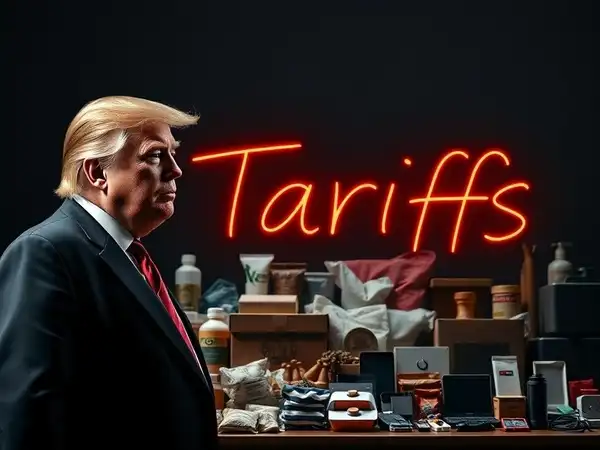
A recent White House fact sheet on tariffs has drawn attention to what it describes as India’s high trade barriers, citing specific products where tariffs are significantly higher than those imposed by the United States. This move comes as part of President Donald Trump’s new trade policy, which includes a baseline 10% tariff on all U.S. imports and additional reciprocal tariffs on countries deemed to have unfair trade practices. India is among the 60 countries targeted under this framework, with the U.S. administration arguing that Indian tariffs and non-tariff barriers restrict American manufacturers from fair market access.
The fact sheet highlights stark differences in tariff rates between the two nations. For instance, the U.S. imposes only a 2.5% tariff on imported passenger vehicles with internal combustion engines, whereas India’s duty on the same category stands at 70%. Similarly, networking switches and routers enter the U.S. duty-free, but India levies duties ranging from 10% to 20% on these products. Other notable discrepancies include rice in the husk, which faces a 2.7% tariff in the U.S. compared to an 80% tariff in India, and apples, which are duty-free in the U.S. but taxed at 50% in India.
The U.S. has long maintained one of the lowest simple average most-favored-nation (MFN) tariff rates, standing at 3.3%. In contrast, India’s average MFN tariff is 17%, significantly higher than other key trading partners such as China (7.5%), the European Union (5%), Brazil (11.2%), and Vietnam (9.4%). The report also points to India’s non-tariff barriers, arguing that these policies make it difficult for American businesses to access Indian markets. It specifically mentions India’s unique testing and certification requirements for sectors such as chemicals, telecom products, and medical devices, which it claims increase costs and complicate market entry for U.S. companies.
According to the fact sheet, eliminating these barriers could result in an annual increase of U.S. exports to India by approximately $5.3 billion. The reciprocal tariffs imposed by the U.S. appear to have been calculated based on the bilateral trade deficit, with higher tariffs applied where the trade imbalance is more pronounced. The U.S. Trade Representative (USTR) has set its methodology to establish tariffs that would theoretically balance trade between the two countries.
The publication of this fact sheet coincides with ongoing negotiations between the two nations, as U.S. Assistant Trade Representative Brendan Lynch recently led a delegation to India to discuss the framework for a bilateral trade agreement (BTA). Donald Trump and Indian Prime Minister Narendra Modi had agreed earlier this year to finalize the BTA, with an initial tranche expected by the fall of 2025. This agreement aims to create a more balanced trade relationship, as the U.S. seeks to address a significant trade deficit with India. In 2024, two-way trade in goods between the two countries was valued at an estimated $129.2 billion, with U.S. exports accounting for $41.8 billion and Indian exports totaling $87.4 billion.