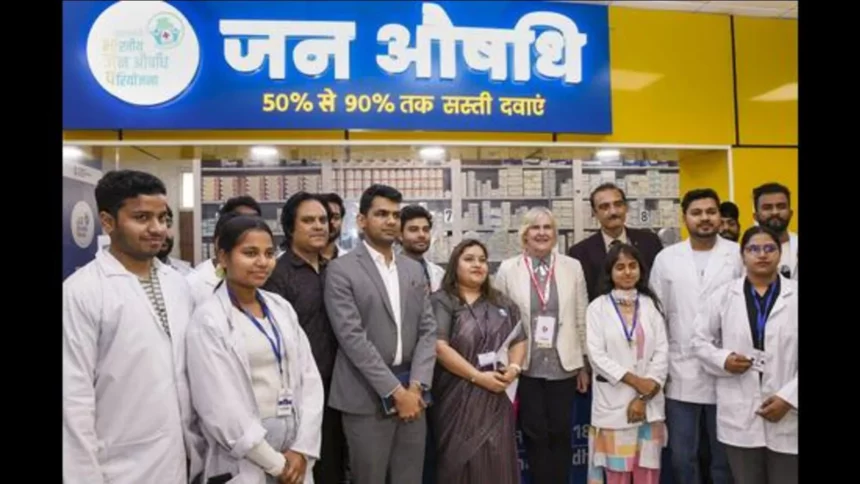
The central government has taken a significant step to improve the reach of affordable medicines by relaxing rules for opening Jan Aushadhi Kendras in metropolitan areas and large cities. Under the Pradhan Mantri Bhartiya Janaushadhi Pariyojana (PMBJP), these Kendras provide high-quality generic medicines at affordable prices, often at least half the cost of branded alternatives. With over 11,000 Kendras already operational across India, the move to ease minimum-distance norms in major urban centers aims to ensure that more people have easier access to essential medicines, thereby reducing out-of-pocket healthcare expenses. This policy shift underscores the government’s commitment to strengthening public healthcare infrastructure and ensuring equitable access to affordable medication for urban populations.
Easing of Norms in Metros and Million-Plus Cities
According to a document issued on September 10 by the Pharmaceuticals & Medical Devices Bureau of India (PMBI), which administers the PMBJP scheme, the new guidelines have done away with the requirement to maintain minimum distance between any two Jan Aushadhi Kendras in seven metropolitan cities: Delhi, Mumbai, Kolkata, Chennai, Bengaluru, Hyderabad, and Ahmedabad. This policy revision is aimed at expanding the outreach of the Kendras in densely populated urban agglomerations where healthcare needs are often concentrated. The decision ensures that more Kendras can be opened in areas where demand for affordable medicines is high, providing citizens with easier and more convenient access to generic drugs. By removing restrictive distance norms, the government intends to make essential healthcare more accessible to urban populations who may otherwise struggle to access affordable medication due to location constraints.
In addition to the seven metros, the relaxation also extends to “million-plus” cities, defined based on the 2011 Census as urban areas with populations exceeding one million. In these cities, there will no longer be a requirement to maintain a minimum distance between new Jan Aushadhi Kendras, except in cases where a Kendra has been operational for less than two years. In such cases, the previous norm of maintaining a one-kilometre distance from the existing Kendra remains in force until the two-year period elapses. This provision ensures that newly established Kendras are given a reasonable timeframe to stabilize operations while still allowing for broader expansion in high-demand urban areas.
The list of 46 million-plus urban agglomerations covers major population centers including Pune (5.05 million), Surat (4.59 million), Jaipur (3.07 million), Kanpur (2.92 million), Lucknow (2.9 million), Nagpur (2.5 million), Ghaziabad (2.36 million), Indore (2.17 million), Coimbatore (2.15 million), and Kochi (2.12 million). With a combined population of over 80 million, these urban centers represent a substantial opportunity for expanding access to affordable healthcare through PMBJP. The policy ensures that the benefits of generic medicines are not limited by artificial geographic constraints, allowing citizens in highly populated urban areas to access medicines conveniently and at reduced costs.
Implications for Public Healthcare and Accessibility
The relaxation of distance norms for Jan Aushadhi Kendras in metro and million-plus cities is expected to have a far-reaching impact on public healthcare accessibility. By increasing the number of Kendras in high-demand areas, the government aims to reduce the dependence on costlier branded medicines and alleviate financial pressure on families. This move aligns with India’s broader health policy objectives of promoting affordable healthcare and reducing out-of-pocket expenditure, which remains a significant challenge for many citizens, particularly in urban centers where healthcare costs are high.
The PMBJP scheme, since its inception, has focused on delivering quality generic medicines at substantially lower prices than branded alternatives. With over 11,000 Kendras already functioning, the scheme has made significant strides in making essential medicines available across India, especially in semi-urban and rural areas. By easing restrictions in large urban agglomerations, the government is now expanding this outreach to metros and million-plus cities, where access to affordable healthcare can be a challenge due to higher population density and limited availability of generic drug outlets.
Pharmaceutical and healthcare experts suggest that this policy revision could encourage more entrepreneurs and pharmacy operators to open Jan Aushadhi Kendras in prime urban locations, thereby increasing competition and improving service delivery. The enhanced presence of these Kendras in cities can facilitate wider dissemination of affordable medicines, ensure better availability of essential drugs, and help citizens manage healthcare costs more effectively. Moreover, the increased number of Kendras will serve as critical nodes for public awareness campaigns, educational initiatives, and distribution of medicines in urban communities.
The directive from the PMBI also emphasizes strict compliance by all officers and functionaries responsible for processing, sanctioning, and operationalizing new Jan Aushadhi Kendras. By mandating immediate implementation, the government seeks to fast-track the establishment of new outlets, thereby quickly expanding the network of affordable pharmacies in high-demand urban areas. The operationalization of additional Kendras is expected to benefit millions of residents, providing them with convenient access to medicines without compromising quality or affordability.
While the relaxation applies to metros and million-plus cities, the rules for smaller towns and urban areas with populations below one million remain unchanged. The minimum-distance requirement of one kilometre between two Jan Aushadhi Kendras continues to be applicable in these smaller cities and towns. This distinction ensures that the density of Kendras in less populated areas remains manageable, preventing operational overlap while maintaining equitable distribution across urban and semi-urban regions. The differentiated approach reflects the government’s strategy to balance expansion with effective resource allocation, ensuring that the benefits of the PMBJP reach both densely populated metros and smaller towns alike.
By removing distance constraints, the government is signaling its commitment to strengthening India’s public healthcare infrastructure while encouraging private participation in expanding the network of Jan Aushadhi Kendras. With increased access to affordable medicines, citizens can manage health conditions more effectively, avoid unnecessary medical expenses, and improve overall health outcomes. The policy is expected to particularly benefit vulnerable urban populations, including low-income groups and elderly residents, who rely heavily on generic medicines for their healthcare needs.
Furthermore, the expansion of Jan Aushadhi Kendras under revised norms supports India’s larger goal of achieving universal healthcare coverage. By ensuring that generic medicines are accessible in every metro and million-plus city, the government is promoting health equity and empowering citizens to take proactive steps in managing their health. The availability of affordable medicines in easily accessible locations can also contribute to better adherence to treatment regimens, improved management of chronic diseases, and enhanced public health outcomes.
The government’s approach aligns with global best practices for increasing access to essential medicines. By targeting high-density urban populations and removing bureaucratic constraints, the PMBJP is positioned to play a central role in India’s healthcare delivery ecosystem. The scheme’s emphasis on quality, affordability, and accessibility ensures that citizens have a viable alternative to expensive branded medicines, reinforcing the government’s vision of a healthier and more equitable society.
The revision of norms for establishing Jan Aushadhi Kendras marks a significant policy shift, reflecting the government’s commitment to addressing urban healthcare challenges and improving citizen access to affordable medicine. The move is expected to encourage further investments, enhance public-private collaboration, and strengthen the distribution network for essential drugs. By facilitating wider access to generic medicines, the policy can play a transformative role in urban healthcare delivery, benefiting millions of citizens across India’s largest metropolitan and million-plus cities.
The focus on enhancing public accessibility through relaxed distance norms also complements broader initiatives under the PMBJP, which include raising awareness about generic medicines, educating citizens on cost-effective alternatives, and promoting responsible use of drugs. The policy is likely to stimulate greater engagement among healthcare providers, pharmacy operators, and community leaders, ensuring that the benefits of affordable medicines reach those who need them most.
The easing of distance norms for Jan Aushadhi Kendras represents a progressive step toward expanding the availability of affordable medicines in India’s urban centers. By removing unnecessary restrictions, the government is not only facilitating the growth of the PMBJP network but also advancing its vision of equitable healthcare access, financial relief for citizens, and sustainable public health outcomes. As the scheme continues to evolve, the expansion of Jan Aushadhi Kendras in metro and million-plus cities is expected to become a key driver in achieving affordable and accessible healthcare for all.