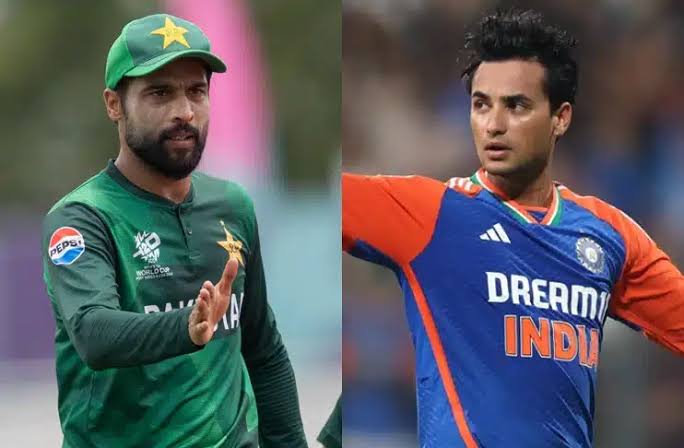
The buildup to Sunday’s high-stakes India versus Pakistan T20 World Cup match has already been intense, but former Pakistan fast bowler Mohammad Amir has added fuel to the fire by targeting India opener Abhishek Sharma. Speaking on the cricket show ‘Haarna Mana Hai’, Amir delivered sharp criticisms of Sharma’s batting approach, questioning both his technique and consistency at the crease. His remarks have stirred conversation among cricket enthusiasts, analysts, and fans, placing a spotlight on the young Indian batsman who has yet to fully establish himself at the international level. Sharma, who played India’s opening game against the USA and was dismissed for a first-ball duck, was sidelined for the subsequent match against Namibia due to illness. With the marquee India-Pakistan clash approaching in Colombo, questions around Sharma’s fitness and form have become central talking points, and Amir’s blunt observations have intensified the scrutiny on the India opener.
Amir Questions Abhishek Sharma’s Technique and Approach
Mohammad Amir, known for his fearless commentary and technical insight from his years as an international pacer, did not mince words when assessing Abhishek Sharma’s batting style. According to Amir, Sharma is primarily a slogger, relying on power hitting rather than sound technique or patience at the crease. Amir suggested that Sharma’s method is highly risk-oriented, leaving him vulnerable to early dismissals unless he finds rhythm immediately in an innings. Reflecting on the limited performances he has seen, Amir said that Sharma’s scores often fluctuate significantly, citing examples where the young opener registers minimal contributions interspersed with occasional big scores. “By whatever little I have seen, if you ask me honestly, I feel he is just a slogger. He has to go hard at every ball. The day he gets going, it’s fine; otherwise, uske failure ke chances zyaada hain,” Amir stated, indicating that Sharma’s reliance on aggressive hitting exposes him to a higher probability of failure.
Amir elaborated that Sharma tends to wait for balls in a specific area rather than adapting to the bowler’s variations or conditions. This predictability, according to Amir, can be a liability in high-pressure games against strong bowling attacks like Pakistan’s. He highlighted that Sharma’s technique has yet to demonstrate versatility or adaptability against quality pace and spin, suggesting that while Sharma has the potential to play match-winning innings, he must develop a more technically sound foundation. Amir also acknowledged Sharma’s capacity to inflict damage once he gets going, but stressed that the young opener’s game is inherently high risk and requires careful execution to succeed consistently.
Fitness Concerns and Match Readiness Ahead of Marquee Clash
Abhishek Sharma’s participation in Sunday’s blockbuster India-Pakistan clash remains uncertain due to illness and limited recovery time. Sharma missed India’s game against Namibia in Delhi, as he had not fully recovered from a viral infection that affected his overall fitness. With the team traveling to Sri Lanka just days before the match, the management is evaluating whether Sharma will be physically prepared to take the field in Colombo. This situation has amplified scrutiny of Sharma’s ability to perform under pressure, and Amir’s comments have added another layer of debate around his readiness and potential impact in one of cricket’s most watched encounters.
The Indian coaching staff and support personnel are likely monitoring Sharma closely, assessing both his health and form to decide on his inclusion in the playing XI. Historically, India-Pakistan clashes in World Cups and T20 tournaments have carried enormous significance, not only in terms of rivalry but also regarding points, momentum, and team morale. A fit and confident opener could provide stability to the batting lineup, while any lingering health concerns could necessitate a last-minute adjustment to the team’s strategy. Amir’s public critique, therefore, adds psychological pressure, underscoring the challenges Sharma faces both on and off the field.
Amir also criticized Sharma’s reliance on predictability in shot selection, observing that the opener appears to favor balls delivered in certain areas, limiting his ability to handle bowlers who vary line and length. In international T20 cricket, where bowlers often employ innovative deliveries, slower balls, and short-pitched challenges, a batsman’s adaptability becomes critical. By pointing out Sharma’s dependency on favorable deliveries, Amir suggested that the young opener may struggle in high-pressure contests against bowlers who can exploit weaknesses. While acknowledging Sharma’s ability to score big when in rhythm, Amir’s analysis portrayed a batsman whose game hinges on a delicate balance between risk and reward.
In addition to technical concerns, Amir highlighted Sharma’s limited international experience as a factor influencing his performance under intense scrutiny. Facing Pakistan’s formidable bowling attack in a high-profile World Cup match is a daunting task for any young cricketer. Amir noted that while Sharma’s aggressive style has the potential to unsettle bowlers, the lack of consistent execution in past innings may expose him to early dismissal and disrupt the team’s batting strategy. The former pacer emphasized that only by demonstrating proficiency against swinging deliveries and varied bowling attacks can Sharma truly be considered a reliable international opener.
Amir’s observations were delivered in his usual forthright manner, combining technical critique with candid opinion. He acknowledged the potential for Sharma to play impactful innings but stressed that until the young opener proves capable of adjusting to challenging conditions, his risk-heavy approach remains a liability. This analysis has sparked widespread discussion among fans and cricket pundits, who have debated whether Sharma’s style can succeed against top-tier international bowlers and whether the Indian team management should alter their plans accordingly.
The upcoming India-Pakistan match represents not only a cricketing contest but also a stage for psychological warfare, where statements from former players like Amir can influence public perception and pressure players. Sharma’s response, whether through form, fitness, or mental resilience, will be closely observed by fans, analysts, and opponents alike. The combination of technical evaluation and fitness assessment highlights the multifaceted nature of preparation required for high-profile T20 matches.
From a tactical standpoint, India may consider flexible strategies if Sharma is included in the playing XI. Adjustments could involve pairing him with experienced partners, assigning him roles that maximize his power-hitting potential, and preparing contingency plans for early dismissals. Amir’s critique has underscored the importance of having a well-rounded batting plan that mitigates risk while leveraging Sharma’s natural strengths. In scenarios where he struggles to adapt, the team’s management may have to reconfigure the batting order or promote other reliable performers to ensure stability during crucial overs.
Amir also pointed out the statistical inconsistencies in Sharma’s career so far, noting that while he occasionally produces high scores, his overall record suggests a lack of regularity. This observation reflects the larger challenge young cricketers face in balancing aggressive intent with disciplined shot selection. According to Amir, Sharma’s batting style, which emphasizes power and boundary-hitting, must be complemented by technical proficiency to succeed consistently against quality bowling. The ongoing debate around his approach provides insight into broader considerations for player development, coaching, and strategy formulation within international T20 cricket.
Mohammad Amir’s sharp criticism of Abhishek Sharma ahead of the India-Pakistan T20 World Cup clash has highlighted concerns regarding technique, consistency, and adaptability. Sharma’s fitness and readiness, coupled with the psychological and tactical pressures of facing a high-caliber bowling attack, will define his potential impact in Colombo. While Sharma possesses the ability to play explosive innings and influence the outcome of a match, Amir’s analysis emphasizes the necessity for sound technique, adaptability, and risk management. As the marquee clash approaches, all eyes will be on Sharma to see whether he can validate his potential on one of cricket’s biggest stages.