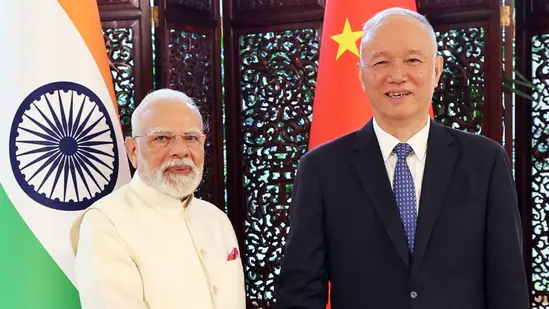
Prime Minister Narendra Modi’s unprecedented meeting with Cai Qi, one of the most influential and feared figures in China’s political hierarchy and a close confidant of President Xi Jinping, has reshaped the discourse on India-China ties. The rare engagement, which took place during the Shanghai Cooperation Organization (SCO) Summit in Tianjin, carried significance far beyond the formalities of protocol. For a leader known to remain elusive even to seasoned diplomats in Beijing, Cai Qi’s 45-minute meeting with PM Modi marked a diplomatic development that could redefine the trajectory of relations between the two Asian giants.
A Powerful Message from Xi Jinping Through Cai Qi
In the opaque world of Chinese politics, Cai Qi commands unparalleled influence. As a member of the Politburo Standing Committee and the first-ranking member of the Secretariat of the Communist Party of China (CPC), Cai Qi wields immense power. Yet in China’s political landscape, positions often matter less than proximity to the paramount leader, and Cai Qi is widely regarded as one of Xi Jinping’s most trusted lieutenants. His reputation as a man who rarely smiles, coupled with his stature as an enforcer of Xi Jinping’s political will, makes him a figure of both fear and admiration within Beijing. Foreign diplomats based in the Chinese capital often describe him as inaccessible, someone whose time and attention is reserved strictly for matters of utmost strategic importance.
It is against this backdrop that his meeting with PM Modi assumes historic proportions. Xi Jinping himself reportedly tasked Cai Qi with engaging directly with the Indian Prime Minister, a gesture few observers could have anticipated. According to accounts from officials privy to the encounter, Cai Qi even lightened the moment by remarking to PM Modi that he had initially been asked to host him for lunch, but later informed that the Indian leader preferred not to eat during engagements. For someone known for his stoicism and gravitas, the comment was viewed as an extraordinary departure, symbolizing both respect and accommodation.
Cai Qi did not extend such courtesies to any other visiting leader during the summit, underlining the exclusivity of the meeting. More importantly, he was present during the separate bilateral between Xi and PM Modi, an indication of the seriousness with which the Chinese leadership views the process of normalization with India. For Beijing insiders, Cai Qi’s presence and personal interaction with PM Modi sent a carefully calibrated message to China’s domestic audience and its anti-India hardliners: that India remains a priority, and Xi Jinping is determined to reframe ties on a pragmatic footing.
Diplomatic watchers believe the significance of Cai Qi’s engagement lies not in the immediate content of discussions—reportedly free of any classified agreements—but in the symbolism it carried. By deputing his most trusted aide, Xi Jinping conveyed that Beijing’s outreach to New Delhi is not perfunctory but deeply strategic. This is particularly important at a time when skeptics in China often portray India as an obstacle in Beijing’s ambitions, whether in the Indo-Pacific or in multilateral forums. Cai Qi’s meeting worked as a subtle rebuke to these voices, reaffirming that Xi Jinping intends to treat PM Modi as a serious partner in dialogue.
Resetting Ties Amid Border Tensions and Global Stakes
The PM Modi-Cai Qi interaction cannot be examined in isolation from the larger canvas of India-China relations, especially the legacy of border tensions since May 2020. The violent clashes in Galwan and the standoffs in Ladakh had pushed the bilateral relationship to its lowest point in decades. Both governments hardened their positions, with India linking broader ties to restoration of peace on the Line of Actual Control, while China sought to compartmentalize the border issue from cooperation in trade and multilateralism. This deadlock had created a deep trust deficit, compounded by China’s growing closeness to Pakistan and its expansive Belt and Road Initiative (BRI), which India has consistently opposed.
However, the meeting in Tianjin signaled a step-by-step recalibration. Sources familiar with the talks suggest that PM Modi and Cai Qi discussed mechanisms to move ties back towards the pre-May 2020 framework, with stability and tranquility along the border forming the bedrock of the renewed relationship. India’s decision not to let Pakistan dictate the pace of India-China normalization was also evident. Despite Beijing’s strong strategic partnership with Islamabad, New Delhi appears determined to pursue its own independent course of engagement, recognizing that freezing ties with China indefinitely could be strategically counterproductive.
This nuanced approach is already visible in the willingness of both sides to restore apex-level military dialogue at the commanders’ level, involving lieutenant generals and major generals. Such engagement is aimed at addressing border frictions swiftly and delineating uncontested portions of the frontier. For two countries with a shared history of mistrust and occasional military rivalries, even this incremental step carries substantial weight.
Beyond bilateral irritants, the discussions underscored areas of convergence in multilateral and global arenas. Climate change, counter-terrorism, and the push for fair trade were among the themes both nations recognized as crucial for cooperation. In an era where global governance structures are under strain, India and China, as two of the world’s largest developing economies, share common stakes in reforming international institutions to reflect more equitable representation. The symbolism of Cai Qi—China’s enforcer of party discipline and Xi Jinping’s confidant—holding direct talks with PM Modi suggests Beijing sees value in building bridges with New Delhi on these shared global priorities.
The SCO summit provided the perfect backdrop for this recalibration. While the forum itself is often dismissed as a talking shop, it has emerged as a platform for both regional security and economic cooperation. The PM Modi-Cai Qi meeting injected fresh energy into this narrative, demonstrating that the India-China equation, despite its complexities, remains one of the most consequential bilateral relationships in Asia. The very fact that Beijing deployed one of its most powerful figures to engage PM Modi, rather than a routine foreign policy official, speaks volumes about the stakes involved.
India, for its part, appears equally committed to cautious normalization. New Delhi recognizes that while competition with China is inevitable, complete estrangement is unsustainable. The two nations are too large, too close, and too intertwined in global issues to afford perpetual hostility. PM Modi’s willingness to engage not only X i but also Cai Qi reflects a pragmatic realism—an acknowledgment that personal diplomacy and high-level signaling can help unlock bureaucratic gridlocks and foster conditions for dialogue.
The road ahead remains fraught with challenges, but Tianjin has undeniably set the stage for a new phase. Both sides appear to have realized that an indefinite freeze benefits neither, and that careful steps toward stability can coexist with competition. For India, the choice to move forward without letting Pakistan’s shadow loom too large over its China policy is particularly significant. For China, the decision to project Cai Qi as the face of its outreach to PM Modi signals Xi Jinping’s personal investment in the process.