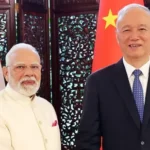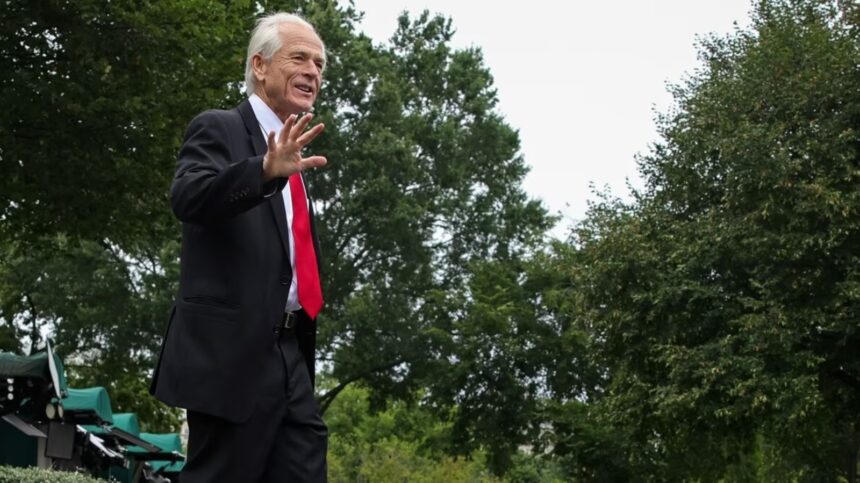
Prime Minister Narendra Modi’s engaging interactions with Russian President Vladimir Putin and Chinese President Xi Jinping at the Shanghai Cooperation Organization (SCO) Summit in Tianjin have triggered sharp remarks from the United States. White House trade adviser Peter Navarro, a staunch supporter of President Donald Trump’s tariff policies, reacted with unusual bluntness, calling it a “shame to see PM Modi getting in bed with the two biggest authoritarians in the world.” The statement, coming on a day when powerful visuals of bonhomie between PM Modi, Vladimir Putin, and Xi Jinping flooded global media, underscored the complexity of India’s strategic balancing act and the sensitivity of Washington’s foreign policy hawks to New Delhi’s outreach to Beijing and Moscow.
Peter Navarro’s Sharp Rebuke of PM Modi’s Engagement with Vladimir Putin and Xi Jinping
Peter Navarro, often known for his hardline economic views and unpredictable public remarks, did not mince words when asked about the camaraderie displayed at the SCO Summit. He declared it shameful that PM Modi, as the leader of the world’s largest democracy, chose to publicly display warmth toward what he described as the “two biggest authoritarians in the world.” For Peter Navarro, the optics of PM Modi shaking hands and exchanging smiles with Xi Jinping and Vladimir Putin represented a troubling departure from what he views as India’s natural alignment with the democratic West.
Peter Navarro went further, questioning the very rationale behind India’s engagement with China. He pointed out that New Delhi and Beijing have been locked in a decades-long rivalry, marked not only by a “cold war” but also by episodes of hot conflict, most recently in the brutal Galwan clashes of 2020. Against this backdrop, Peter Navarro implied, PM Modi’s visible bonhomie with Xi Jinping made little sense. The juxtaposition of past hostility and present handshakes, Peter Navarro argued, undermined the narrative of India as a bulwark of democracy aligned with Western values.
He also brought Russia into his critique, noting that Vladimir Putin’s government stands accused of authoritarian crackdowns at home and aggressive adventurism abroad, including the war in Ukraine. Peter Navarro said he hoped the Indian leader would “come around” to recognizing that his natural allies were not Russia and China but rather the United States, Europe, and Ukraine. His comments sought to position India as a necessary democratic partner in the West’s coalition, particularly as tensions with Moscow and Beijing dominate Washington’s strategic priorities.
This was not the first time Peter Navarro had taken swipes at India. In the past, he has derided the country as the “maharaja of tariffs,” criticized it for allegedly serving as a “laundromat of Russia” in the Ukraine conflict, and even described the war as “PM Modi’s war” in a characteristically provocative statement. Most recently, he triggered outrage by claiming that Brahmins in India were “profiteering at the expense of the Indian people.” Taken together, these remarks have cast him as a controversial figure in India, often dismissed as an erratic voice within Donald Trump’s circle but nonetheless influential in shaping perceptions of Washington’s trade and foreign policy debates.
At the SCO Summit, however, PM Modi’s interactions with Xi Jinping and Vladimir Putin seemed designed to project a different message altogether. The images of the three leaders shaking hands, hugging, and conversing candidly were carried across social media platforms and global news portals. For India, participation in the SCO and visible engagement with its two most powerful members signal not abandonment of democratic partners but a pragmatic assertion of strategic autonomy. Yet for Peter Navarro and others in Washington’s hawkish camp, the optics told a different story—one of a democratic leader warming up to authoritarian powers at a time of deep geopolitical polarization.
Washington’s Mixed Messaging on India Amid SCO Diplomacy
Even as Peter Navarro issued his barbed remarks, the broader American establishment struck a notably different tone. On the very same day, the US Embassy in India posted a message on social media emphasizing that the partnership between the United States and India “continues to reach new heights.” Quoting Secretary of State Marco Rubio, the post described the bilateral relationship as a “defining relationship of the 21st century” and highlighted areas of cooperation ranging from innovation and entrepreneurship to defense and people-to-people ties. The embassy urged followers to track the hashtag #USIndiaFWDforOurPeople as part of a campaign showcasing progress in the partnership.
This juxtaposition of Peter Navarro’s criticism and the embassy’s affirmation reflects the complex interplay of views within Washington regarding India’s foreign policy. While official channels seek to underscore the steady upward trajectory of US-India ties, hawks like Peter Navarro see in New Delhi’s engagement with Moscow and Beijing a potential dilution of alignment with the West. The divergence highlights the challenge faced by American policymakers: how to reconcile India’s pursuit of strategic autonomy with Washington’s desire for clear alliances in an era of great-power rivalry.
The US Treasury Secretary, Scott Bessent, also weighed in on the SCO Summit, dismissing it as “largely performative.” In his view, the gathering was a long-standing annual ritual that did not necessarily translate into substantive strategic shifts. Bessent emphasized that India, as the world’s most populous democracy, shares values much closer to the West than to Russia. While his comment aimed to temper concerns about India’s outreach to Moscow, it also implicitly recognized the enduring importance of New Delhi’s role in the global democratic camp.
For India, the SCO Summit served as an opportunity to assert its independent voice in a multipolar world. PM Modi’s willingness to engage with Xi Jinping and Vladimir Putin reflects New Delhi’s understanding that it cannot afford to isolate itself from two of Asia’s most consequential powers, no matter the friction. Border disputes with China and Russia’s entanglement in Ukraine remain thorny issues, but India calculates that pragmatic engagement provides more leverage than outright disengagement.
New Delhi also views multilateral platforms like the SCO as venues where it can advocate for concerns that resonate with much of the Global South—terrorism, climate change, energy security, and fair trade. By visibly engaging with Xi Jinping and Vladimir Putin, PM Modi signaled India’s capacity to act as an independent pole of influence rather than simply aligning with one bloc. This message, however, sits uneasily with Washington’s desire to build a unified front against Moscow and Beijing.
The optics of the SCO Summit illustrate the delicate balancing act India continues to pursue. On the one hand, it maintains a deepening strategic partnership with the United States, evident in defense cooperation, technology initiatives, and diplomatic coordination in forums like the Quad. On the other, it insists on engaging Russia, a longstanding defense supplier, and China, a powerful neighbor with whom it shares both competition and cooperation. Peter Navarro’s frustration reflects the difficulty of reconciling this balancing act with the binary worldview often prevalent in Washington.
For Indian policymakers, such criticism is not new. They have long argued that India’s foreign policy is driven by national interest and not by alignment to one ideological camp. Whether in purchasing oil from Russia despite Western sanctions, participating in the SCO alongside China, or simultaneously deepening ties with the US and Europe, New Delhi’s strategy has been to preserve flexibility and maximize its options. The blowback from figures like Peter Navarro only underscores how closely global audiences are watching India’s every diplomatic move.
The images from Tianjin of PM Modi in warm conversation with Vladimir Putin and Xi Jinping will remain powerful symbols of this strategy. They highlight India’s willingness to engage across divides, even at the risk of criticism from key partners. While Washington’s official statements emphasize partnership, voices like Peter Navarro’s reveal the unease that such balancing generates. For now, India appears determined to chart its own path, mindful of both the opportunities and the risks that come with such visibility on the global stage.