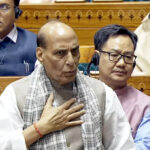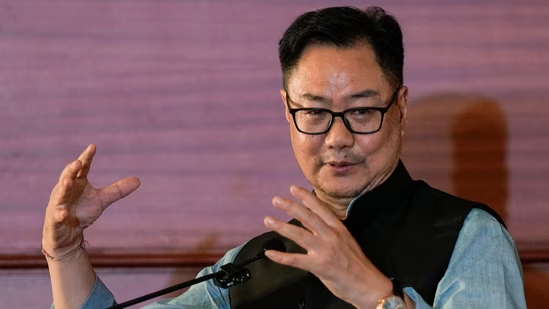
In a charged political atmosphere, the Indian Parliament witnessed the opening of a high-stakes debate on Operation Sindoor, the military response to the Pahalgam terror attack. While the ruling Bharatiya Janata Party (BJP) sought to frame the operation as a testament to national pride and decisive leadership, the Opposition pushed back with tough questions about foreign diplomacy, transparency, and the role of international powers like the United States. The day-long Lok Sabha debate comes amid heightened political rhetoric, with references to religious epics, patriotic symbolism, and fierce partisanship.
Ramayan reference sets the tone
Hours before the debate on Operation Sindoor commenced in the Lok Sabha, Parliamentary Affairs Minister Kiren Rijiju ignited the mood with a symbolic reference to the Ramayan. In a post on X (formerly Twitter), Rijiju drew a parallel between the mythological burning of Lanka and India’s cross-border strike on terrorist camps in Pakistan. “When Ravan crossed the Laxman Rekha, Lanka burned. When Pakistan crossed the red lines drawn by India, terrorist camps faced the fire!” he posted.
Alongside his message, Rijiju also shared a musical video featuring singer Kailash Kher’s vocals, celebrating Operation Sindoor as a mission for India’s “aan, baan, aur swabhimaan” (dignity, pride, and self-respect). The video began with Prime Minister Narendra Modi’s voice, dedicating the operation to “every mother, sister and daughter of the country.” The messaging was clear: the government aimed to position the operation as both a military and emotional victory.
Debate sparked by Pahalgam attack and US claims
Operation Sindoor was launched in response to a deadly terror attack in Jammu and Kashmir’s Pahalgam region on April 22, which claimed 26 lives, many of them civilians. The cross-border operation took place in May, targeting camps in Pakistan believed to be linked to the attackers. Since then, the political narrative around the operation has intensified, especially with unexpected interventions from foreign leaders.
Among the more controversial talking points has been the repeated claim by former US President Donald Trump that he brokered a ceasefire between India and Pakistan, preventing a potential nuclear confrontation. Trump has asserted that he used trade leverage to bring both sides to the table. These assertions have raised questions among Indian lawmakers, with the Opposition demanding clarity on how much influence external powers had over the timing and nature of the Indian strike.
Though Indian officials have firmly stated that the decision to act militarily was made independently, the opposition has continued to press for transparency. They have called for a full briefing on the diplomatic and military timeline leading up to Operation Sindoor, including the sequence of international conversations.
Opposition walks a tightrope
Even as they demanded accountability, opposition parties, including the Congress, walked a delicate line by expressing “full support” for the military operation while simultaneously criticizing what they see as the government’s politicization of national security.
The debate itself was the result of days of disruption in the monsoon session of Parliament, which began on July 21. Congress and other opposition members had demanded not just a debate, but even a special session dedicated to Operation Sindoor. Their persistence finally led to the scheduling of a 16-hour debate in the Lok Sabha on Monday, with a similar duration planned for the Rajya Sabha on Tuesday, July 29.
The debate is expected to feature prominent voices from both sides of the aisle. Defence Minister Rajnath Singh is likely to open the discussion, followed by contributions from Home Minister Amit Shah, External Affairs Minister S. Jaishankar, and BJP MPs such as Anurag Thakur and Nishikant Dubey. Prime Minister Narendra Modi is also expected to make an intervention, potentially using the platform to reinforce his government’s narrative of strength and sovereignty.
A test of messaging and memory
The Operation Sindoor debate is being seen as more than just a discussion on national security. It is also a moment of political messaging—how each party frames its role in supporting or scrutinizing the government. For the BJP, this is an opportunity to showcase its military decisiveness and patriotic credentials, especially with Lok Sabha elections on the horizon. For the opposition, it is a chance to hold the government accountable without appearing to undermine the armed forces.
At the heart of the matter lies the public’s perception. The government has successfully built an emotional connect around Operation Sindoor by invoking national pride, sacrifice, and a shared sense of purpose. But the Opposition’s questions about foreign influence and transparency could still influence voters who are concerned about diplomatic credibility and government accountability.
As the debate unfolds, Parliament becomes not just a chamber of legislation but a stage for national storytelling—one where myth, memory, and military strategy all collide.