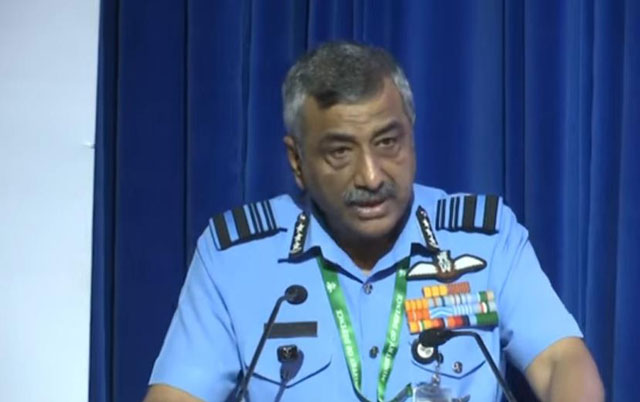
The evolving nature of warfare, shaped by cutting-edge technologies and long-range precision weaponry, has redefined how military strategists must view distance and vulnerability, said Chief of Integrated Defence Staff Air Marshal Ashutosh Dixit. Speaking at a seminar jointly hosted by the Centre for Air Power Studies (CAPS) and Indian Military Review (IMR), Dixit used insights from Operation Sindoor to stress the urgent need for deeper surveillance capabilities and a strategic rethink of traditional military doctrines.
New threats blur old battlefield boundaries
Air Marshal Dixit explained that conventional ideas about safe distances and threat limits are now outdated. “What once marked the end of immediate threat—the horizon—has been overtaken by missiles like SCALP, BrahMos, and HAMMER,” he said. These precision-guided munitions, along with supersonic air-to-ground missiles and beyond visual range (BVR) air-to-air weapons, have dramatically expanded the reach of modern forces. In this context, geographical buffers and natural barriers are no longer reliable shields.
He warned that the ability to launch accurate strikes from hundreds of kilometres away has rendered older distinctions—such as frontlines, rear areas, and combat zones—nearly obsolete. The traditional understanding of depth and flank protection, once central to battlefield planning, must be replaced with more fluid and adaptive models of threat analysis.
Deep surveillance and adaptability key to future readiness
Dixit emphasized the need to expand India’s surveillance envelope significantly. With the nature of warfare evolving, he argued that a robust and layered surveillance network is no longer a luxury, but a necessity. “We must be able to detect threats long before they breach our borders,” he said.
He also highlighted the importance of developing new doctrines that prioritize situational awareness, adaptability, and technology integration across all defence platforms. Operation Sindoor, he noted, has provided valuable operational insights into how India’s military must transform its thinking to stay ahead in the age of precision warfare.
The seminar brought together defence experts and senior military officers to evaluate how traditional combat theories are being challenged. Dixit concluded that a shift in mindset is essential to navigate the emerging landscape of high-tech warfare, where distance no longer equates to safety.