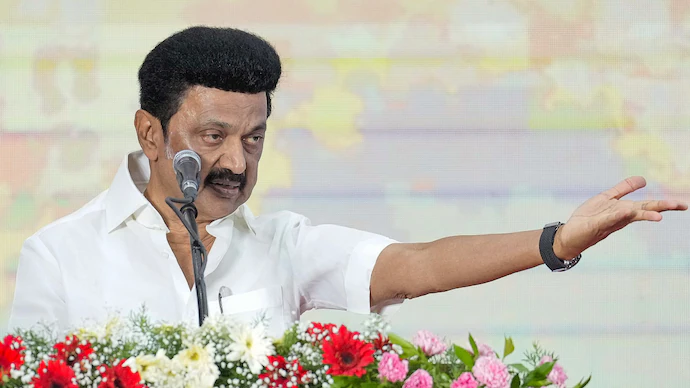
In a strongly worded attack on the Election Commission’s latest voter list revision drive in Bihar, Tamil Nadu Chief Minister MK Stalin has raised serious concerns about the intent and implications of the exercise. Calling it a calculated attempt to suppress certain voter groups, MK Stalin warned that this is not about cleaning up the system but manipulating it. As opposition parties and civil society groups mount a legal and political challenge, the move has sparked nationwide debate on voter rights, constitutional limits, and democratic safeguards.
Tamil Nadu’s chief minister expressed deep alarm over the Election Commission of India’s (EC) Special Intensive Revision (SIR) process that is currently underway in Bihar. In a post on social media platform X (formerly Twitter), MK Stalin declared that the move was “not about reform, but about engineering outcomes.” His warning—“Don’t play with fire”—suggests the DMK leader sees the revision exercise as a direct threat to democratic participation, particularly ahead of crucial elections.
The EC’s decision to carry out the SIR in Bihar has been met with growing resistance from opposition parties. They have questioned the timing of the drive, the scale of document requirements, and the underlying motives. MK Stalin went a step further by asserting that the revision drive is a means to deliberately exclude voters who are likely to vote against the ruling party at the Centre. In his words, “Delhi knows the Bihar electorate that once voted for it will now vote it out. That’s why it is trying to stop them from voting altogether.”
Concerns Over Citizenship Verification and Document Rules
The core of the controversy revolves around the EC’s push for stricter citizenship verification norms. As part of the SIR, voters—especially those born between July 1987 and December 2004—are being asked to submit documentary proof of Indian citizenship. However, the EC has ruled out commonly held documents such as Aadhaar, ration cards, and even EPICs issued before January 2025, from its acceptable list for voter registration.
Instead, individuals are being told to present alternative, more specific documents, including parental proof of citizenship. This has triggered confusion and fear, particularly among economically weaker and minority sections, many of whom may not possess such paperwork or may struggle to produce it within the deadlines.
The EC has defended its actions in an affidavit submitted to the Supreme Court, stating that it holds constitutional authority to demand such documents. According to the EC, ensuring that only Indian citizens are enrolled in the electoral rolls is essential for the integrity of the election process. It claims that Electoral Registration Officers (EROs) and Chief Electoral Officers (CEOs) have full powers to scrutinize documents and verify voter eligibility.
Critics, however, argue that the EC’s insistence on shifting the burden of proof entirely onto the individual is undemocratic and exclusionary. Many fear that the move could disenfranchise thousands, if not lakhs, of legitimate voters.
Legal Ambiguities and Political Fallout
The controversy is now heading for judicial scrutiny, with the Supreme Court set to hear petitions challenging the EC’s move. Legal experts are raising red flags over the blurred lines between electoral verification and citizenship determination. Constitutionally, the authority to cancel or verify citizenship lies with the Union government—not the EC. However, the EC has maintained that its verification process is confined to ensuring voter eligibility and does not interfere with citizenship status.
Opposition parties have labeled this justification a smokescreen. They argue that the EC is setting up a parallel, unaccountable system for verifying citizenship, one that lacks transparency and oversight. Their primary concern is that this new mechanism could be misused to target particular demographics in the name of voter roll clean-up.
On the ground, implementation issues are also piling up. Reports from Bihar suggest that during the door-to-door enumeration phase, many citizens filled out forms without attaching documents, either due to confusion or lack of awareness. Now, they are being summoned to produce the necessary proof in person within a tight deadline, raising concerns of large-scale exclusions.
The confusion has been further compounded by inconsistent guidelines. Initially, field officials were instructed to collect citizenship documents during the home visits. Later, this requirement was shifted to a separate verification round. This mid-course correction has created procedural ambiguities and worsened public anxiety.
MK Stalin’s reaction is among the sharpest so far, but it aligns with a broader chorus of dissent. Several opposition leaders have accused the EC of carrying out the revision with political intent, rather than administrative necessity. According to them, the timing—just ahead of state polls—suggests an ulterior motive: to tilt the electoral balance by suppressing specific voter groups, especially the poor and marginalized.
The BJP, on the other hand, has come out in full support of the revision drive. Party leaders argue that the EC is simply trying to ensure that only genuine Indian citizens are allowed to vote, which is a matter of national interest. They have accused the opposition of spreading misinformation and fear to create unrest ahead of elections.
Despite these reassurances, public trust in the process appears to be eroding. Voter registration, traditionally seen as a routine administrative task, has now become the center of a political and legal storm. The implications go beyond Bihar; if the model is extended to other states, it could set a new precedent in how voter eligibility is determined across India.
As the Supreme Court prepares to weigh in, the broader question remains unanswered: where should the line be drawn between electoral scrutiny and the right to vote? The answer may shape the future of democratic participation in India.