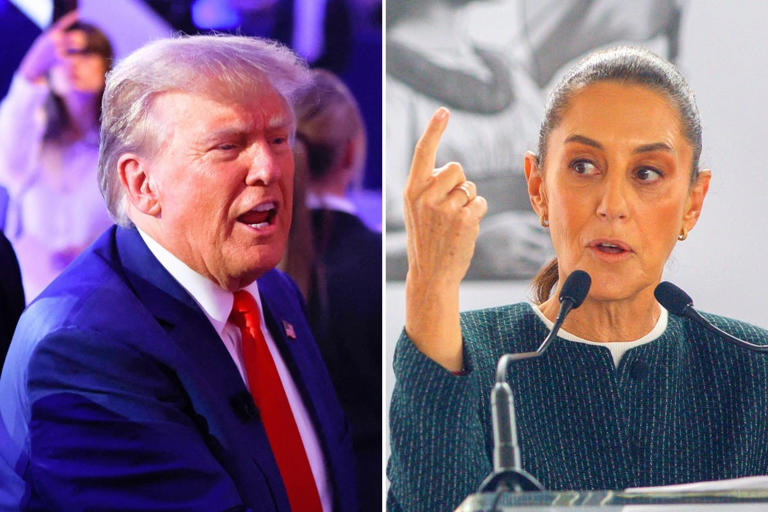
Mexico’s President, Claudia Sheinbaum, responded to U.S. President-elect Donald Trump’s recent statement about renaming the Gulf of Mexico to the “Gulf of America” in a sharply pointed manner during a press conference on Wednesday. Sheinbaum, displaying a 17th-century world map, pointed out that North America was once referred to as “Mexican America,” using the map as evidence of historical ties. She then humorously turned the tables on Donald Trump’s proposal, asking, “Why don’t we call it ‘Mexican America’?” Sheinbaum added that the name had a pleasant ring to it, suggesting that if Donald Trump was in the business of renaming geographical landmarks, perhaps the United States itself could adopt such a name.
Donald Trump had made headlines on Tuesday with his plan to rename the Gulf of Mexico, claiming that “the Gulf of America” had a more appropriate and beautiful ring to it. The proposal came along with his ongoing rhetoric about tightening U.S. borders, with Donald Trump asserting that Mexico needed to halt the flow of illegal immigrants and drugs into the United States. He also commented that Mexico was controlled by drug cartels, a statement that was met with a firm rebuttal from Sheinbaum. The Mexican president responded, stating unequivocally that “in Mexico, the people rule,” rejecting Trump’s portrayal of the country.
This back-and-forth between the two leaders follows a long-standing history of contentious relations between the United States and Mexico, particularly regarding issues of immigration, border security, and drug trafficking. Donald Trump’s administration has been vocal in its criticisms of Mexico, repeatedly suggesting that the country was not doing enough to curb illegal immigration and the smuggling of drugs into the U.S. As he prepares to take office for a second term on January 20, Donald Trump’s rhetoric regarding Mexico remains a central point of focus in his foreign policy stance.
The Gulf of Mexico, named for the country of Mexico, is an important body of water that borders the southern United States and is a key area for both countries’ trade, commerce, and environmental concerns. The name is internationally recognized, including by the United Nations, and Donald Trump’s suggestion to change it has been seen by many as another example of his penchant for rebranding and challenging international norms.
Sheinbaum’s response highlights the ongoing diplomatic tensions between the U.S. and Mexico, tensions that have often been characterized by Donald Trump’s combative approach towards foreign relations. Despite these tensions, Sheinbaum emphasized that she hopes to maintain “good relations” with the incoming U.S. president, signaling that Mexico remains open to diplomatic dialogue, even as it responds to provocative statements with humor and historical context.
The rhetoric surrounding the U.S.-Mexico relationship is likely to intensify as Donald Trump begins his second term, with ongoing debates about trade policies, tariffs, and immigration reform. With Donald Trump’s continued focus on securing the U.S.-Mexico border and his rhetoric about Mexico’s role in drug trafficking, the relationship between the two nations is expected to be a major point of contention in the years to come. Sheinbaum’s remarks serve as a reminder of Mexico’s sovereignty and its determination to maintain its own political and social structure, despite the criticisms and challenges from its northern neighbor.