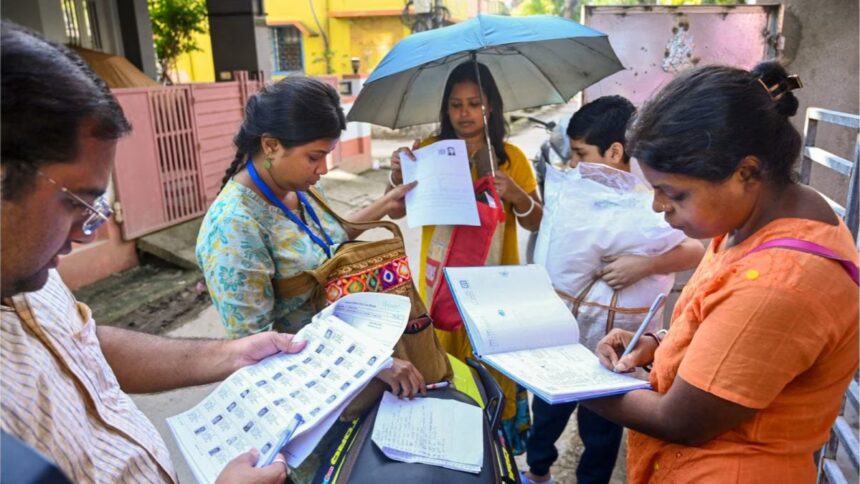
Noida/Greater Noida: Gautam Buddh Nagar district administration has announced one of the most extensive voter-list revision exercises in its history, scaling up the Special Intensive Revision (SIR) campaign to ensure inclusive, location-flexible, and fast-tracked citizen participation. The drive, led by District Magistrate Medha Rupam, will see the deployment of 500 dedicated registration camps over December 1 and 2, enabling residents from labor communities, professionals, students, medical workers, industrial employees, and high-rise society members to submit forms for name addition and correction at any camp, regardless of their designated polling booth.
Officials said the major decision to allow ‘any-booth, any-location’ form submission is aimed at removing previous logistical bottlenecks that prevented citizens from completing registration processes smoothly. The restriction on booth-specific submissions had long been considered the biggest hurdle in urban residential layouts like Noida and Greater Noida, where population clusters include technology hubs, industrial belts, educational campuses, and creative districts such as Film City and media offices.
A strategy meeting chaired by the DM on Sunday in the Greater Noida Authority auditorium brought a wide spectrum of stakeholders to the table—Authority coordinators, booth-level officials, resident welfare associations (RWAs), apartment owner associations (AOAs), builder groups, traders, entrepreneurs, labor unions, industry representatives, educational and medical organizations, volunteers, and members of the district election office were part of the deliberations.
The DM briefed participants that the initiative intends to simplify voter-list procedures by expanding on-ground touchpoints and offering real-time verification support. Booth Level Officers (BLOs) have been trained to cross-check applicants’ details instantly through official portals, including references to legacy voter data records, allowing citizens to receive immediate confirmation or guidance about corrections.
Outreach lanes have been carved based on community segmentation. The labor ecosystem will have 50 camps operating in a lunch-break window from 12 noon to 2 pm on both days to match the work cycles of contractual and daily-wage employees. Industrial workers will have 50 special camps set up near manufacturing clusters and corporate factory zones, enabling submission without leaving their workplaces. Educational institutes and medical campuses, covering 35 landmark institutions across the district, will also host dedicated SIR kiosks so that students, faculty members, campus residents, and medical professionals can register or request modifications without facing procedural delays.
A major leg of the operations will be organized in high-density residential spots, including high-rise societies and housing clusters, under BLO and Authority supervision. Additionally, 16 special camps will cater exclusively to the media and film-industry community inside Film City and key newsroom complexes, allowing creative professionals working on stringent deadlines to complete voter formalities with ease. All key enumeration forms such as Form-6 for new entries, Form-8 for corrections, and other electoral documentation applications will be accepted at these camps.
Administration removes submission barriers with any-location form deposit, emphasizes pace, transparency, and digital safety
Gautam Buddh Nagar’s SIR campaign is being appraised as a model for future urban voter-list revisions owing to its unique population mix and fast spatial expansion. District officials said that the camp model has been built with accessibility, transparency, speed, and digital security as the core pillars, ensuring that the process aligns with the needs of a digitally active urban population, without exposing citizens to fraud or third-party intervention.
All 500 camps will operate with an open-submission framework, eliminating geographic dependence. This enables residents from any sector or booth zone to submit forms at whichever camp is closest or most convenient. For instance, an applicant mapped to a polling booth in Sector-150 can deposit forms at a media-centered SIR desk in Sector-137 or a labor-community camp in a different tehsil pocket, without rejection or redirection. The intent is to make the citizen journey process-driven rather than location-driven.
To further accelerate impact, the administration has issued booth-level targets for community coordinators and contractual staff assisting with enrollment. Weekly progress tracking, review of performance by employee cluster, and cross-department coordination will be carried out at the tehsil and district election-office level. Field officers have been asked to ensure staggered queues and dedicated registration slots at each camp to prevent crowd congestion. Working professionals and travelers are being accommodated specifically within light-administrative windows such as lunch-break hours, retargeted evening slots, and on-compound society access points so that registrations see fewer drop-offs.
Authorities are also implementing digital safety protocols to combat the rising risks of phishing, impersonation, and personal-device fraud. The DM has underscored that no OTP-based email communication, external links, or unsolicitated caller-assisted verification will be used by camp officials. Citizens are being guided to treat any unsolicited bank-style link or private email instruction around SIR or voter registration as suspicious and verify processes only through authorized government platforms and supervised physical camps.
Additional instructions issued to field teams include ensuring that: forms are accepted without booth rejection, documents are verified on official databases in real time, grievance support remains decentralized, society and industry coordinators work as submission bridge points, labor-site supervisors assist vulnerable individuals including the homeless, disabled and destitute whose names may be missing from updated lists, performance review is objective and measurable, and crowd management remains dynamic and booth-agnostic.
District Election Officer Atul Kumar, SDM Sadar Ashutosh Gupta, Deputy Commissioner (Industry) Anil Kumar, and senior officials from the labor department, industrial associations, and electoral data units were present during the meeting and confirmed full administrative alignment on the rollout plan.
As the SIR campaign accelerates, administration officials maintain that this is not merely a name-addition exercise, but a structural effort to reinforce democratic integrity by minimizing errors, duplication, and data gaps in fast-growing urban regions. Authorities believe that the scale, flexibility and inclusivity of the initiative will help ensure that no eligible voter is excluded from electoral participation due to process barriers, legacy mapping issues, or lack of awareness.