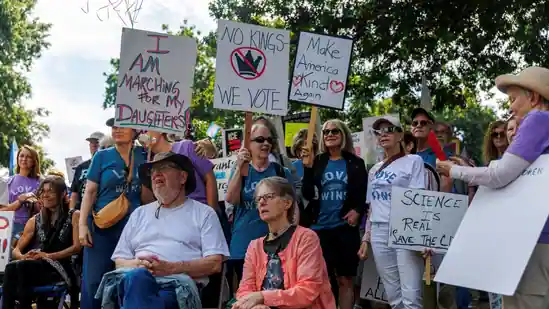
The United States is witnessing one of the largest waves of public dissent in recent years as millions of citizens mobilised across all 50 states under the banner of the “No Kings” movement. The protests, which brought together an estimated 80 lakh participants across more than 3,300 locations, reflect growing frustration with the leadership of President Donald Trump and his administration’s policies.
Organisers have described this as the most extensive mobilisation yet in the ongoing protest series, surpassing previous demonstrations held in June and October 2025. With nearly 10 lakh more participants than earlier protests and hundreds of additional events organised, the movement appears to be gaining momentum and expanding its reach across diverse sections of American society.
At the core of the protests lies widespread dissatisfaction with several key policy areas. Demonstrators have voiced strong opposition to escalating tensions with Iran, strict immigration enforcement measures, and the persistent rise in inflation, which has impacted households across the country. These concerns have collectively fuelled a narrative that the administration’s decisions are not aligned with the interests of ordinary citizens.
Across major cities, the scale of participation has been particularly striking. In Minnesota, around 2 lakh people marched through Minneapolis and St. Paul, creating one of the largest regional gatherings. The protests in these cities combined political speeches, cultural performances, and organised marches, highlighting both the seriousness of the issues and the community-driven nature of the movement.
In New York City, thousands gathered in iconic locations such as Times Square and Manhattan. The sheer volume of participants led authorities to shut down several major roads, underscoring the magnitude of the demonstration. Protesters carried placards, banners, and symbolic imagery criticising the administration and calling for accountability.
Similarly, in Chicago, large crowds took to the streets, chanting slogans such as “Remove Trump.” Local leaders addressed the gatherings, noting that the movement continues to grow in strength and visibility. The demonstrations in Chicago reflected a broader national sentiment of dissatisfaction and demand for change.
The capital city, Washington, D.C., became a focal point of the protests. Thousands assembled near the Lincoln Memorial and the National Mall, locations that carry deep historical and symbolic significance. Protesters used these spaces to voice their concerns about democracy, governance, and leadership.
While the majority of protests remained peaceful, some areas experienced heightened tensions. In Portland, demonstrators burned the American flag outside an office of the Immigration and Customs Enforcement agency, reflecting anger over immigration policies. In Los Angeles, clashes between protesters and law enforcement resulted in multiple arrests, highlighting the challenges of managing such large-scale demonstrations.
A notable feature of the protests was the use of creative and symbolic expressions. In Washington, participants staged theatrical acts, including pouring fake blood on themselves to represent the perceived human cost of policy decisions. Effigies of the president were also displayed, serving as visual representations of dissent.
The protests were not confined to the United States alone. Demonstrations were reported in several international cities, including Paris, London, Lisbon, and Rome. In these locations, participants expressed solidarity with the movement and criticised broader global political trends. In Rome, protesters displayed posters targeting multiple leaders, including Israeli Prime Minister Benjamin Netanyahu and Italian Prime Minister Giorgia Meloni, alongside Donald Trump.
Prominent political figures and public personalities also lent their voices to the movement. In Minnesota, Senator Bernie Sanders addressed large crowds, emphasising concerns about the growing influence of wealth in politics. Congresswoman Ilhan Omar also spoke at rallies, reinforcing calls for accountability and reform.
The cultural dimension of the protests was highlighted by performances from well-known artists. Musicians such as Bruce Springsteen, Maggie Rogers, and Joan Baez performed in support of the demonstrations, helping to amplify the movement’s message and attract broader public attention.
Another controversial aspect that emerged during the protests was the display of posters referencing financier Jeffrey Epstein. Protesters highlighted Trump’s name appearing in documents linked to Epstein, using it as part of their criticism. This added another layer of political and social tension to the demonstrations.
Despite the scale and intensity of the protests, the White House dismissed them, describing the gatherings as “therapy sessions” that do not reflect the concerns of ordinary Americans. President Donald Trump defended his administration’s policies, stating that they are intended to strengthen the country and ensure national security. He also rejected accusations of authoritarianism, asserting that the characterisation of him as a “king” is unfounded.
However, the persistence and expansion of the “No Kings” movement suggest that public dissatisfaction may not subside easily. The protests have evolved into a platform for expressing a wide range of grievances, from economic challenges to foreign policy decisions and civil liberties concerns.
Analysts believe that the scale of these demonstrations could have significant political implications. Large-scale public mobilisation often influences policy discussions, electoral strategies, and public perception of leadership. The movement’s ability to sustain momentum will likely determine its long-term impact on the political landscape.
Public opinion remains divided. While many support the protests and their demands, others view them as politically motivated or exaggerated. This division reflects broader polarisation within American society, where differing perspectives on governance and policy continue to shape national discourse.
The protests also highlight the role of civic engagement in democratic systems. Large-scale demonstrations are a means for citizens to express their views, hold leaders accountable, and influence public debate. The “No Kings” movement, regardless of its outcomes, underscores the importance of participation and dialogue in shaping the future of governance.
As the situation continues to unfold, attention will remain focused on how the administration responds to the protests and whether any policy changes emerge as a result. The coming weeks and months are likely to be crucial in determining the trajectory of both the movement and the broader political environment.