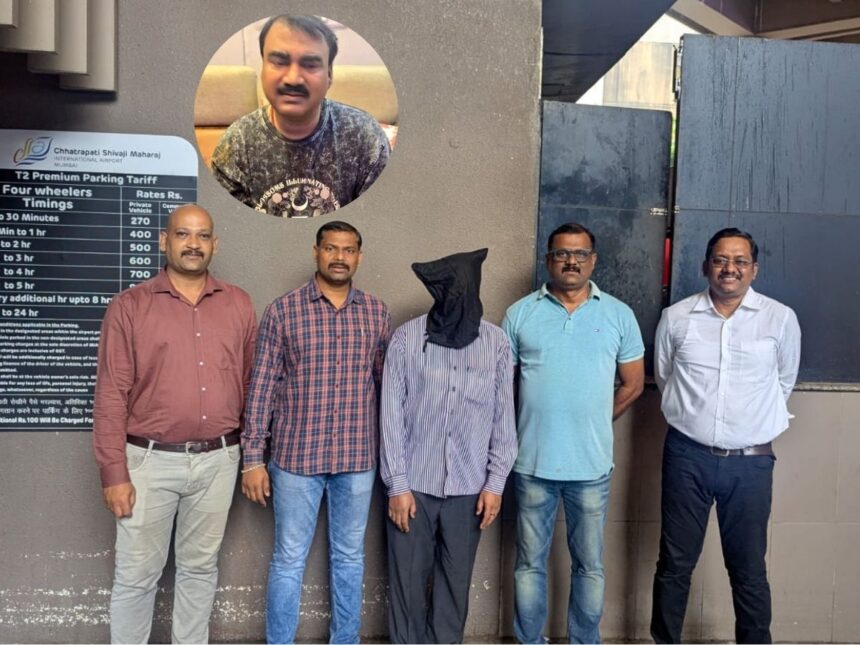
Mumbai Police have arrested a 51-year-old man from Noida for allegedly sending a chilling WhatsApp message threatening to unleash large-scale terror across Mumbai. The message, which warned of 34 human bombs, 14 Pakistani terrorists, and 400 kilograms of RDX being used in explosions, was received by the official WhatsApp number of the Mumbai Traffic Police just a day before the city’s Ganesh Visarjan celebrations. The alarming nature of the threat immediately triggered a state of high alert in Mumbai, with security forces stepping up their presence and intensifying checks across sensitive areas. Within hours, investigators tracked the origin of the message to Noida, leading to the swift arrest of the suspect, identified as Ashwini Kumar, an astrologer hailing from Bihar.
The arrest and nature of the threat
The accused, Ashwini Kumar, had been residing in Noida for the past five years and earned his living through astrology. His arrest was carried out after technical analysis revealed that the threat message to the Mumbai Traffic Police had been sent from his phone. Police seized his mobile phone, SIM card, and other digital devices from his residence before taking him into custody. He was subsequently transferred to Mumbai for further interrogation and investigation.
According to the First Information Report filed by Mumbai Police, the message was drafted in the name of an organisation that claimed to be “Lashkar-e-Jihadi,” a self-styled outfit that allegedly threatened to carry out coordinated terror strikes in India. The contents of the message were enough to put the entire city on edge. It declared that 14 Pakistani terrorists had entered India and that 34 human bombs were already positioned across Mumbai, with 400 kilograms of RDX ready to be used in devastating blasts. Given the timing, on the eve of Ganesh Visarjan—a festival that draws massive public gatherings—the threat forced security agencies to treat it with utmost seriousness.
Mumbai Police officials revealed that the immediate response involved mobilising special anti-terror squads, bomb detection and disposal units, and paramilitary reinforcements. Public places, particularly religious processions, railway stations, airports, and crowded markets, were put under enhanced surveillance. Roadblocks were set up in multiple parts of the city, and intelligence-sharing networks were activated to rule out the possibility of any genuine attack. While officials quickly assessed that the message could be a hoax, the possibility of a larger conspiracy was not dismissed outright until the accused was apprehended and interrogated.
When questioned, Ashwini Kumar confessed to sending the message. However, investigations soon revealed that his motives were not linked to terrorism but to a bitter personal grudge. This revelation, though relieving in terms of immediate security risk, underscored the dangerous misuse of digital communication channels for personal vendetta, highlighting the strain such hoax messages place on law enforcement machinery.
Personal vendetta disguised as terrorism
Investigators uncovered that the real motive behind the threatening message was a long-standing feud between Ashwini Kumar and an acquaintance named Firoz. The FIR revealed that Ashwini had been embroiled in a dispute with Firoz since 2023, when the latter filed a case against him in Phulwari Sharif, Patna, resulting in Ashwini spending three months in jail. Deeply embittered by this incident, Ashwini sought revenge. His method was not physical confrontation but an elaborate digital frame-up. By sending the terror threat message to the Mumbai Traffic Police in Firoz’s name, he hoped to implicate his rival in a grave national security case, thereby turning the tables on him.
The attempt, however, backfired spectacularly. Mumbai Police’s cyber cell and crime branch deployed advanced digital forensics to trace the origin of the WhatsApp message. Technical analysis of IP addresses, SIM card registration, and device usage patterns quickly led them to Ashwini Kumar’s location in Noida. Within hours of the threat being reported, the Uttar Pradesh Police, in coordination with their Mumbai counterparts, arrested him and secured crucial electronic evidence from his possession.
During the search operation, the police recovered a startling array of devices and accessories. Seven mobile phones, three SIM cards, six memory card holders, an external SIM slot, two digital cards, four additional SIM card holders, and one memory card holder were found in his possession. Investigators believe these devices were used to create multiple digital identities, allowing Ashwini to mask his communications and attempt to implicate others. The level of preparation, despite being motivated by personal rivalry, created a façade of a professionally orchestrated terror plan, which explains why law enforcement initially treated the threat as credible.
The incident has exposed the vulnerability of public institutions to digitally transmitted threats and the scale of disruption that can be caused even by an individual acting out of personal enmity. For Mumbai, a city that has faced traumatic terror attacks in the past, such threats cannot be taken lightly. The police had no choice but to launch full-scale counter-terror protocols, which disrupted public life and consumed significant resources. At the same time, it highlighted the importance of swift inter-state cooperation between police forces and the need for technological vigilance in tackling digitally enabled crimes.
Ashwini’s arrest also raises questions about the psychological and social underpinnings of individuals who misuse terror narratives for personal purposes. While his profession as an astrologer may suggest a mundane life, his decision to exploit the fear of terrorism reveals a disturbing disregard for public safety. The fact that he chose the eve of Ganesh Visarjan for his ploy further demonstrates an awareness of how sensitive timing could amplify panic and pressure authorities into immediate action.
Beyond the immediate disruption caused, such incidents have broader implications for security planning. Law enforcement agencies must constantly refine their capacity to distinguish between genuine threats and hoaxes without compromising public safety. Each false alarm stretches resources, creates unnecessary fear among citizens, and risks desensitising the system to future alerts. In this case, although the threat was ultimately rooted in a personal vendetta, the spectre of terrorism it evoked was powerful enough to mobilise an entire city’s security apparatus.
This episode also underscores the changing landscape of criminal intent in the digital age. Earlier, personal rivalries may have resulted in physical confrontations or legal battles; today, they can escalate into national security scares through the misuse of communication technologies. WhatsApp, with its vast reach and encrypted channels, has become both a tool for connectivity and, at times, a vehicle for spreading panic. The Mumbai Police, by swiftly identifying and neutralising the source of the threat, demonstrated both technological expertise and operational coordination. Yet, the case serves as a reminder that cyber-crime is no longer confined to financial fraud or identity theft—it can mimic the language of terrorism with devastating consequences.
In the broader context, India’s law enforcement agencies are already grappling with challenges posed by cross-border terror outfits, radicalisation through digital platforms, and misinformation campaigns. Against this backdrop, even hoax threats can serve as dangerous distractions. They divert attention and resources away from genuine threats, create unnecessary panic, and weaken public confidence in security mechanisms. Ashwini Kumar’s case fits into this troubling pattern. Though his intent was personal vengeance, the form it took was indistinguishable from that of a potential terror conspiracy until investigators exposed the truth.
As Ashwini is brought to Mumbai for detailed questioning, police are expected to probe whether his actions were entirely isolated or whether he had any networks or enablers assisting him. While early evidence points to a personal dispute as the driving factor, investigators remain cautious, given the scale of devices recovered and the sophistication of his attempt to implicate another person. The episode illustrates not only the misuse of digital tools but also the continuing need for vigilance, coordination, and a nuanced understanding of modern-day security threats.