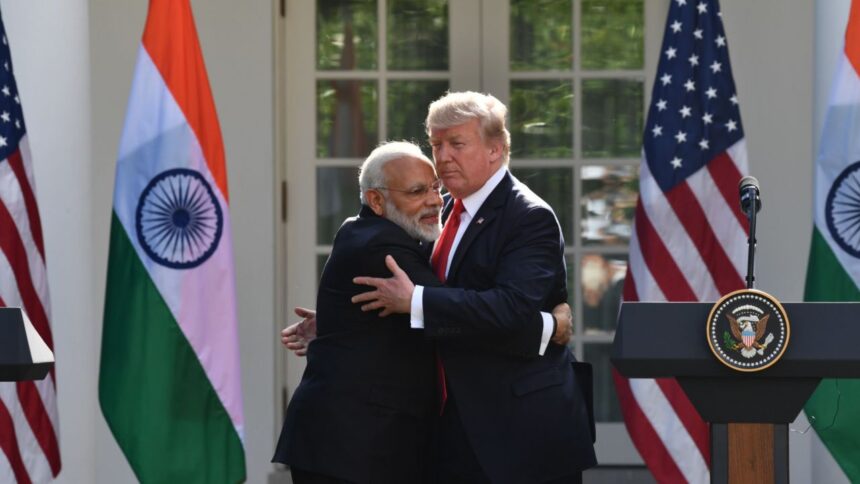
Prime Minister Narendra Modi has publicly acknowledged US President Donald Trump’s remarks describing their ties as “always friends,” offering a warm response that he “fully reciprocates” and “deeply appreciates” the sentiment. This exchange, coming at a time when India-US relations have been strained by fresh American tariffs on Indian imports, highlights the resilience of personal diplomacy between two leaders who have often projected a strong rapport on the global stage. PM Modi’s statement on social media platform X marks his first public recognition of Donald Trump since the imposition of additional trade duties on Indian goods, indicating an attempt to balance economic disagreements with diplomatic reassurance.
Donald Trump’s Praise Amid Trade Frictions
The backdrop to this exchange is one of heightened trade tensions. President Donald Trump, speaking to reporters at the White House, lauded PM Modi as a “great prime minister” and reaffirmed that he would “always be friends” with the Indian leader. Yet his praise was carefully qualified by frustration over ongoing disputes, particularly India’s policies on tariffs and energy trade. Donald Trump noted that while the India-US relationship remained “special,” he disapproved of “what PM Modi is doing at this particular moment.” His comments reflected the duality of US-India ties under his administration: an appreciation of strategic partnership and personal camaraderie with PM Modi, but an insistence on tougher trade terms that aligned with his America-first economic approach.
The trade dispute itself has escalated significantly over recent months. In August, Donald Trump’s administration announced a 25 per cent tariff on Indian imports, citing concerns over India’s purchase of Russian oil, and shortly thereafter followed up with an additional 25 per cent duty, bringing the effective tariff burden to 50 per cent. These moves were framed as punitive measures against New Delhi’s continued economic engagement with Moscow despite Western sanctions, and they represented one of the sharpest challenges in bilateral relations since Donald Trump took office. For India, the response was swift and categorical: New Delhi dismissed the tariffs as “unjustified” and accused Washington of selectively targeting it for maintaining a pragmatic trade relationship with Russia. This exchange underscored the delicate balance India has attempted to strike between its traditional partnerships with Russia, its growing ties with China through forums like the Shanghai Cooperation Organisation, and its expanding strategic cooperation with the United States.
Donald Trump’s public remarks on social media added another layer of controversy. On Truth Social, he suggested that the United States risked “losing India” to “deepest, darkest China,” a pointed reference to the recent display of bonhomie between PM Modi, Chinese President Xi Jinping, and Russian President Vladimir Putin during a summit of the SCO in Tianjin. Donald Trump’s assertion that India might be gravitating toward Beijing and Moscow was a stark warning, though one that New Delhi chose not to directly engage with. By refusing to respond to the suggestion, India avoided escalating rhetorical tensions while still reaffirming, through PM Modi’s subsequent statement, the importance of a positive and forward-looking partnership with the United States.
PM Modi’s Diplomatic Response
Prime Minister Modi’s reaction was both measured and strategic. His post on X emphasized that India and the United States share a “very positive and forward-looking comprehensive and global strategic partnership,” language that pointed to the breadth and depth of the relationship beyond short-term trade disputes. By affirming that he “fully reciprocates” Donald Trump’s positive sentiments, PM Modi framed the conversation not in the language of grievance but in that of continuity and commitment. The choice of words like “comprehensive” and “global” also reflected New Delhi’s understanding of the relationship as extending across defense, technology, climate cooperation, and multilateral engagement, not limited to the narrow lens of tariffs or bilateral trade balances.
This approach is consistent with PM Modi’s broader diplomatic strategy. Throughout his tenure, he has sought to personalize India’s global partnerships by cultivating strong leader-to-leader ties, whether with Donald Trump during his presidency, President Joe Biden in the current context, or other world leaders such as Japan’s Shinzo Abe, Russia’s Vladimir Putin, and France’s Emmanuel Macron. In the case of Donald Trump, the relationship was particularly visible, from massive rallies such as “Howdy Modi” in Houston and “Namaste Trump” in Ahmedabad to joint statements emphasizing democratic values and shared strategic goals. PM Modi’s decision to reciprocate Donald Trump’s latest comments despite the tariff dispute suggests a desire to maintain goodwill with him personally, even as India navigates the complexities of US foreign policy.
The framing of the US-India partnership as “forward-looking” is also significant. It signals PM Modi’s intent to keep the relationship oriented toward future cooperation in areas such as defense collaboration, supply-chain resilience, clean energy, and digital innovation, rather than allowing present disagreements over tariffs to define the narrative. This kind of reassurance matters not only for Donald Trump as an individual but also for broader American policymakers and business stakeholders who view India as an indispensable partner in the Indo-Pacific. In positioning the relationship as resilient, PM Modi is also sending a message to domestic audiences that India can weather temporary trade shocks without undermining its long-term strategic objectives.
Donald Trump’s assertion that India may be moving closer to China also complicates the picture. While it is true that India participates actively in multilateral organizations alongside China and Russia, New Delhi has simultaneously deepened its defense and economic ties with Washington. For instance, the Quad grouping with the US, Japan, and Australia remains a cornerstone of India’s Indo-Pacific strategy, while defense purchases such as advanced aircraft, drones, and missile systems underscore the mutual trust in security cooperation. PM Modi’s refusal to engage directly with Donald Trump’s China-related rhetoric reflects an awareness that public disputes over alignments could undermine India’s carefully calibrated foreign policy, which rests on the principle of strategic autonomy.
The situation also illustrates the enduring importance of leader-level diplomacy in managing turbulence in bilateral ties. By focusing on positive statements and avoiding open confrontation, PM Modi has kept the door open for future engagement even as both countries contest each other’s trade decisions. This diplomatic balancing act reflects India’s broader international posture, where economic disagreements with key partners do not necessarily derail cooperation in other domains.
In a larger sense, the PM Modi-Donald Trump exchange is emblematic of the multi-dimensional nature of India-US relations. The relationship cannot be reduced simply to trade disputes or tariff wars, nor can it be understood purely in terms of personal camaraderie between leaders. It is instead a tapestry woven from shared democratic values, converging strategic interests, economic complementarities, and, at times, hard bargaining over specific issues. PM Modi’s statement acknowledges this complexity while signaling that India values continuity and partnership over short-term discord.