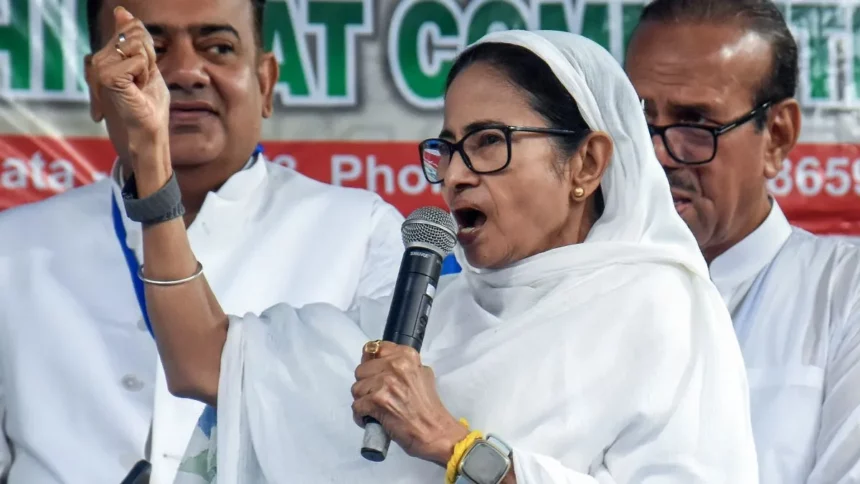
West Bengal Chief Minister Mamata Banerjee used an Eid gathering on Kolkata’s Red Road on March 22 to turn a religious and social occasion into a direct political confrontation with Prime Minister Narendra Modi, accusing him of hypocrisy on Muslims and calling him the “bigger infiltrator” in the context of voter roll politics. Her remarks were closely tied to the ongoing Special Intensive Revision, or SIR, of electoral rolls in Bengal, an exercise that has already become one of the most charged issues ahead of the state elections. By framing the controversy as a fight to protect voting rights, democratic inclusion, and Bengal’s social fabric, Mamata was not simply attacking the BJP rhetorically; she was trying to convert administrative anxiety over the voter list into a broader political narrative of exclusion and resistance. Reports from the event say she told the audience that many names had been deleted and that she had moved the Calcutta High Court and the Supreme Court over the issue.
Mamata turns voter roll controversy into a larger political message
Mamata Banerjee’s intervention matters because the dispute over the electoral rolls is no longer a technical matter of revision and scrutiny. It has become a central political battlefield in Bengal. The Election Commission’s SIR process is part of a wider exercise it says is meant to strengthen the purity and accuracy of electoral rolls by identifying duplicate, shifted, dead, or ineligible entries, with appeals and adjudication mechanisms built into the system. The ECI’s own presentation on SIR says such revisions are legally grounded and intended to ensure that no eligible citizen is left out while no ineligible person is included.
But in Bengal, the scale and timing of the exercise have turned it into a source of deep political suspicion. According to a March 18 report, more than 60 lakh names had been placed under adjudication in the February 28 voter list, even as 1.9 lakh new voters were added, taking the state’s total electorate to 6.44 crore. The same report said hundreds of judicial officers had been engaged in the adjudication process and that a supplementary list was expected by the end of that week.
That is the setting in which Mamata delivered her attack. At Red Road, she argued that the rights of ordinary people, especially minorities, were being threatened through deletions from the voter list, and she cast herself as the defender of those rights. The Indian Express reported that she said she would continue to stand by the people of Bengal across religions, castes, and communities, while accusing Modi of behaving one way with Muslims abroad and another way at home.
Her use of the word “infiltrator” was especially sharp because it reversed one of the BJP’s most politically loaded terms. Rather than accept the BJP’s language around illegal entry and suspicious voters, she turned it back on Modi to suggest that the real intrusion was political and constitutional: an attempt to interfere with the rights and status of Bengal’s people. Whether that charge is fair or excessive, it was clearly crafted to energise minority voters and to widen concern among all those worried about disenfranchisement.
SIR, minority outreach and the Bengal election frame
The choice of an Eid gathering for this intervention was politically deliberate. It allowed Mamata to speak directly to a community that could feel especially vulnerable in a debate involving voter verification, “infiltrator” rhetoric, and identity-based polarisation. At the same time, her message was broader than minority outreach alone. She described the coming election as a test of Bengal’s inclusive ethos and said she hoped all people of Bengal would remain included in the rolls regardless of caste, community, or creed, according to the reported remarks.
This is important because the SIR dispute may resonate beyond one voter bloc. If large numbers of people believe genuine names are being wrongly scrutinised, delayed, or excluded, the issue can quickly become one of administrative trust rather than just partisan messaging. Mamata and the Trinamool Congress appear to understand that. Their strategy seems to be to frame the electoral roll exercise not as neutral scrutiny, but as a politically tilted process that could alter representation itself.
The ECI, for its part, maintains that SIR includes notices, hearings, claims, objections, and appeals, and that eligible voters should not be harassed. Its published material states that district magistrates hear first appeals and chief electoral officers hear second appeals, while volunteers are meant to help vulnerable groups. Even so, the sheer volume of adjudication in Bengal has created space for political alarm, especially in a poll-bound state.
That is why Mamata’s speech is significant beyond its headline-grabbing language. It shows how a procedural election-management exercise can become a high-voltage campaign issue when public trust is weak and political stakes are high. Her remarks also indicate that she intends to make voter rights one of the central moral themes of the Bengal contest, alongside social harmony and federal resistance to central power.
The opposition response has been predictably fierce. In the report you shared, BJP leader Suvendu Adhikari attacked Mamata for calling the Prime Minister an infiltrator. That exchange is likely to deepen the polarisation around the issue rather than calm it. In the immediate term, the political question is not whether the rhetoric was extreme, but whether it succeeds in persuading voters that the battle over names on the rolls is really a battle over belonging, dignity, and democratic power.