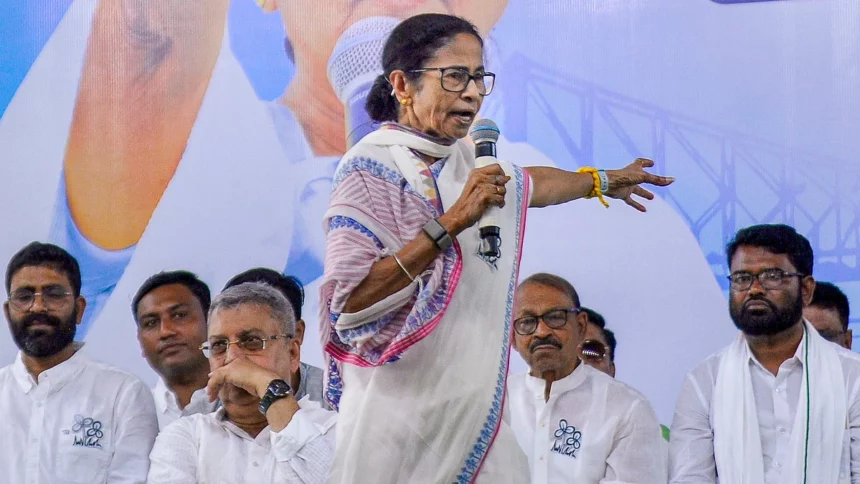
A fresh political confrontation has emerged in West Bengal as Chief Minister Mamata Banerjee accused the Bharatiya Janata Party (BJP) and the Election Commission of India (ECI) of selectively targeting Trinamool Congress (TMC) leaders, intensifying the already heated atmosphere ahead of the state’s election cycle.
The controversy escalated after Mamata Banerjee alleged that central forces and election authorities were conducting biased checks and actions against TMC leaders while ignoring similar scrutiny of opposition figures. The allegations come amid a broader political conflict in West Bengal, where tensions between the ruling TMC and BJP have sharply increased in the run-up to the 2026 assembly elections. Banerjee claimed that such actions were part of a coordinated attempt to weaken her party’s organisational strength and influence voter perception. The Election Commission has not issued a detailed response to these specific allegations, though it has consistently maintained that security and enforcement actions during elections are based on intelligence inputs and standard protocols. The BJP has rejected the accusations, stating that law enforcement agencies are acting independently to ensure free and fair elections. The issue has further deepened political polarization in the state, where both parties have been trading allegations over governance, security, and electoral fairness.
Rising Political Tensions Over Alleged Selective Targeting
The latest dispute centers on allegations made by TMC leaders that their vehicles and movements are being disproportionately monitored by central forces deployed during election-related operations. Mamata Banerjee has repeatedly claimed that such checks are politically motivated and aimed at intimidating opposition leaders ahead of polling. She further argued that the Election Commission is not acting impartially, and that enforcement actions are being selectively applied.
TMC leaders have echoed similar concerns, stating that senior party figures are being subjected to repeated inspections and surveillance, while opposition leaders are not facing equivalent scrutiny. These claims have intensified the political narrative in West Bengal, where accusations of misuse of central agencies have been a recurring theme in electoral politics.
On the other hand, BJP leaders have dismissed these allegations, accusing the TMC of attempting to deflect attention from internal governance issues and corruption allegations. They maintain that security protocols are being followed uniformly and that enforcement agencies are acting on specific inputs related to illegal cash movement and election violations.
Election Commission and Institutional Neutrality Debate
The Election Commission has become a central point of political debate following the allegations. While the TMC has questioned its neutrality, the Commission has consistently maintained that its actions are guided by legal frameworks and election integrity requirements.
Officials involved in election management have stated that flying squads and central forces are deployed to prevent malpractice such as illegal cash transport, voter intimidation, and other electoral violations. These teams are instructed to conduct checks based on intelligence reports and operational necessity rather than political affiliation.
Despite these clarifications, opposition parties argue that the timing and pattern of enforcement actions raise concerns about selective targeting. This has led to renewed demands for greater transparency in the deployment of central forces and monitoring mechanisms during elections.
Broader Electoral Climate in West Bengal
The allegations come at a time when West Bengal’s political environment is already highly charged due to multiple overlapping issues including governance disputes, allegations of corruption, and debates over state identity. The upcoming assembly elections have intensified competition between TMC and BJP, both of which are seeking to consolidate their political base.
Political analysts note that such allegations are likely to continue as part of broader campaign strategies, where institutional actions often become part of political messaging. The situation reflects a deeper pattern of distrust between the ruling party in the state and central institutions, which has been a defining feature of West Bengal politics in recent years.
As election preparations continue, both sides are expected to escalate their political messaging, making issues of fairness, institutional neutrality, and governance central to the electoral debate.