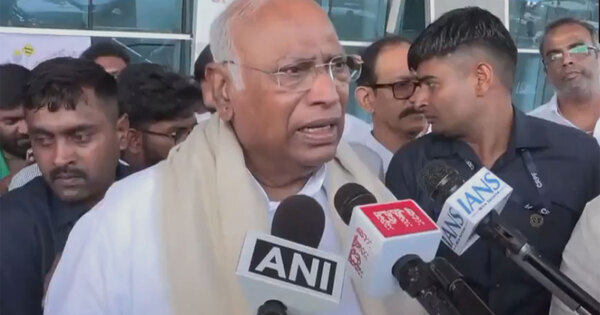
The political contest in Puducherry has intensified ahead of the 2026 Assembly elections, with Mallikarjun Kharge expressing strong confidence in a Congress-led victory. Speaking publicly, the Congress National President asserted that the party’s position remains robust not only in Puducherry but also in neighboring Tamil Nadu. His remarks come at a time when electoral campaigning is gaining momentum, and political narratives are being sharply contested between the opposition alliance and the ruling bloc led by the Bharatiya Janata Party.
Congress-DMK Alliance Projects Confidence and Targets Ruling Coalition
Mallikarjun Kharge emphasized that the Congress, in alliance with the Dravida Munnetra Kazhagam, is well-positioned to secure victory in both Puducherry and Tamil Nadu. He highlighted the alliance’s historical success, asserting that their electoral record in Tamil Nadu has consistently been strong. According to Kharge, this track record, combined with current political momentum, strengthens the prospects of forming a government in Puducherry through a coalition arrangement.
In his remarks, Kharge directly criticized Narendra Modi, stating that while the Prime Minister remains optimistic about his party’s prospects, the Congress believes it has the support of the people. This exchange reflects the broader political narrative shaping the elections, where both sides are projecting confidence while attempting to sway undecided voters.
During a public meeting in Puducherry, Kharge also targeted the ruling All India N R Congress-led coalition and its ally, the Bharatiya Janata Party. He accused them of misgovernance and alleged corruption, claiming that the administration has failed to meet public expectations. His speech focused on positioning the Congress alliance as a credible alternative capable of addressing governance challenges and restoring accountability.
A significant part of Kharge’s address was dedicated to the demand for full statehood for Puducherry. He argued that administrative interference by the Lieutenant Governor hampers the functioning of the elected government, thereby affecting governance and development. This issue has long been a point of political debate in the Union Territory and is likely to remain central to campaign discussions.
Governance Debate Deepens as BJP Counters Opposition Claims
The political discourse in Puducherry has further intensified with allegations and counter-allegations surrounding governance, development, and public welfare. Kharge raised concerns about rising corruption, alleging that promises of clean governance have not been fulfilled. He also pointed to issues such as the expansion of liquor outlets and increasing instances of drug abuse, framing them as indicators of administrative failure.
These criticisms form part of a broader opposition strategy aimed at highlighting governance gaps and mobilizing voter dissatisfaction. By focusing on everyday issues such as public health, law and order, and resource management, the Congress seeks to connect with voters on practical concerns that directly impact their lives.
In response, Prime Minister Narendra Modi defended the performance of the National Democratic Alliance government in Puducherry. He argued that opposition parties lack a clear vision for the Union Territory’s development and are more focused on political control than public welfare. His remarks emphasized the NDA’s development agenda, positioning it as forward-looking and aligned with the aspirations of the people.
Modi also accused opposition parties of attempting to use Puducherry for political gain, suggesting that their approach prioritizes centralized control over local governance. He contrasted this with what he described as the NDA’s commitment to empowering local leadership and delivering tangible progress under Chief Minister N Rangasamy.
This exchange of claims and counterclaims highlights the evolving narrative of the Puducherry elections, where governance, development, and political vision are central themes. As campaigning intensifies, both sides are likely to sharpen their messaging further, seeking to influence voter perception and consolidate support across key constituencies.