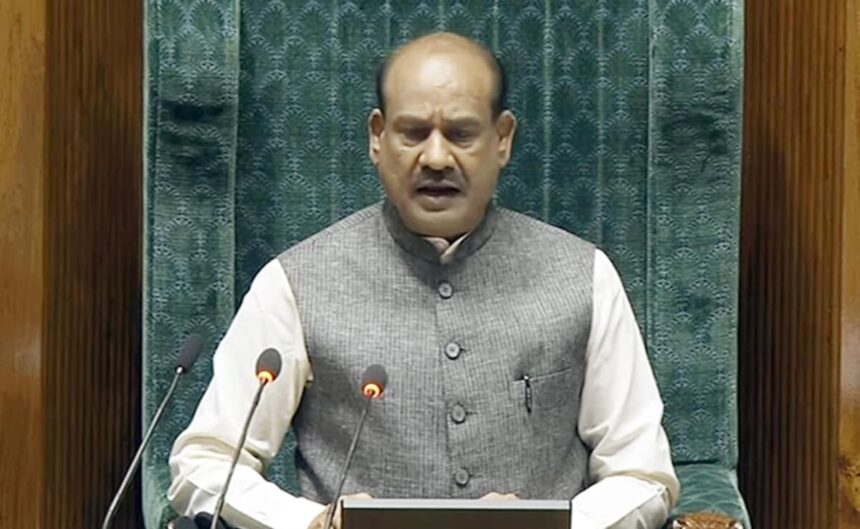
The fourth day of the second phase of Parliament’s Budget Session began with fresh disruptions in the Lok Sabha as opposition members raised slogans and protested over multiple issues. The House was adjourned till 12 noon within just two minutes of commencing proceedings amid loud uproar from opposition benches.
Speaker Om Birla returned to preside over the House and appealed to Members of Parliament to allow the proceedings to continue smoothly, especially during the Question Hour. Despite his repeated requests, opposition members continued their protests, forcing the House to be adjourned shortly after the session began.
The developments reflect the continuing standoff between the government and opposition parties during the ongoing Budget Session, which has witnessed frequent disruptions since the second phase began earlier this week.
Key issues driving the confrontation include rising LPG cylinder prices, allegations against the Election Commission, and broader political disagreements over parliamentary procedures.
Opposition protests and ongoing parliamentary tensions
As soon as the Lok Sabha convened at 11:00 AM, opposition members began raising slogans inside the House, expressing their dissatisfaction over several policy issues and alleged government inaction.
One of the primary issues raised by opposition parties is the recent increase in LPG cylinder prices, which they claim is placing an additional financial burden on households across the country.
Opposition leaders have demanded a detailed discussion on the issue, arguing that the rising cost of cooking gas and other essential commodities is affecting ordinary citizens.
Members of the opposition also staged protests within the Parliament premises earlier in the day. Leader of the Opposition in the Lok Sabha Rahul Gandhi joined Congress MPs in demonstrating against reports of shortages and price increases related to LPG cylinders.
During the session, Speaker Om Birla urged MPs to allow the Question Hour to proceed without disruption. He emphasised that the Question Hour is a crucial part of parliamentary functioning as it allows MPs to hold the government accountable and raise issues concerning the public.
“I request all honourable members to allow Question Hour to continue as it is an important time when the government is accountable and members can raise issues,” Birla said while addressing the House.
However, despite his appeal, the protests continued and the House was adjourned until noon.
The repeated disruptions have highlighted the deep political divisions between the ruling government and opposition parties during the current parliamentary session.
Motion against Chief Election Commissioner and political debate
Another issue that has intensified tensions in Parliament is the opposition’s plan to introduce a motion seeking the removal of Chief Election Commissioner Gyanesh Kumar.
Sources indicate that opposition parties have already gathered the required signatures from Members of Parliament to introduce the proposal in both the Lok Sabha and Rajya Sabha.
If formally presented, the motion could become a major political development as it would initiate a constitutional process similar to the removal procedure for a Supreme Court judge.
Opposition parties have alleged that the Election Commission has acted in ways that benefit the ruling government, particularly regarding the Special Intensive Revision (SIR) of electoral rolls.
They claim the voter list revision process could potentially lead to the removal of legitimate voters from electoral rolls in certain states.
The government and Election Commission have rejected these allegations, stating that voter list revisions are routine administrative exercises conducted to ensure accuracy and transparency in electoral rolls.
The motion to remove the Chief Election Commissioner, if introduced, could trigger extensive debate in Parliament regarding electoral processes and the functioning of constitutional institutions.
Debate over Speaker Om Birla and previous proceedings
The tensions in Parliament have also been linked to developments from the previous day’s proceedings.
On Wednesday, the Lok Sabha rejected a no-confidence motion against Speaker Om Birla through a voice vote.
The motion had been moved by opposition MPs who alleged that the Speaker had shown bias while conducting parliamentary proceedings.
According to opposition members, they were not given sufficient opportunities to speak during debates and discussions in the House.
Around 119 opposition MPs supported the motion, arguing that the Speaker’s decisions had limited their ability to raise important issues.
The debate over the motion lasted nearly 13 hours, during which several leaders from both sides presented their views.
Leader of the Opposition Rahul Gandhi claimed that he was interrupted repeatedly while attempting to speak in Parliament.
“Whenever we try to speak, we are interrupted,” Gandhi said while addressing the House during the debate.
Responding on behalf of the government, Home Minister Amit Shah delivered a detailed reply lasting nearly 56 minutes.
Shah criticised the allegations made by the opposition and defended the functioning of the Speaker.
He also took a personal swipe at Rahul Gandhi, remarking that the opposition leader is often travelling abroad when important parliamentary debates take place.
“Whenever the opportunity arises to speak, Rahul Gandhi is in Germany or England,” Shah said during his speech.
The government argued that the opposition’s allegations were politically motivated and aimed at disrupting parliamentary functioning.
Continued disruptions in Budget Session
The second phase of Parliament’s Budget Session began earlier this week and has already witnessed multiple disruptions.
On previous days as well, the Lok Sabha had to be adjourned several times due to protests by opposition members.
Apart from the LPG price issue and the Election Commission controversy, opposition parties have also raised concerns regarding energy shortages, the West Asia crisis and economic challenges.
External Affairs Minister S. Jaishankar recently addressed both Houses regarding the evolving geopolitical situation in West Asia and its potential impact on India.
He said that India remains in contact with countries in the region and continues to advocate a peaceful and negotiated resolution to the crisis.
Jaishankar also highlighted the government’s preparations to assist Indian citizens living in Gulf countries if the situation worsens.
The ongoing disruptions have raised concerns about the functioning of Parliament and the ability of lawmakers to conduct legislative business during the Budget Session.
Despite these challenges, both the government and opposition are expected to continue pushing their respective agendas in the coming days.
With several contentious issues on the parliamentary agenda, the Budget Session is likely to witness further heated debates and political confrontations in the days ahead.