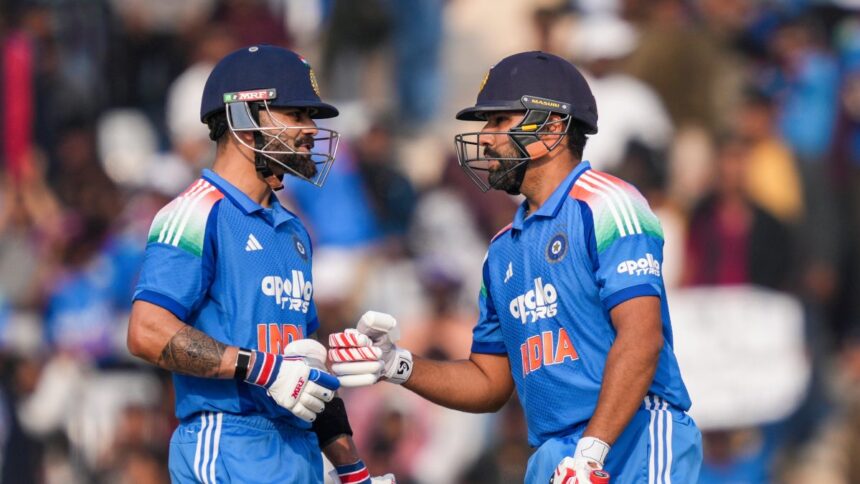
The Board of Control for Cricket in India has taken a decisive step toward reinforcing the importance of domestic cricket by directing all current Indian national team players to participate in at least two matches of the upcoming Vijay Hazare Trophy, a move that brings senior stars like Rohit Sharma and Virat Kohli back into the domestic fold and signals a broader shift in selection philosophy.
The Vijay Hazare Trophy, India’s premier 50-over domestic competition, is scheduled to begin on December 24. The timing of the tournament aligns with a three-week gap in the international calendar between India’s final T20 international against South Africa in Ahmedabad on December 19 and the opening one-day international against New Zealand on January 11, 2026. The BCCI views this window as an ideal opportunity for international players to represent their state teams, stay match-ready, and remain closely connected to domestic cricket.
The directive has been communicated to players by the national selection committee headed by Ajit Agarkar. It follows an internal review conducted after India’s underwhelming performance in the recent Test series in Australia, which prompted introspection within the board regarding preparation, workload management, and the perceived disconnect between senior internationals and domestic competitions.
Senior players return to domestic cricket under new BCCI directive
Under the new mandate, several of India’s most prominent cricketers are expected to don their state colours during the Vijay Hazare Trophy. Rohit Sharma and Virat Kohli, two of the most experienced and influential players in the Indian setup, have already confirmed their availability for the tournament. Their participation is being seen as a significant boost for the competition and a strong message about the value the board places on domestic cricket.
Other senior players, including Shubman Gill, Jasprit Bumrah, KL Rahul, Hardik Pandya, and Suryakumar Yadav, have also been instructed to play at least two matches for their respective state sides. The board has made it clear that this requirement is not optional, reinforcing the principle that international status does not exempt players from domestic commitments.
According to officials familiar with the discussions, the Vijay Hazare Trophy schedule includes six rounds between December 24 and the start of the New Zealand ODI series. Players, in consultation with their state associations, are free to choose which two rounds they wish to participate in, allowing some flexibility to manage workloads and travel.
However, the underlying message from the board is firm. After the second T20 international in Mullanpur, players were categorically informed that participation in the Vijay Hazare Trophy is compulsory unless there is a valid medical reason. Exceptions will only be granted if a player is declared unfit by the Centre of Excellence, the BCCI’s high-performance and medical assessment unit.
The decision also addresses perceptions that certain players were being singled out for scrutiny. In recent months, there had been speculation that only senior figures like Kohli and Rohit were being pressured to play domestic cricket. By issuing a blanket directive applicable to all national team players, the board has sought to dispel such notions and underline that the same standards apply across the board.
The only notable exception at present is Shreyas Iyer, who is still recovering from injury and requires additional time to regain full fitness. The board has acknowledged his situation and indicated that his case will be reviewed once he is medically cleared to return to competitive cricket.
This renewed emphasis on domestic participation stems from the belief that regular exposure to domestic conditions, pitches, and competitive intensity helps players maintain sharpness and adaptability. The internal review following the Australia Test series reportedly highlighted the need for senior players to engage more consistently with domestic cricket, particularly in longer formats where form and rhythm are crucial.
By ensuring that international stars share dressing rooms with domestic players, the BCCI also hopes to create an environment of mentorship and learning. Younger cricketers competing in the Vijay Hazare Trophy will gain invaluable experience from playing alongside established internationals, while senior players can stay grounded in the domestic system that serves as the foundation of Indian cricket.
Selection timelines, World Cup planning and Bumrah’s personal situation
Alongside the domestic participation directive, the BCCI is also preparing for key selection announcements early next year. India’s squads for the New Zealand T20 international series and the T20 World Cup are expected to be announced on the same day, likely in the first week of January.
According to sources within the board, the squad selected for the New Zealand T20 internationals will mirror the squad chosen for the T20 World Cup. This approach reflects the selectors’ intention to provide continuity and clarity, allowing players to prepare with a defined role and extended run rather than facing frequent changes.
The alignment of the two squads also suggests that the upcoming New Zealand series will be treated as a critical preparatory phase for the World Cup, offering selectors a final opportunity to assess combinations, form, and fitness under competitive conditions.
Meanwhile, fast bowler Jasprit Bumrah has temporarily stepped away from the ongoing T20 international series against South Africa due to personal reasons. Bumrah returned home ahead of the third T20I in Dharamsala after a close family member was hospitalised. The board has prioritised his personal situation, emphasising that his family’s well-being takes precedence over cricketing commitments.
Sources indicate that Bumrah could rejoin the squad for the fourth or fifth T20 international, including the final match in Ahmedabad, if circumstances permit. However, no definitive timeline has been set, and the decision will depend entirely on developments at home.
The handling of Bumrah’s situation underscores the board’s attempt to strike a balance between professional expectations and personal considerations. While the broader directive on domestic cricket participation is firm, the BCCI has reiterated that genuine medical or personal emergencies will always be treated with sensitivity and flexibility.
Taken together, these developments reflect a period of recalibration in Indian cricket administration. The emphasis on domestic cricket, combined with clear selection timelines and a focus on uniform standards, points to a more structured and accountable approach as the team prepares for major international assignments in 2026.
The return of high-profile players like Rohit Sharma and Virat Kohli to the Vijay Hazare Trophy is likely to draw increased attention to the tournament, benefiting broadcasters, state associations, and fans alike. More importantly, it reinforces the message that domestic cricket remains central to India’s cricketing ecosystem, regardless of a player’s stature on the international stage.
As the Vijay Hazare Trophy gets underway and selection decisions loom, the coming weeks promise to be a defining phase for players seeking to cement their places in India’s plans, whether through international performances, domestic consistency, or a combination of both.