In recent weeks, reports have emerged that Libya’s National Security Adviser Ibrahim Dbeibah, a close relative of Prime Minister Abdul Hamid Dbeibah, has been engaged in secretive negotiations with Israeli officials regarding a controversial plan that could fundamentally reshape the Palestinian issue and Libya’s own political trajectory. According to multiple Libyan, Arab, and European sources, the talks revolve around the possibility of resettling hundreds of thousands of Palestinians displaced from Gaza into Libya, with the promise of unlocking $30 billion in frozen Libyan assets held by the United States. The revelations, if confirmed, would underscore the increasingly complex interplay of geopolitics, economic interests, and humanitarian crises in the Middle East and North Africa region.
The negotiations are said to have been deliberately concealed from Libya’s parliament and the broader public, given the deep pro-Palestinian sentiment that runs through Libyan society. At stake are not only Libya’s internal stability and sovereignty but also broader questions about the rights of Palestinians, the legitimacy of Israel’s strategies in Gaza, and the role of the United States in shaping post-war arrangements. While Libyan officials have denied the existence of such a plan, evidence continues to surface suggesting that the talks, although preliminary, have already reached “practical” stages.
Secretive Negotiations, Economic Incentives, and the Shadow of Gaza
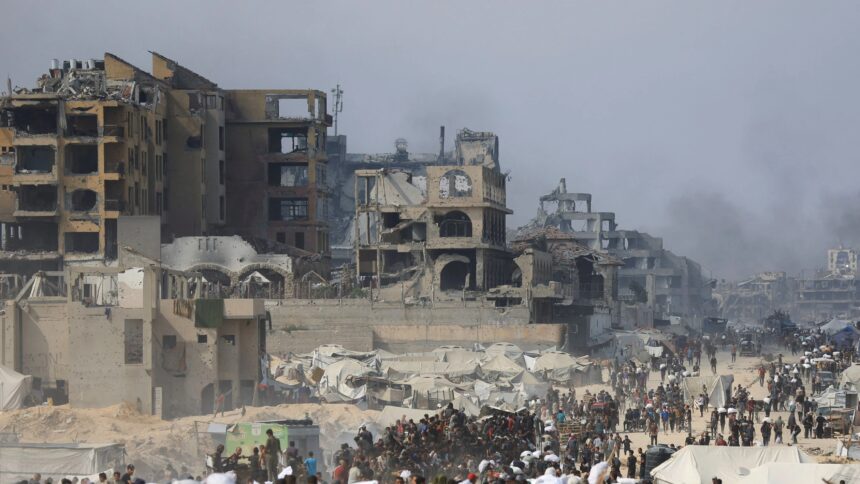
Sources speaking to Middle East Eye, under condition of anonymity due to the sensitivity of the subject, indicated that the talks were spearheaded by Ibrahim Dbeibah, who has quietly taken on the role of chief negotiator with Israel. These discussions reportedly began in the aftermath of heightened international pressure on Israel following its military operations in Gaza, which displaced hundreds of thousands of civilians. Israeli leaders, including Prime Minister Benjamin Netanyahu, have increasingly spoken openly about relocating Palestinians to third countries, framing the initiative as a humanitarian measure rather than a forced expulsion. Critics, however, see it as a direct violation of international law, particularly Article 49 of the Fourth Geneva Convention, which prohibits the forcible transfer of protected populations by an occupying power.
One Libyan source described the negotiations as already having entered “practical talks,” though without clear mechanisms or timelines. Another suggested that discussions were deliberately being kept away from Libya’s legislative structures to avoid an immediate public backlash. The secrecy reflects the volatile nature of Libyan politics, where factions aligned with different power centers—Tripoli’s Government of National Unity (GNU) on one side and General Khalifa Haftar’s eastern administration on the other—vie for influence while balancing international interests.
The reported incentives are significant. According to multiple accounts, the United States has promised to release approximately $30 billion in frozen Libyan assets, originally sanctioned in 2011 during the final months of Muammar Gaddafi’s rule. These funds, locked under international sanctions, have long been a source of frustration for successive Libyan administrations. The potential unlocking of these assets provides a powerful lure for a government struggling with legitimacy, governance, and the dire economic realities of post-civil war Libya.
Massad Boulos, an adviser to former U.S. President Donald Trump and father-in-law to Trump’s daughter Tiffany, has been named in earlier reports as a participant in related financial discussions, though he has denied any involvement in resettlement talks. White House officials, meanwhile, have suggested that Trump has long supported “creative solutions” to the Palestinian issue, including relocation to third countries under the promise of rebuilding Gaza afterward.
Despite these assurances, the plan has ignited outrage among Palestinian groups, who see any resettlement scheme as an extension of Israel’s ethnic cleansing strategy. For Palestinians, displacement to Libya—a country already fractured by civil war and political instability—would mean moving from one form of existential precarity to another.
Libya’s Fragile Politics, U.S. Leverage, and Israel’s Expulsion Strategy
The broader context of these talks is as important as the reported details. Libya remains a nation divided, with Prime Minister Abdul Hamid Dbeibah heading the internationally recognized GNU in Tripoli, while Khalifa Haftar exerts control in the east through his Libyan National Army and a rival parliament. Both men are said to have engaged in conversations with Israeli intermediaries, with each seeking to curry favor with the United States in exchange for concessions that could bolster their domestic and international standing.
For Haftar, reports suggest that Israel or its allies may have offered greater access to Libya’s lucrative oil reserves in return for cooperation in a resettlement plan. Although Haftar has publicly denied these claims, the mere suggestion of his involvement reflects the extent to which foreign powers are exploiting Libya’s fractured state to push geopolitical agendas. For Abdul Hamid Dbeibah, whose government has faced legitimacy crises and accusations of corruption, the unlocking of billions in frozen funds would provide both immediate financial relief and an opportunity to consolidate power.
The Libyan public, however, remains overwhelmingly sympathetic to the Palestinian cause, viewing their plight through a lens of shared struggle against foreign domination and displacement. Analysts warn that any perceived complicity in an Israeli-driven resettlement plan would ignite widespread unrest in Libya. As Mohamed Mahfouz, a Libyan political analyst, told MEE, “Accepting Palestinians could come at a high price for any of the parties that will engage with the United States on this matter.”
Internationally, the idea of resettling Palestinians in Libya feeds into a broader narrative advanced by some Israeli officials. Agriculture Minister Avi Dichter recently described Libya as “the ideal destination” for Palestinians, pointing to its vast land and Mediterranean coastline as parallels to Gaza. Netanyahu himself has argued that countries concerned about Palestinian welfare should “open their doors” to them, portraying Israel’s actions as facilitation rather than forced expulsion. This rhetoric, however, is widely dismissed as disingenuous by critics, who note the historical continuity of Israeli leaders advocating for the displacement of Palestinians since the state’s founding.
Compounding the controversy is the potential humanitarian fallout. Libya, already scarred by years of civil war, fractured governance, and a broken infrastructure, is ill-equipped to absorb a massive influx of refugees. Experts fear that Palestinians resettled in Libya would face marginalization, lack of state support, and eventual desperation, pushing many to attempt perilous migrations across the Mediterranean toward Europe. The image of Palestinian refugees drowning in overloaded boats, echoing the tragedies of Syrian migrants in recent years, looms as a chilling possibility.
Furthermore, Europe, already strained by waves of migration, is unlikely to welcome a sudden influx of hundreds of thousands of Palestinians. The prospect of new migration crises could destabilize EU politics further, fueling the rise of far-right movements and deepening divisions over asylum policies.
Against this backdrop, the U.S. role becomes increasingly pivotal. By tying the release of frozen Libyan assets to Palestinian resettlement, Washington risks being perceived as complicit in an ethnic cleansing plan dressed up as humanitarian relocation. While U.S. officials have denied pursuing such a scheme, the steady drip of revelations suggests that powerful actors within or aligned with Trump’s orbit see Libya as a bargaining chip in the Palestinian question.
The diplomatic fallout is equally concerning. Libya does not officially recognize Israel, and past revelations of secret meetings between Libyan and Israeli officials have already sparked outrage. In 2023, for instance, then-Foreign Minister Najla al-Mangoush was suspended after it was revealed she had met Israeli Foreign Minister Eli Cohen in Italy, reportedly under direct orders from Prime Minister Abdul Hamid Dbeibah. The controversy ignited mass protests and exposed the fragility of any attempt to normalize ties with Israel behind closed doors.
For Palestinians, the plan represents yet another betrayal by regional and international actors. Displacement to Libya would mean uprooting survivors of bombardments in Gaza and depositing them into a country where governance is fractured, armed militias wield power, and institutions are unable to provide even basic services to citizens. Far from a solution, the resettlement scheme threatens to compound their suffering, pushing them further into statelessness and despair.