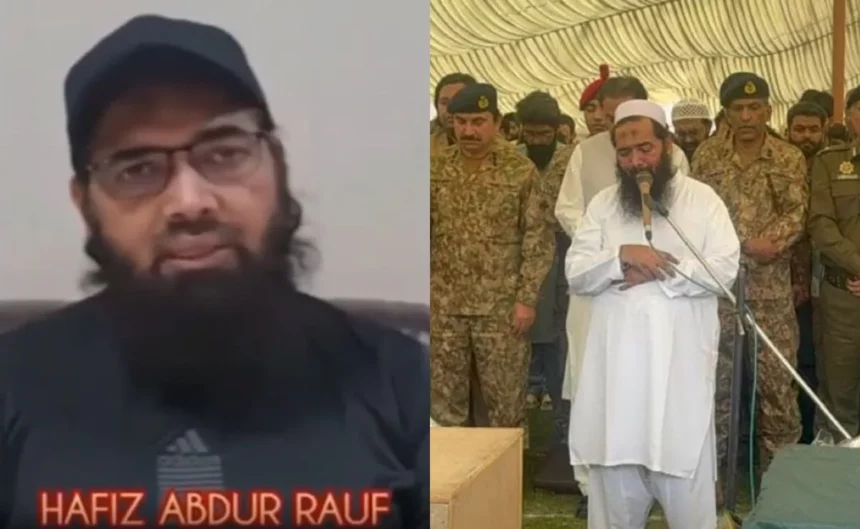
A resurfaced video of Pakistan-based Lashkar-e-Taiba commander Hafiz Abdul Rauf has triggered widespread concern after he issued inflammatory threats against India, claiming Pakistan has taught India a lesson and warning that New Delhi would not dare to retaliate for decades.
The video, recorded in November last year but now widely circulating on social media, features Hafiz Abdul Rauf delivering an aggressive and ideologically charged speech. In it, he invokes extremist slogans, glorifies violence, and asserts that Lashkar-e-Taiba’s long-term objective is to rule Delhi and impose a system of governance based on Sharia. Rauf’s remarks, couched in religious and militant rhetoric, have drawn attention not only because of their content but also due to his long-standing links with some of the most notorious terror figures operating from Pakistan. Indian security analysts view the renewed circulation of the video as part of a broader attempt to revive militant propaganda amid heightened regional tensions.
Rauf claims that Pakistan has effectively deterred India through recent military developments and operations, boasting that India’s armed forces, including the Indian Air Force, would not dare enter Pakistani airspace. He repeatedly emphasizes Pakistan’s status as the only Islamic nuclear power, presenting it as a shield behind which militant groups can continue issuing threats. His speech reflects a familiar pattern of extremist messaging aimed at projecting strength, denying India’s military capabilities, and sustaining ideological motivation among followers.
Extremist rhetoric, Kashmir claims, and denial of India’s military strength
In the video, Abdul Rauf rejects assertions that terrorism has declined in Jammu and Kashmir, insisting instead that the conflict is far from over and will intensify further. He dismisses reports suggesting improved security conditions in the region, asserting that those who believe the Kashmir issue has been settled are mistaken. According to Rauf, militant groups remain committed to escalating violence, framing their activities as part of a broader ideological and territorial struggle.
Rauf repeatedly references the concept of Ghazwa-e-Hind, an apocalyptic narrative often invoked by extremist groups to justify violence against India. He claims that their ultimate goal is to overthrow the existing system and establish Islamic rule in Delhi. In doing so, he cites Abdul Rehman Makki, Lashkar-e-Taiba co-founder and brother-in-law of Hafiz Saeed, portraying him as an ideological guide whose vision continues to inspire the group even after his death from a heart attack last year.
The Lashkar commander also attempts to downplay India’s military capabilities, stating that advanced assets such as Rafale fighter jets, the S-400 missile defense system, and drones are ineffective. He asserts that after what he calls Operation Sindoor, India would not dare to attack Pakistan for the next 50 years. Such claims are widely viewed as propaganda designed to boost morale among militants rather than an objective assessment of military realities.
Security experts note that this rhetoric follows a familiar script, blending exaggeration, religious symbolism, and selective references to geopolitical events. By framing Pakistan as an invincible power and India as a restrained adversary, Rauf seeks to reinforce the narrative that militant groups continue to operate with ideological legitimacy and strategic confidence.
Pakistan’s response, Rauf’s background, and earlier Lashkar threats
Abdul Rauf has been associated with Lashkar-e-Taiba since 1999 and currently heads the Falah-e-Insaniyat Foundation, an organization that has been accused of acting as a front for militant activities. He is a close associate of Lashkar founder Hafiz Saeed and has been sanctioned by the United States for his involvement in terrorism-related activities. Despite this, Pakistan has repeatedly attempted to distance itself from him in public statements.
After reports emerged of Rauf attending funerals of terrorists killed in Indian air strikes, the Pakistani army sought to portray him as a “common man.” Following India’s air strikes on terror hideouts during Operation Sindoor on May 7, Rauf was seen offering funeral prayers for slain militants alongside Pakistani officers. When questioned, Pakistan army spokesperson Ahmed Sharif Chaudhry claimed that the individual leading the prayers was merely a cleric associated with the Pakistan Markazi Muslim League. He even shared personal details such as the man’s identity number and date of birth, which, however, matched exactly with the information listed for Hafiz Abdul Rauf on the US Specially Designated Nationals and Blocked Persons list.
The resurfaced video of Rauf is not an isolated instance. In recent months, several Lashkar leaders and operatives have released similar threatening messages. Lashkar deputy chief Saifullah Kasuri, identified as the mastermind of the Pahalgam attack, had earlier issued threats against India and Prime Minister Narendra Modi. In a video released in September, Kasuri urged Pakistan army chief Asim Munir to teach India a lesson, echoing the same militant bravado seen in Rauf’s speech.
Kasuri has also blamed India for natural disasters in Pakistan, including floods, and has repeatedly threatened violence, stating that every action by India would be answered with greater force. In one such message, he declared that a brick would be answered with a stone, vowing revenge for every perceived injury. In other videos, Kasuri went further, openly threatening to wipe out Hindus from India and proclaiming the eventual establishment of Islamic rule across the country.
Images and videos circulating online have also shown Pakistani army officers welcoming Kasuri with flowers, raising further questions about the relationship between militant groups and elements within Pakistan’s security establishment. These visuals, combined with repeated attempts to downplay or deny the identities of known extremists, have fueled international criticism and reinforced long-standing concerns about Pakistan’s approach to terror networks operating from its soil.
As the video of Abdul Rauf continues to circulate, Indian authorities and analysts view it as another reminder of the persistent ideological threat posed by groups like Lashkar-e-Taiba. While such statements are often dismissed as propaganda, their recurrence underscores the enduring challenge of extremist messaging in the region, particularly when it is amplified through social media platforms long after it was originally recorded.