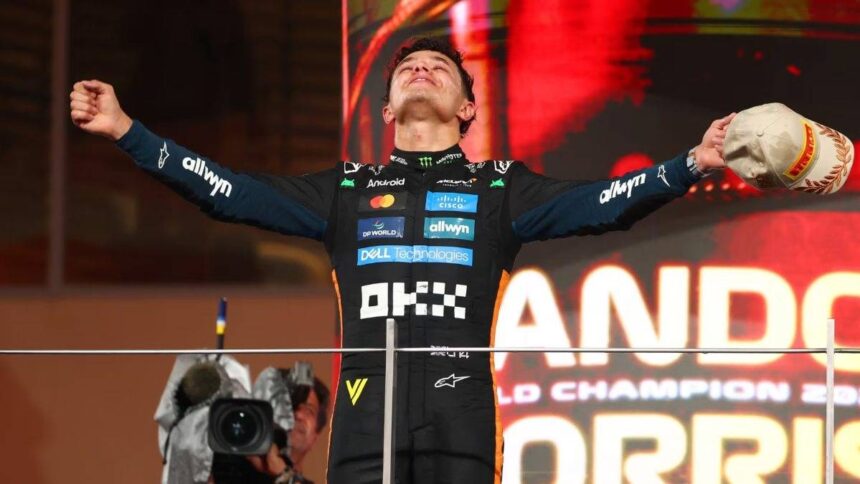
In one of the most gripping title finales in modern Formula One history, McLaren’s Lando Norris clinched his maiden world championship after finishing third in the Abu Dhabi Grand Prix, a race that tested not only his driving ability but also his composure under extraordinary pressure. Although Max Verstappen won the race and Oscar Piastri crossed the line second, Norris secured enough points to protect his narrow advantage in the standings, emerging as the 2025 Formula One World Champion by a margin of just two points. What unfolded under the lights of Yas Marina was a masterclass in strategy, mental control and precision driving, culminating in a triumph that marked a symbolic shift in the competitive dynamics of the sport.
A Season Finale Filled With Tension, Strategy and High-Stakes Wheel-to-Wheel Drama
From the moment the cars lined up on the grid, the championship atmosphere crackled with tension. Norris entered the final race with a slim lead over Charles Leclerc and Max Verstappen, fully aware that even a small mistake could cost him the title. His objective was clear: stay within the top three and avoid unnecessary risks. But the Grand Prix unfolded in a manner that continually tested his judgement, forcing him to balance aggression with restraint.
Early in the race, Norris found himself battling with Yuki Tsunoda, who was under team orders to complicate the McLaren driver’s progress. Tsunoda’s weaving and defensive tactics pushed Norris to the limit, culminating in a controversial overtake in which Norris briefly ran off track. The stewards later reviewed the incident, eventually ruling Tsunoda at fault for improper defensive manoeuvres, a decision that removed a major cloud of uncertainty from Norris’ title fight.
Meanwhile, at the front of the pack, Verstappen drove a near-perfect race. Starting with fierce determination, he controlled the pace and executed his strategy flawlessly, making it clear that he intended to win the race regardless of the championship permutations. For Verstappen, victory was the only option for keeping his hopes alive. Yet even as he extended his lead, he knew that the outcome depended on where Norris would finish, not on his own performance alone.
Oscar Piastri added another layer of complexity by attempting an alternative strategy centred around an extended stint on hard tyres. For a brief period, the young Australian even led the race, showcasing both tyre management and raw pace. His strategy forced McLaren to remain alert as the race evolved, particularly because Piastri’s position also had implications for the final championship standings. Eventually, he yielded position to Verstappen after his long stint ended, settling into second place.
As the race reached its midpoint, the title scenario began to crystallise. Norris needed to hold position within the top three while Leclerc, who remained within striking distance, needed to finish ahead of Norris to deny him the championship. Ferrari recognised this opportunity and pushed Leclerc to maximise every lap, reducing the gap through controlled aggression.
The true drama erupted in the final twenty laps, when Leclerc began closing in steadily on Norris. Each sector of the Yas Marina Circuit told a different story: Leclerc gaining momentum on the straights while Norris defended expertly through the technical middle sector. The Ferrari pit wall sensed a final opportunity and urged Leclerc forward, hoping to pressure Norris into a mistake. But the McLaren driver remained steady, refusing to be rattled.
Those final laps transformed the track into a theatre of emotion. The cameras frequently cut to the McLaren garage, where engineers held their breath, and to Norris’ mother, Cisca, who watched the broadcast feed with her hands covering her eyes. Her anxious presence became an emblem of the emotional weight behind Norris’ long journey to the brink of a world championship.
Despite the relentless pressure from behind, Norris executed a flawless defensive drive. He maintained his pace, avoided errors and refused to risk the car unnecessarily. As Leclerc’s tyres began to fade, Norris extended the gap again, securing the breathing room he desperately needed.
The Making of a Champion: A Season Defined by Consistency, Growth and Unshakeable Mental Strength
Lando Norris’ 2025 championship was not the result of a single race but the culmination of a season defined by relentless consistency, strategic intelligence and exceptional adaptation to varied race conditions. While other title contenders saw their campaigns shaped by highs and lows, Norris focused on scoring solid points and avoiding costly mistakes. This approach—once seen as overly cautious—proved to be the decisive factor in a year when the margins between victory and defeat were razor thin.
Throughout the season, Norris demonstrated exceptional qualifying form, regularly placing his McLaren on the front rows. But what truly distinguished his campaign was his race management. Whether facing unpredictable weather, aggressive rivals or intricate strategic battles, he showed the maturity of a seasoned champion. His overtakes were calculated, his defensive driving measured and his communication with the team calm and clear.
McLaren’s role in this triumph cannot be overstated. The team delivered its most competitive car in years, bridging the performance gap to Red Bull and Ferrari through continuous upgrades. Strategic calls from the pit wall often placed Norris in advantageous positions, particularly in races where tyre degradation and safety cars altered the rhythm of the competition. The synergy between driver and team, built over several seasons of shared growth, blossomed fully in 2025.
Norris’ relationship with teammate Oscar Piastri also shaped the season. A rivalry defined by mutual respect, it brought out the best in both drivers. While Piastri pushed Norris with his raw speed, Norris countered with consistency and racecraft. Their clean on-track battles and collaborative feedback strengthened the team environment, contributing to McLaren’s rise as a top-tier force.
Off the track, Norris matured significantly as well. Once known primarily for his humour and youthful persona, he transformed into a composed competitor who embraced leadership roles within the team. His ability to stay focused under pressure was repeatedly evident, none more so than in the season finale where the weight of expectation could have easily unsettled a less resilient driver.
When Norris crossed the finish line in third place at Yas Marina, the McLaren garage exploded in celebration. Mechanics embraced, engineers applauded and team principal Andrea Stella could be seen wiping tears as the era of McLaren’s newest world champion officially began. Norris, emotional yet composed, absorbed the moment before thanking the team over the radio.
This victory also carries symbolic significance for Formula One. For years, the championship narrative was shaped by Verstappen’s dominance and Ferrari’s struggles to execute consistently. Norris’ title represents the emergence of a new contender capable of challenging the established hierarchy. It also signals McLaren’s full return to title-winning form after years of rebuilding and transition.
As the global motorsport community reacts, the consensus is clear: Lando Norris earned this championship not simply through speed but through resilience, intelligence and personal evolution. His triumph stands as a testament to how perseverance, even in the face of repeated near-misses, can culminate in historic achievement.