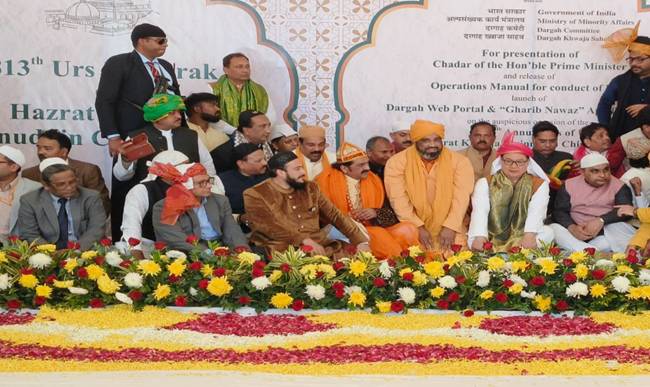
Union minister Kiren Rijiju on behalf of Prime Minister Narendra Modi presented a sacred chadar at the revered shrine of Khwaja Moinuddin Chishti Dargah, marking a spiritually significant moment during the annual Urs that celebrates the legacy of the great Sufi saint and his message of harmony, devotion, and inclusiveness.
The presentation of the chadar took place at Ajmer Sharif amid prayers and traditional rituals associated with the Urs, an occasion that draws devotees from across India and abroad. Representing the prime minister, Kiren Rijiju conveyed greetings and reverence to the shrine, underlining the enduring importance of Khwaja Gharib Nawaz in India’s spiritual and cultural landscape. The Urs commemorates the death anniversary of the Sufi saint and is widely regarded as a symbol of unity, where people from different faiths and backgrounds gather in shared devotion.
Alongside the ceremonial offering, the visit also marked the launch of several key initiatives aimed at improving facilities, accessibility, and overall convenience for pilgrims visiting the Dargah. These measures, announced during the event, reflect the government’s focus on combining respect for tradition with the use of modern technology to enhance the experience of millions of devotees who visit Ajmer Sharif every year.
Urs at Ajmer Sharif and the message of spiritual harmony
The Urs of Khwaja Moinuddin Chishti holds a special place in India’s spiritual calendar, as it commemorates a saint whose teachings emphasised love, service to humanity, and equality beyond religious or social boundaries. Every year, the Dargah in Ajmer becomes a focal point of devotion, welcoming pilgrims who come to offer prayers, chadars, and seek blessings. The event is not only religious in nature but also cultural, reflecting centuries-old traditions that continue to thrive in contemporary India.
During his address at the shrine, Kiren Rijiju highlighted the unique character of the Urs, describing it as an occasion that transcends divisions of faith and culture. He noted that the gathering of devotees from diverse backgrounds reinforces the inclusive values preached by Khwaja Moinuddin Chishti and strengthens the spirit of social harmony. By presenting the chadar on behalf of the prime minister, the government reaffirmed its respect for India’s pluralistic heritage and the role of Sufi traditions in promoting peaceful coexistence.
The presence of senior officials and representatives from the Dargah administration added to the significance of the event. The ceremony was conducted under the supervision of the Dargah Committee, Dargah Khwaja Saheb, with participation from representatives of the Sajjadanashin and both Anjumans of Khadims. Their involvement underscored the collaborative nature of arrangements for the Urs, which requires coordination between religious custodians and government authorities to ensure smooth conduct of rituals and pilgrim movement.
The Urs period typically witnesses a sharp increase in footfall, placing immense responsibility on organisers to manage crowds, security, healthcare, and sanitation. Against this backdrop, the minister’s visit was also an opportunity to review preparations and emphasise the importance of maintaining the sanctity of the shrine while ensuring the safety and comfort of devotees. The spiritual atmosphere of Ajmer Sharif during Urs, combined with administrative preparedness, remains central to the success of the event.
Digital initiatives and improved facilities for pilgrims
In conjunction with the ceremonial offering, Kiren Rijiju unveiled a set of initiatives designed to modernise pilgrim services at the Dargah. Among these was the release of the Operations Manual for Urs, a detailed document intended to guide the effective organisation of the annual event. The manual outlines protocols related to crowd management, security arrangements, healthcare services, emergency response, and sustainability measures, providing a structured framework for authorities involved in Urs management.
Another major step announced was the launch of the official Dargah web portal, aimed at serving as a comprehensive digital resource for pilgrims. The portal offers information about the shrine, schedules of Urs-related events, accommodation options, and other essential services. By centralising information online, the initiative seeks to reduce confusion among pilgrims and enable better planning of visits, particularly for those travelling from distant regions.
Complementing the web portal is the introduction of the “Garib Nawaz” mobile application, which further extends digital access to pilgrim services. The app is designed to provide real-time updates, important announcements, and guidance related to the Dargah and Urs activities. It also reflects a broader push towards transparency and accessibility, aligning with the government’s Digital India vision of using technology to deliver citizen-centric services.
Addressing the gathering, Kiren Rijiju stated that the introduction of these digital platforms was intended to preserve the sanctity of the Urs while ensuring a seamless and enriched experience for devotees. He emphasised that technology, when used thoughtfully, can support age-old traditions by making them more accessible and better organised without diluting their spiritual essence.
The event was attended by several dignitaries, including Bhagirath Choudhary, Minister of State for Agriculture and Farmers’ Welfare, and Chandra Shekhar Kumar, Secretary, Minority Affairs. Their presence highlighted inter-ministerial coordination in matters related to minority affairs, cultural heritage, and large-scale pilgrim management.
Collectively, the initiatives announced at Ajmer Sharif underscore the government’s commitment to preserving the legacy of Khwaja Gharib Nawaz while embracing technological advancements to better serve pilgrims. By combining traditional reverence with modern administrative tools, the efforts aim to ensure that the Urs continues to be a spiritually fulfilling and well-managed event for generations to come.