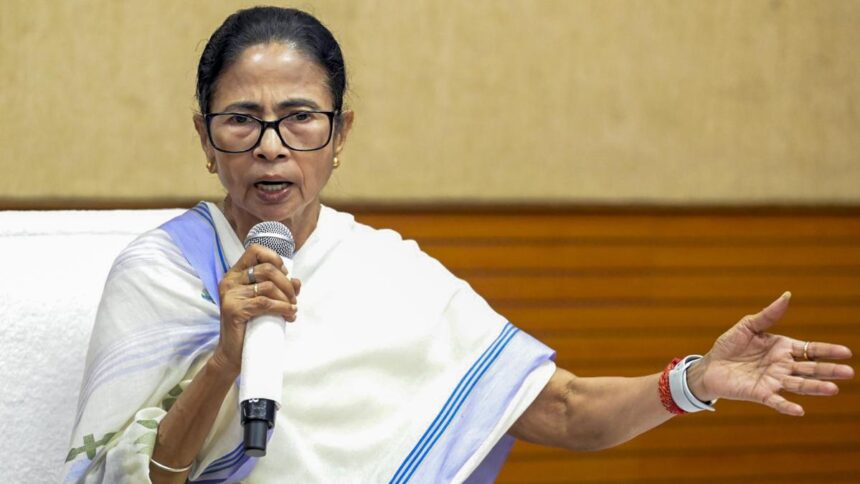
West Bengal Chief Minister Mamata Banerjee is preparing to convene a crucial meeting with booth-level agents of the Trinamool Congress in Kolkata, an interaction widely seen as politically significant amid growing controversy over the Special Intensive Revision of electoral rolls in the state.
The meeting, scheduled to take place on Monday at Kolkata’s Netaji Indoor Stadium, will bring together selected booth-level agents from several key Assembly constituencies in and around the city. Party insiders describe the gathering as part of a broader effort by the Chief Minister to directly engage with grassroots-level election workers at a time when the state’s electoral landscape is under intense scrutiny following the Election Commission’s recent exercise.
Special Intensive Revision and Political Mobilisation
According to senior leaders within the Trinamool Congress, the Chief Minister has called booth-level agents from 11 Assembly constituencies in Kolkata, along with representatives from selected constituencies in North 24 Parganas, South 24 Parganas, Howrah and Hooghly districts. These regions collectively represent a significant share of West Bengal’s urban and semi-urban electorate and are considered politically sensitive due to their dense population and competitive voting patterns.
The primary focus of the meeting is expected to be the situation arising from the Special Intensive Revision process undertaken by the Election Commission of India. The revision exercise, aimed at updating and cleaning electoral rolls, has triggered widespread debate across the state after the publication of the draft voters’ list in its first phase. Nearly 58.5 lakh names were reportedly dropped from the rolls, a figure that has raised serious questions among political parties, civil society groups, and voters themselves.
In percentage terms, the 11 Assembly constituencies in Kolkata have recorded the highest proportion of deleted names, a development that has placed the city at the centre of the ongoing controversy. The deletions include voters from Bhabanipur, the constituency represented by the Chief Minister herself, adding a personal and political dimension to the issue.
Mamata Banerjee had already met booth-level agents from Bhabanipur at her Kalighat residence last week, where she reportedly sought detailed feedback on the revision process and its impact at the ground level. During that interaction, she hinted that broader discussions would follow, signalling her intent to escalate the issue beyond individual constituencies. Monday’s meeting at the Netaji Indoor Stadium is seen as the next step in that direction, expanding the conversation to include a larger group of party functionaries who play a direct role in voter outreach and election-day operations.
Political observers believe that the Chief Minister’s emphasis on booth-level agents reflects her long-standing political style of relying on grassroots mobilisation. By directly addressing BLAs, she is expected to reinforce organisational discipline while also gathering first-hand accounts of how the SIR exercise has unfolded across different neighbourhoods. For the ruling party, this interaction is also an opportunity to craft a unified narrative around voter list revisions and to prepare its cadre for possible political and legal responses.
There is also speculation that the meeting could serve as a platform for Mamata Banerjee to sharpen her criticism of the Election Commission. Some observers suggest that she may question the timing, scope, and implementation of the SIR in West Bengal, especially in light of the scale of deletions reported in urban constituencies. While no official agenda has been made public, party leaders indicate that the Chief Minister is likely to emphasise vigilance, documentation, and outreach to affected voters.
Opposition Watch and Wider Political Implications
The political significance of Monday’s meeting extends beyond the Trinamool Congress. The opposition Bharatiya Janata Party is closely monitoring developments, viewing the Chief Minister’s interaction with booth-level agents as a signal of heightened political mobilisation ahead of future electoral contests.
Leader of the Opposition in the West Bengal Assembly and senior BJP leader Suvendu Adhikari is expected to be present in the Assembly premises around the same time. BJP sources indicate that he has summoned several party MLAs to the Assembly on Monday, suggesting parallel political activity that underscores the charged atmosphere surrounding the SIR issue.
The BJP’s Legislative Party is reportedly keeping a close watch on Mamata Banerjee’s speech at the Netaji Indoor Stadium, assessing both its tone and content. From the opposition’s perspective, the ruling party’s focus on the voter list revision is being viewed through the lens of accountability and institutional process. BJP leaders have argued that electoral roll revisions are a routine administrative exercise, while also accusing the Trinamool Congress of politicising the issue for electoral gain.
At the same time, a section of political analysts believes that the scale of deletions revealed in the draft voters’ list has created genuine concern among voters, cutting across party lines. In densely populated urban constituencies, even minor errors in voter lists can translate into large numbers of disenfranchised citizens. This reality has amplified the political stakes, making the Chief Minister’s engagement with BLAs a closely watched event.
For Mamata Banerjee, the meeting represents an opportunity to consolidate her party’s organisational strength while positioning herself as a defender of voter rights. Her past political messaging has often emphasised federal autonomy and resistance to what she describes as overreach by central institutions. In the context of the SIR exercise, these themes are expected to resurface, resonating with her core support base while also appealing to undecided voters concerned about electoral fairness.
The presence of both ruling and opposition leaders in high-profile engagements on the same day highlights the broader political churn in West Bengal. With Assembly elections still some time away, the current focus on electoral rolls underscores how preparatory processes themselves have become arenas of political contestation. The outcome of these debates, and the narratives that emerge from meetings like the one at the Netaji Indoor Stadium, are likely to shape public discourse in the months ahead.
As booth-level agents gather to hear directly from the Chief Minister, their role as intermediaries between the party leadership and ordinary voters will come into sharp focus. Their feedback, mobilisation efforts, and messaging are expected to play a crucial role in how the Trinamool Congress navigates the challenges posed by the SIR exercise and counters opposition criticism.