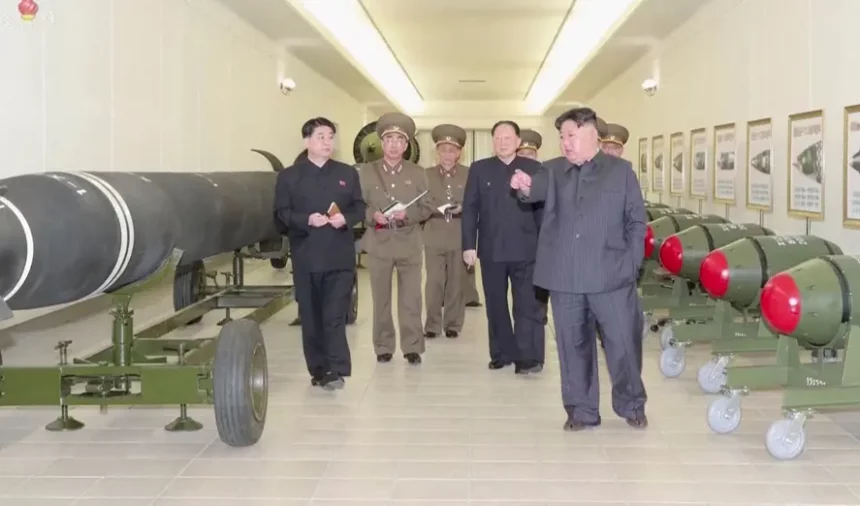
Kim Jong Un has strongly defended North Korea’s nuclear weapons programme, asserting that recent global conflicts highlight the importance of maintaining powerful military capabilities to ensure national security. Speaking during a parliamentary address in Pyongyang, Kim emphasized that countries without strong defence systems are vulnerable in today’s geopolitical environment. His remarks come amid rising global tensions and ongoing conflicts involving major powers. The statement reflects North Korea’s long-standing strategic doctrine. It also signals continued commitment to nuclear expansion.
Kim argued that the current global security environment, including tensions involving the United States and Israel, reinforces his country’s decision to strengthen its military capabilities. He stated that only nations with sufficient military strength can protect their sovereignty and independence. According to him, nuclear weapons provide a reliable deterrent against external threats. This position aligns with North Korea’s historical stance on defence policy. It also reflects its broader geopolitical calculations.
Military Strength and Nuclear Deterrence
Kim Jong Un stated that North Korea is now more secure due to its nuclear arsenal and can simultaneously focus on economic development. He emphasized that strengthening nuclear weapons and missile systems remains essential for national survival. The leadership views military power as the foundation of stability. This approach combines defence preparedness with long-term development goals. It reflects a dual strategy.
He also described the expansion of nuclear capabilities after the breakdown of diplomatic talks with Donald Trump in 2019 as a strategic decision. The failure of negotiations reinforced North Korea’s belief that self-reliance in defence is necessary. Kim described this move as one of the most effective steps taken by his leadership. It marked a turning point in policy direction. The country has since accelerated its missile development.
North Korea’s deterrence strategy is rooted in the belief that nuclear weapons prevent external intervention. The leadership often cites examples of countries that lacked such capabilities and faced regime change. This perspective shapes its security doctrine. It influences both domestic policy and international relations. The emphasis remains on maintaining a credible deterrent.
Hardline Stand on South Korea
Kim reiterated a strong stance against South Korea, describing it as the “biggest enemy” and warning of strict retaliation against any perceived threat. He stated that North Korea would not engage in dialogue unless its conditions are met. This reflects a hardened position in inter-Korean relations. The rhetoric signals reduced prospects for immediate reconciliation.
He also emphasized that any provocation would be met with a firm and decisive response. This warning is consistent with North Korea’s previous statements on national defence. The leadership aims to project strength and readiness. It also seeks to deter potential threats. The stance contributes to ongoing tensions in the region.
Relations between North and South Korea have remained strained despite periodic diplomatic efforts. The latest statements indicate a continuation of this trend. Analysts believe that such rhetoric is part of a broader strategic messaging. It reinforces North Korea’s position on regional security. The situation remains complex.
Expansion of Missile Capabilities
North Korea has significantly advanced its missile programme in recent years, developing a range of ballistic missiles capable of reaching various distances. The country has tested intercontinental ballistic missiles such as Hwasong-15, Hwasong-17 and Hwasong-18. These systems are believed to have ranges between 10,000 and 15,000 kilometres. This capability allows potential reach to parts of the United States.
Experts estimate that North Korea possesses a substantial number of ballistic missiles, including short-, medium- and long-range systems. While exact numbers remain uncertain, some assessments suggest the country may have dozens of nuclear-capable missiles. This expansion enhances its deterrence capabilities. It also raises concerns among the international community.
The development of advanced missile systems reflects North Korea’s focus on strengthening its defence infrastructure. Continuous testing and technological improvements indicate ongoing investment in military capabilities. This trend is likely to continue. It forms a key component of national strategy.
Self-Reliance and Economic Focus
Kim also highlighted the importance of building a self-reliant economy alongside military strength. He stated that economic development and defence are interconnected. A strong military ensures stability, which supports economic growth. This approach aligns with North Korea’s broader policy framework.
The leadership aims to balance defence priorities with domestic development. While sanctions and international pressure continue, the focus remains on internal resilience. Self-reliance is a central theme in policy decisions. It reflects the country’s approach to external challenges.
Kim emphasized that global developments justify North Korea’s strategic choices. He argued that maintaining strong defence capabilities is essential in an uncertain world. This perspective shapes the country’s long-term planning. It influences both economic and military policies.
Diplomatic Stalemate and Future Outlook
Efforts by the United States and its allies to persuade North Korea to abandon its nuclear programme have not yielded significant results. Diplomatic talks that began in 2018, including meetings between Kim Jong Un and Donald Trump, failed to produce lasting agreements. The breakdown of negotiations in 2019 marked a setback. Since then, progress has been limited.
North Korea has maintained that future negotiations are possible only if it is recognized as a nuclear power. This condition remains a major obstacle to dialogue. The lack of consensus has contributed to ongoing tensions. Diplomatic channels remain uncertain.
The current situation reflects a complex geopolitical landscape. North Korea’s continued emphasis on nuclear development indicates that its strategic priorities remain unchanged. The international community faces challenges in addressing the issue. The future of negotiations remains unclear.
Conclusion
Kim Jong Un’s latest statements reaffirm North Korea’s commitment to its nuclear programme and military expansion. By linking global conflicts to national security concerns, the leadership has justified its strategic direction. The emphasis on deterrence, self-reliance and military strength reflects a consistent policy approach. While diplomatic efforts continue, the path forward remains uncertain. The developments highlight ongoing tensions and the challenges of achieving stability in the region.