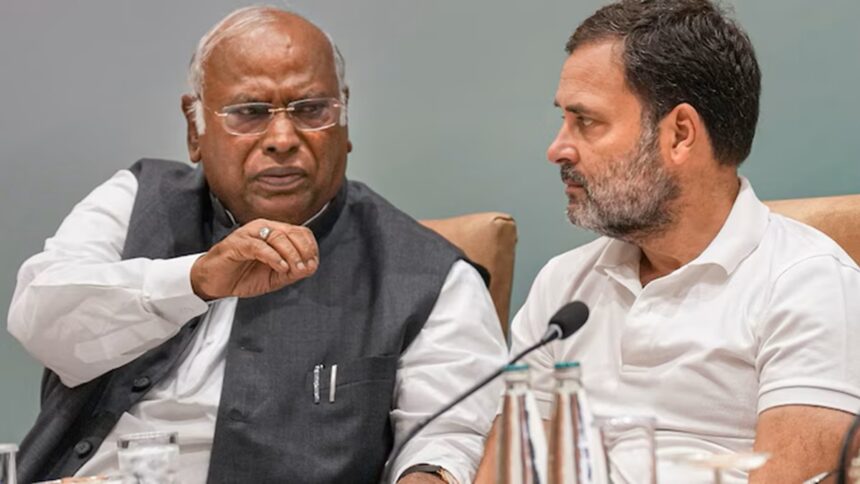
Political rhetoric intensified across multiple states as senior Congress leaders stepped up their attacks on the ruling Bharatiya Janata Party and its leadership. Speaking at a rally in Cooch Behar, Congress president Mallikarjun Kharge questioned the political priorities of Prime Minister Narendra Modi and accused him of making misleading claims during election campaigns. The remarks come amid a high-voltage election season, with parties mobilising support across West Bengal and Tamil Nadu.
Escalating Political Rhetoric in Election Campaigns
Mallikarjun Kharge, addressing supporters in West Bengal, raised questions about the Prime Minister’s continued campaign presence in the state. He alleged that repeated visits indicated a deeper political strategy and questioned whether Narendra Modi intended to shift focus from national responsibilities to state politics. Kharge also accused the Prime Minister of making false promises to influence voters, using strong language that reflects the increasingly confrontational tone of the campaign.
The Congress leader also weighed in on the debate around the Women’s Reservation Bill, stating that the responsibility for its failure lay with the government rather than the opposition. He argued that his party had objected specifically to the delimitation aspect of the proposal, framing the issue as one of procedural disagreement rather than opposition to women’s representation.
Meanwhile, election-related tensions were visible in Tamil Nadu, where clashes broke out between workers of the Dravida Munnetra Kazhagam and the All India Anna Dravida Munnetra Kazhagam in Karur during a campaign event. Police intervened to control the situation, and security measures were subsequently tightened.
Rahul Gandhi’s Ideological Positioning
At a separate rally in Tamil Nadu, Rahul Gandhi outlined what he described as a broader ideological contest between the Congress and its political opponents, including the BJP and the Rashtriya Swayamsevak Sangh. He framed the contest as a clash between differing visions of India’s identity and governance.
Rahul Gandhi emphasised the constitutional principle of India being a “union of states,” arguing that each state should retain its voice and autonomy. He criticised what he described as a push towards centralisation, alleging that the BJP promotes a uniform approach to culture, language, and history that does not reflect India’s diversity.
He also highlighted the importance of federalism, stating that governance should reflect the aspirations of individual states rather than a single overarching framework. These remarks align with the Congress party’s broader campaign narrative focusing on decentralisation and inclusivity.
Wider Campaign Developments Across States
The election landscape remains highly dynamic, with multiple leaders from different parties actively campaigning across regions. In West Bengal, Chief Minister Mamata Banerjee criticised the Prime Minister over symbolic campaign gestures, while BJP leaders projected confidence about forming the government in the state.
Union Defence Minister Rajnath Singh announced plans for a “Durga Squad” aimed at enhancing women’s safety if the BJP comes to power in West Bengal. Uttar Pradesh Chief Minister Yogi Adityanath predicted a political shift in the state, while other BJP leaders continued their outreach through rallies and roadshows.
In Tamil Nadu, campaign activity remained equally intense, with leaders from the DMK, AIADMK, BJP, and Congress addressing public meetings and engaging voters. The presence of multiple national and regional leaders underscores the significance of the ongoing elections in shaping the political narrative.
The Election Commission has also stepped up preparations to ensure smooth polling, including deployment of security forces and training of polling personnel. Voting is expected to take place under tight security arrangements.
Political Narrative and Electoral Impact
The sharp exchange of statements between political leaders reflects the high stakes involved in the elections. Campaign narratives are increasingly centred around governance models, ideological differences, and regional aspirations.
While the Congress is positioning itself as a defender of federalism and diversity, the BJP continues to emphasise development and national unity. Regional parties are also asserting their influence, making the electoral contest multi-dimensional.
As campaigning intensifies, such statements are likely to shape voter perceptions and influence electoral outcomes. The coming days are expected to witness further escalation in rhetoric as parties make their final push before polling.