In a major political twist that underscores the uneasy balance within Kerala’s ruling coalition, the Left Democratic Front (LDF) government has decided to put the implementation of the Centre’s PM-SHRI (Schools for Rising India) scheme on hold. The decision comes only days after the state signed a memorandum of understanding (MoU) with the Union government to access crucial funds for improving school infrastructure and clearing pending dues under the Sarva Shiksha Abhiyan (SSA). The reversal reflects growing ideological friction within the LDF, particularly between the Communist Party of India (CPI) and the Communist Party of India (Marxist) [CPI(M)], over the alleged “saffronisation” of education and the state’s engagement with policies linked to the National Education Policy (NEP) 2020.
Political Pressures and the U-Turn
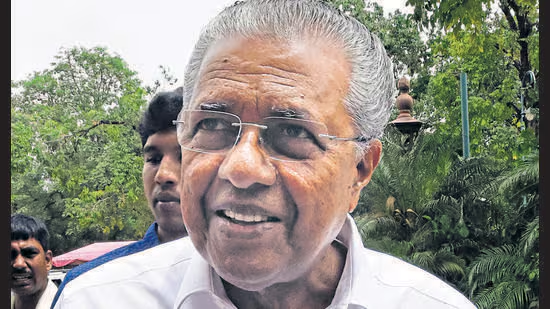
The state’s abrupt decision was announced by Chief Minister Pinarayi Vijayan at a press briefing in Thiruvananthapuram on Wednesday. Citing “controversies and concerns” surrounding the MoU, Vijayan declared that the government would constitute a seven-member cabinet sub-committee to review the scheme before any further steps are taken. “In the wake of the concerns and controversies around the signing of the MoU for the PM-SHRI scheme, the government has decided to review it. A seven-member cabinet sub-committee will be formed to review the scheme and submit a report. Until then, the state will inform the Union government that it will not proceed with implementation,” he said.
However, the Chief Minister refrained from directly addressing why the MoU was signed before such a review was initiated. When reporters pressed him on whether the Union government had exerted pressure to sign the agreement in haste, Vijayan responded tersely, saying, “Anyway, we have decided to review it. Let’s not go into other details right now.”
The announcement marked a dramatic reversal from the state’s earlier position. Just days before, K. Vasuki, Secretary of Kerala’s General Education Department, had signed the MoU with the Union Ministry of Education in New Delhi. The agreement was viewed as a pragmatic step by the state to secure funds for strengthening school infrastructure and fulfilling salary obligations of SSA staff.
Yet, this pragmatic approach clashed with ideological objections raised by the CPI, which claimed the MoU had been signed without adequate consultation within the LDF or the state cabinet. The CPI argued that participation in the PM-SHRI scheme would effectively open the door to the NEP 2020 framework — a policy the Left parties have consistently opposed, viewing it as a vehicle for centralisation and ideological infiltration in education.
The CPI’s resistance created a deadlock within the ruling coalition. Several rounds of discussions between CPI and CPI(M) leaders failed to resolve the issue, ultimately forcing the government to pause the scheme’s rollout. The decision to form a cabinet sub-committee thus became a political compromise — an attempt to pacify the CPI while preserving the image of unity within the LDF.
CPI state secretary Binoy Viswam hailed the government’s reversal as a political victory. “This is the victory of the LDF and Left unity. It is the victory of Left ideals,” he declared, framing the decision as a reaffirmation of the coalition’s ideological consistency.
However, the episode has exposed fault lines within the LDF and raised questions about the decision-making process within the government. While the CPI celebrated the move as a triumph of principle, critics argue that the sudden reversal has dented the government’s credibility and risked the state’s access to much-needed central funds.
Education Funding and Ideological Tensions
The PM-SHRI scheme, launched by the Union government, aims to upgrade existing schools into “exemplar institutions” that showcase the principles of the NEP 2020. Participating states receive financial support for infrastructure development, teacher training, and digital resources, provided they align with certain policy criteria. For Kerala, participation promised significant financial relief, particularly for clearing SSA-related arrears and improving school facilities.
The CPI(M), led by Chief Minister Pinarayi Vijayan, had earlier defended the decision to sign the MoU, emphasizing that the scheme would benefit the state’s education system without compromising its autonomy. Education Minister V. Sivankutty had also maintained that turning away from the scheme would mean forfeiting crores in central funding that could modernize Kerala’s public schools.
Despite these arguments, the CPI’s objections carried weight within the coalition. The party has 16 MLAs and four ministers in the cabinet, giving it considerable influence. CPI leaders argued that the Centre’s education initiatives, including PM-SHRI, are embedded in the NEP 2020 framework, which they believe promotes a centralized, ideologically driven curriculum. They warned that accepting the scheme could undermine Kerala’s long-standing independent education model, rooted in secular and democratic values.
The ideological debate soon escalated into a political confrontation. The CPI accused the education department of acting unilaterally, bypassing proper consultations with LDF partners. According to CPI insiders, the MoU was signed hastily, without prior discussion in the cabinet or with the LDF coordination committee. The CPI leadership conveyed its dissatisfaction directly to the CPI(M) leadership, insisting that the decision must be reconsidered to protect the coalition’s ideological integrity.
This friction reflects broader tensions within Left politics in Kerala, where governance pragmatism often collides with ideological purism. While the CPI(M) has increasingly adopted a pragmatic approach to federal relations and resource mobilization, the CPI has sought to hold the coalition accountable to its traditional Left principles. The PM-SHRI controversy thus became a flashpoint for these competing tendencies.
Meanwhile, opposition parties have seized upon the controversy to attack the government. Leader of the Opposition V.D. Satheesan of the Congress accused the LDF of political doublespeak and administrative confusion. “A cabinet sub-committee should have been formed before signing the MoU. What’s the relevance of the sub-committee after signing it? The CM did not even state the time-frame for the sub-committee to file its report. It is just a tactic to save the government’s face,” Satheesan said.
He further alleged that the government’s handling of the issue reflects a deeper political vulnerability. “At least the CPI must realise it. The BJP has greater hold over the government than the CPI,” he remarked, suggesting that the LDF’s indecision benefits the Centre politically while damaging Kerala’s governance credibility.
The controversy also reignites an old debate about the balance of power between the Centre and the states in matters of education. Kerala has often resisted central policies that it perceives as encroaching on state autonomy. From the implementation of the NEP to the roll-out of centrally sponsored schemes, the state’s Left government has maintained that education should remain within the constitutional purview of the states. The PM-SHRI episode adds another layer to this ongoing tug-of-war, highlighting the political and administrative challenges of navigating cooperative federalism in a polarized national environment.
Within the LDF, however, the immediate concern is to preserve the coalition’s stability. The formation of the cabinet sub-committee, while a temporary measure, has provided the CPI(M) with some breathing space to manage internal dissent without completely alienating its partner. Yet, the larger question of whether Kerala will eventually opt back into the PM-SHRI scheme remains unresolved.
The issue also carries significant administrative implications. With education funds from the Centre tied to compliance with certain policy frameworks, Kerala risks losing substantial financial support by opting out. Officials in the education department privately admit that the state’s fiscal position has already constrained its ability to fund development initiatives independently. The MoU was seen as a means to ease these constraints. Now, with the decision on hold, uncertainty looms over pending projects and staff payments under the SSA.
As Kerala’s education sector awaits clarity, the government’s balancing act between ideological conviction and financial necessity continues. The PM-SHRI controversy has become more than a policy debate — it is a reflection of how political alliances, ideological commitments, and fiscal realities intersect in state governance. For Chief Minister Vijayan and the LDF, the challenge ahead lies in reconciling these competing priorities without undermining the credibility of either governance or ideology.
The coming weeks will determine whether the cabinet sub-committee merely serves as a political buffer or leads to a substantive policy reconsideration. For now, Kerala’s U-turn on the PM-SHRI scheme stands as a telling reminder of the complex interplay between coalition politics, education policy, and the broader battle over India’s federal structure.