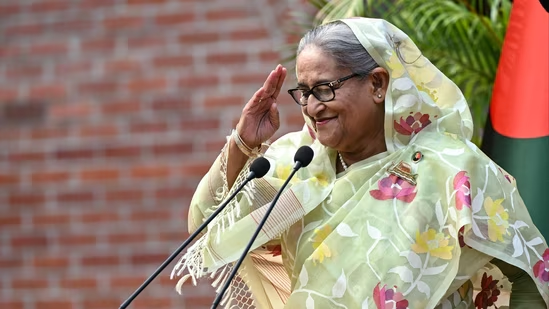
After a dramatic escape from Dhaka amid violent student-led protests in 2024, Bangladesh’s former Prime Minister Sheikh Hasina has been living in quiet exile in New Delhi. Once the most powerful woman in the country and a dominant force in South Asian politics, Sheikh Hasina now leads a subdued life in the Indian capital, far from the corridors of power she ruled for more than fifteen years. Her exile, marked by a deep sense of loss and reflection, has also reignited debates about democracy, legitimacy, and the uncertain political future of Bangladesh.
From Dhaka’s Palace to Delhi’s Safe House
Sheikh Hasina’s exit from Bangladesh was as dramatic as it was symbolic. On August 5, 2024, amid escalating protests led by students demanding reforms and accountability, Sheikh Hasina fled her official residence in Dhaka aboard a Bangladesh Air Force helicopter. The protests had grown violent, with demonstrators eventually storming the compound that once symbolized her authority. The scene evoked haunting memories of 1975, when her father, Sheikh Mujibur Rahman—the founding leader of Bangladesh—along with three of her brothers, was assassinated in a brutal military coup while Sheikh Hasina and her sister Sheikh Rehana were abroad.
That sense of déjà vu was not lost on the 76-year-old leader, who once again found herself forced into exile while her homeland faced political upheaval. Her departure came amid a total collapse of law and order in Dhaka, as the army reportedly refused to suppress the protests by force, leaving the long-serving premier with no option but to flee.
Sheikh Hasina’s aircraft landed at India’s Hindon airbase near Delhi, where she was received discreetly by senior Indian officials. Sources at the time reported that she met National Security Adviser Ajit Doval and a few top military officers, who coordinated her transfer to a secure location under India’s protection. After two days at the airbase, she was moved to a safe house in Delhi’s Lutyens Bungalow Zone—an area known for housing top bureaucrats and politicians under heavy security surveillance.
Since then, Sheikh Hasina’s life has been remarkably restrained. While she remains under constant security watch, reports suggest she enjoys occasional walks in the nearby Lodhi Garden, one of Delhi’s most peaceful and historic public spaces. A Reuters journalist once spotted her there, accompanied by two plainclothes security personnel, politely nodding to those who recognized her. Despite her isolation, she continues to maintain a quiet dignity—acknowledging her exile but refusing to call it a permanent departure from politics.
In private conversations, Sheikh Hasina has expressed a strong desire to return to Bangladesh, but only under what she calls “legitimate governance.” Speaking to The Independent (UK), she remarked, “I would of course love to go home, so long as the government there was legitimate, the constitution was being upheld, and law and order genuinely prevailed.” Her statement reflected not only her longing for home but also her deep distrust of the interim setup now running the country.
The Indian government, while officially silent on the matter, has provided her the necessary protection and accommodation. For New Delhi, Sheikh Hasina’s presence is both a diplomatic responsibility and a geopolitical balancing act. Her long tenure saw India-Bangladesh relations flourish, particularly in trade, counterterrorism cooperation, and connectivity. However, her exile places India in a delicate position as it seeks to maintain neutrality while ensuring regional stability.
The Interim Government and Political Stalemate in Bangladesh
Back home, Bangladesh has been under an interim administration led by Nobel Peace Prize laureate Muhammad Yunus. Appointed after Sheikh Hasina’s ouster, Yunus took charge with the promise of restoring order and organizing national elections in February 2027. His leadership, however, has been fraught with challenges. The political vacuum left by the absence of Sheikh Hasina’s Awami League—a party that had dominated Bangladeshi politics for more than a decade and a half—has created uncertainty about the legitimacy of any forthcoming election.
Sheikh Hasina’s supporters, millions of whom are deeply loyal to her, have vowed to boycott any election held without her or her party’s participation. “Millions of people support the Awami League, so as things stand, they will not vote,” Sheikh Hasina declared in a recent interview. “You cannot disenfranchise millions of people if you want a political system that works.” Her statement underlined the growing rift between the interim government and the political base that once kept her in power.
Meanwhile, Yunus’s administration faces increasing pressure from both domestic and international quarters. In a high-level meeting earlier this week, Yunus reportedly warned of attempts “from home and abroad” to derail the planned elections. “Many forces from inside and outside the country will work to spoil the election,” his press secretary, Shafiqul Alam, quoted him as saying. “Many powerful forces, not minor ones, will attempt to thwart it. Sudden attacks may come.”
These remarks highlight the fragility of the current political climate in Bangladesh. The absence of Sheikh Hasina and her party has led to a legitimacy crisis that no amount of international goodwill can easily resolve. The country’s opposition, once suppressed under Sheikh Hasina’s rule, has re-emerged but remains fragmented and leaderless. The military, too, appears reluctant to intervene directly, preferring instead to let the civilian administration handle the volatile situation.
Sheikh Hasina, for her part, remains vocal even from exile. She continues to give occasional interviews to foreign media outlets, stressing that her ultimate goal is to “restore democracy” and ensure that any future government in Bangladesh is formed through “free, fair, and inclusive elections.” Her words carry weight not only among her supporters but also in diplomatic circles where concerns about the erosion of democratic institutions in Bangladesh are being increasingly raised.
The situation is further complicated by her ongoing legal troubles. Sheikh Hasina is currently facing trial in absentia on various charges, including corruption and abuse of power—cases that her supporters dismiss as politically motivated. The interim government has defended the proceedings as part of its commitment to accountability and transparency, but many observers see them as an attempt to permanently sideline the Awami League and consolidate power.
For the people of Bangladesh, the absence of Sheikh Hasina represents both relief and uncertainty. To some, her departure marks the end of an era of authoritarian control, while to others, it signals the loss of a stabilizing figure who, despite her flaws, maintained relative order and economic growth. The streets of Dhaka, once dominated by her party’s slogans, are now filled with mixed emotions—hope for change, fear of chaos, and nostalgia for stability.
For Sheikh Hasina, Delhi has become a reluctant refuge. Her days are quiet, her public appearances rare, and her political moves cautious. Yet, those close to her say she continues to hold meetings with advisors and maintain contact with loyalists scattered across South Asia and the diaspora. Her residence in Delhi’s high-security zone is said to be modestly furnished but equipped with all necessary facilities, reflecting both her reduced circumstances and India’s discreet hospitality.
The story of Sheikh Hasina’s exile, therefore, is not merely one of political downfall but also of resilience and endurance. It is the tale of a leader who once ruled with an iron hand, now living under the shadows of her past decisions, reflecting on the power she once wielded and the nation she can no longer govern.
Whether she will ever return to Bangladesh remains uncertain. For now, she watches her country’s political drama unfold from across the border, hoping perhaps that history, which has often repeated itself in her life, might one day offer her another chance to reclaim her place. But as the clock ticks toward the 2027 elections and the interim government tightens its control, the odds appear increasingly stacked against her return.
What is certain, however, is that Sheikh Hasina’s story of power, exile, and political redemption will remain central to Bangladesh’s unfolding history. Her presence in Delhi is not merely a personal exile; it is a reminder of how fragile democracy can be in a nation still haunted by its violent past and uncertain of its political future.