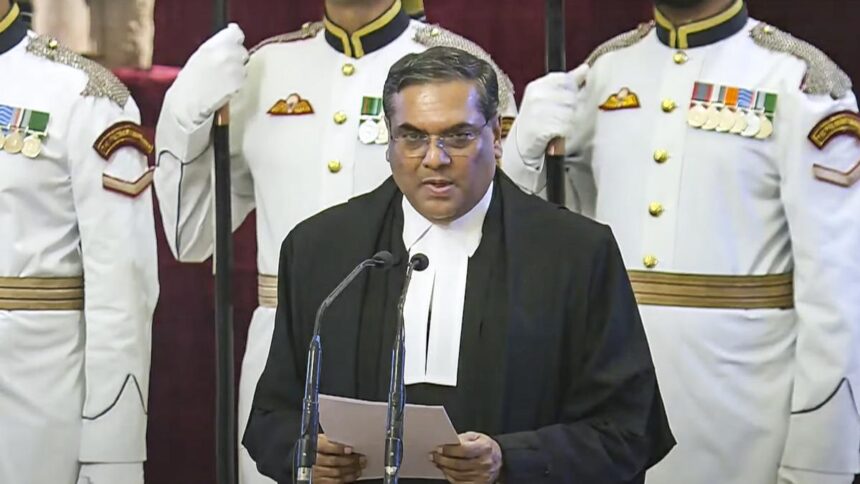
Justice Sanjiv Khanna took oath as the 51st Chief Justice of India (CJI) in a solemn ceremony held at Rashtrapati Bhavan on Monday. The oath of office was administered by President Droupadi Murmu in the presence of key dignitaries, including Prime Minister Narendra Modi, Vice President Jagdeep Dhankhar, Defence Minister Rajnath Singh, Minister of Parliamentary Affairs Kiren Rijiju, Minister of Power Manohar Lal Khattar, and former Chief Justice DY Chandrachud. His appointment follows the retirement of Justice DY Chandrachud, who demitted office on November 10 upon reaching the retirement age of 65. Justice Sanjiv Khanna, who will serve as the Chief Justice till May 13 next year, was recommended for the position by his predecessor in keeping with the established convention of seniority in the Supreme Court.
Born on May 14, 1960, Justice Sanjiv Khanna hails from a legal lineage, being a third-generation lawyer. He pursued his legal studies at the Campus Law Centre of Delhi University before embarking on a distinguished judicial career. He was appointed as a judge of the Delhi High Court, where he presided over several significant cases. His judicial acumen and administrative capabilities led to his appointment as the executive chairman of the National Legal Services Authority (NALSA), an institution dedicated to ensuring access to justice for the underprivileged. In January 2019, he was elevated to the Supreme Court, where he played a crucial role in several landmark judgments and politically sensitive cases.
During his tenure as a Supreme Court judge, Justice Sanjiv Khanna headed benches that adjudicated on high-profile legal matters, including cases involving political leaders. One of the most notable among them was the case concerning the bail applications of Aam Aadmi Party (AAP) leader and former Delhi Chief Minister Arvind Kejriwal in connection with the liquor policy case. In a precedent-setting move, Justice Sanjiv Khanna’s bench granted interim bail to Kejriwal in May, specifically to allow him to campaign during the Lok Sabha elections. The matter was subsequently referred to a larger bench, and the interim bail was extended in July to further deliberate on the necessity of additional grounds for arrest under the Prevention of Money Laundering Act (PMLA), thereby aiming to prevent potential misuse of the legislation.
Justice Sanjiv Khanna also played a significant role as part of the Constitution Bench, contributing to several landmark rulings, including the revocation of Article 370, which stripped Jammu and Kashmir of its special status, and the verdict on the controversial electoral bonds case. His bench also addressed issues surrounding the integrity of India’s electoral process, specifically matters related to electronic voting machines (EVMs) and the Voter Verified Paper Audit Trail (VVPAT) system, which have been the subject of intense debate in recent years.
Known for his balanced and nuanced approach to legal interpretation, Justice Sanjiv Khanna has built a reputation for his commitment to upholding constitutional values and judicial independence. His elevation to the position of Chief Justice comes at a crucial juncture, with the judiciary facing complex legal challenges, including matters pertaining to civil liberties, economic regulations, and the evolving landscape of technology and privacy. As he assumes leadership of the Supreme Court, all eyes will be on his approach to addressing key constitutional and legal questions that will shape India’s judicial discourse in the years to come.