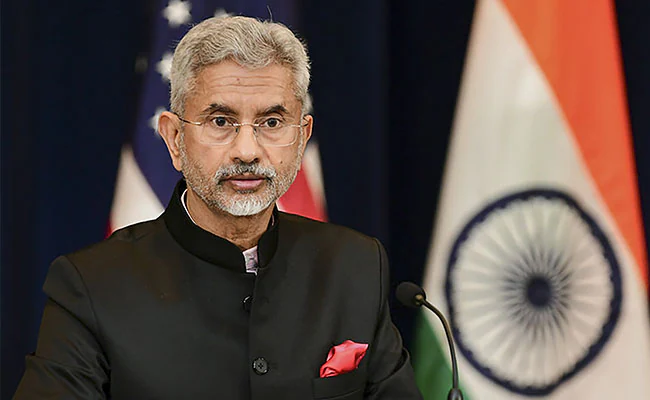
Amid growing global attention on India’s regional and international posture, External Affairs Minister S Jaishankar, during his visit to Brussels, delivered a strong and clear message to the West: India’s actions in Kashmir should be understood through the lens of fighting terrorism, not as a border conflict with Pakistan. Speaking with European publication Euractiv, he addressed a wide array of issues including the EU-India Free Trade Agreement, terrorism rooted in Pakistan, India’s position on Ukraine, and evolving global alliances.
Terrorism Cannot Be Framed as a Border Dispute
In a sharp critique of international media and policy circles, Jaishankar questioned why Osama bin Laden, the most wanted terrorist, felt secure in a Pakistani military town. He stressed that this alone proves the systemic nature of Pakistan’s terror ecosystem. “This is not merely an India-Pakistan issue. It’s about terrorism, and that same terrorism will eventually threaten others,” he said. He criticized attempts to portray India’s response to terrorism—such as Operation Sindoor after the Pahalgam attack—as a bilateral tit-for-tat.
On the trade front, Jaishankar reaffirmed India’s ongoing negotiations with the European Union for a free trade agreement, positioning India as a trusted and stable economic partner in contrast to China. “European companies are increasingly choosing India to de-risk their supply chains. They are placing data and infrastructure in countries they can trust,” he stated.
India’s Neutral Stand on Ukraine and West’s Historical Bias
When asked about India’s reluctance to impose sanctions on Russia after its Ukraine invasion, Jaishankar reiterated that New Delhi does not believe wars resolve conflicts. “We’re not being prescriptive or judgemental—but we’re not uninvolved either,” he said. He highlighted India’s longstanding diplomatic ties with both Russia and Ukraine, but also reminded Europe of its past alignment with Pakistan. “Just months after India’s independence, Pakistan invaded Kashmir—and the West backed them. If those same countries now talk about international principles, we have the right to ask them to reflect on their history.”
Addressing the EU’s proposed carbon tax, Jaishankar made it clear that India strongly opposes unilateral climate standards being imposed globally. He emphasized that such mechanisms, like the EU’s Carbon Border Adjustment Mechanism (CBAM), are seen as unfair by developing nations.
On U.S. relations, Jaishankar reiterated that India deals with nations based on interests, not personalities, and called the India-U.S. relationship a cornerstone of its foreign policy evolution.