The Government of India has said it will carefully examine the implications of the newly signed “Strategic Mutual Defense Agreement” between Pakistan and Saudi Arabia, under which an attack on either country would be treated as an aggression against both. New Delhi noted that this pact, signed during Pakistani Prime Minister Shehbaz Sharif’s visit to Riyadh on the invitation of Crown Prince Mohammed bin Salman, carries potential consequences not only for India’s national security but also for the stability of the wider region and the international order.
India’s Response to the Pakistan-Saudi Agreement
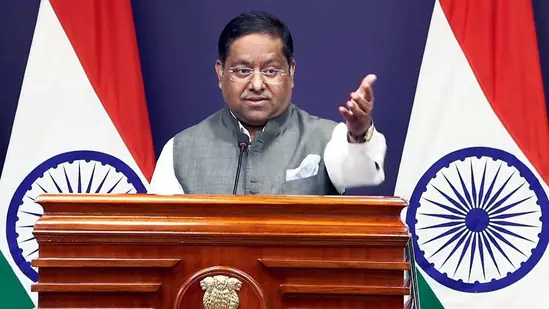
The Ministry of External Affairs (MEA) responded on Thursday to media queries over the development. MEA official spokesperson Randhir Jaiswal said that India had long been aware that such an agreement was under consideration and is now reviewing the impact of its formalisation. “We have seen reports of the signing of a strategic mutual defence pact between Saudi Arabia and Pakistan. The Government was aware that this development, which formalises a long-standing arrangement between the two countries, had been under consideration,” Jaiswal stated.
He further stressed that India remains vigilant about its national interests and will conduct a thorough assessment of the pact in the context of its national security as well as its ramifications for regional and global peace. “We will study the implications of this development for our national security as well as for regional and global stability,” the MEA’s statement said. Jaiswal underscored that New Delhi’s commitment to ensuring comprehensive security across all domains remains resolute, reiterating that safeguarding India’s sovereignty and protecting its interests remains the government’s foremost priority.
The Saudi Press Agency, citing official sources, confirmed that the defence pact between Riyadh and Islamabad aims to strengthen defence cooperation, develop joint deterrence capabilities, and formalise a mechanism under which both nations would respond collectively to any external aggression. According to Saudi officials, this step was necessary in the face of new regional challenges and increasing uncertainty in West Asia.
This agreement comes at a time when India and Pakistan have only recently emerged from a sharp military escalation earlier in the year. Following the April 22 terrorist attack in Pahalgam, India launched Operation Sindoor on May 7, conducting a series of precision strikes that targeted terror infrastructure inside Pakistan and Pakistan-occupied Kashmir. The cross-border conflict escalated into a four-day exchange involving drones, missiles, and heavy artillery, underscoring the volatility of ties between the two nuclear-armed neighbours.
The Strategic Context of the Defence Pact
The timing of the Pakistan-Saudi deal has raised questions in New Delhi and beyond, particularly because of its coincidence with multiple regional flashpoints. The pact was signed only days after an Israeli strike in Doha, the Qatari capital, killed senior Hamas leaders. That strike, condemned by the United States as a unilateral move undermining American and Israeli interests, underscored shifting dynamics in the Gulf region where traditional security dependencies on Washington are being reconsidered.
Analysts believe Saudi Arabia’s decision to formalise its military cooperation with Pakistan reflects a broader attempt to diversify its security partnerships and strengthen deterrence outside the US umbrella. While Riyadh and Washington have historically shared close defence ties, the recalibration of US commitments in West Asia, combined with new security threats, has encouraged Saudi Arabia to expand its strategic options.
For Pakistan, the agreement represents both a political and strategic victory. Domestically, it provides Prime Minister Shehbaz Sharif’s government with the chance to showcase its close alignment with a powerful Gulf partner. Strategically, it signals that Pakistan, often isolated diplomatically because of its terror links, has secured the backing of a major Islamic power. Islamabad has often leaned on Riyadh not only for economic support but also for political cover in international forums. This pact, therefore, strengthens the symbolism of solidarity while also institutionalising security cooperation.
For India, however, the development could complicate its diplomatic calculus. New Delhi maintains growing strategic and economic ties with Saudi Arabia, particularly in energy, investment, and diaspora relations. Yet, with Riyadh now explicitly entering into a defence pact with Islamabad, questions arise about how the Gulf kingdom will balance its relations with India against its long-standing support for Pakistan.
The Indian government’s measured response reflects the need to avoid a premature reaction while signalling seriousness in evaluating the pact’s full implications. India’s priority remains preventing any shift in the regional security balance that could embolden Pakistan or provide it with enhanced legitimacy in pursuing aggressive policies. Given the recent military tensions following Operation Sindoor, New Delhi is particularly alert to any moves that could alter Pakistan’s confidence or encourage it to escalate provocations along the Line of Control and beyond.
Observers point out that while the pact declares that aggression against one is aggression against both, the practical implementation of such an arrangement remains uncertain. The Saudi military, though well-funded, is largely dependent on Western systems and training. Meanwhile, Pakistan has traditionally provided Riyadh with military personnel and advisors, including high-ranking officers who have often served in Saudi defence establishments. This agreement could further institutionalise those linkages, yet whether Riyadh would intervene militarily on Pakistan’s behalf in the event of renewed India-Pakistan hostilities is far from guaranteed.
At the same time, the pact adds an additional layer to India’s regional security concerns. The Gulf is home to millions of Indian expatriates, and India remains heavily dependent on energy imports from the region. Any instability in ties with Riyadh could therefore have both strategic and economic implications. Balancing its robust relations with Saudi Arabia against the latter’s deepened partnership with Pakistan will require deft diplomacy from New Delhi in the coming months.
The broader international backdrop also matters. The US reaction to this pact will be closely watched, particularly because Washington remains Saudi Arabia’s principal defence supplier. Any perception of Riyadh leaning too heavily on non-Western alliances, particularly with countries like Pakistan whose security record remains controversial, could introduce new complexities in US-Saudi relations. For India, managing its triangular relations with Washington, Riyadh, and Islamabad will be critical in ensuring that its interests are not undermined.
As this defence pact takes shape, New Delhi’s task will be to safeguard its strategic interests without undermining its strong economic and diplomatic engagement with Saudi Arabia, while simultaneously keeping a firm eye on Pakistan’s manoeuvres. The MEA’s emphasis on studying the implications rather than issuing a hasty condemnation reflects this nuanced approach. The government’s strategy appears aimed at ensuring India’s security remains uncompromised while avoiding unnecessary frictions with one of its key energy and trade partners.