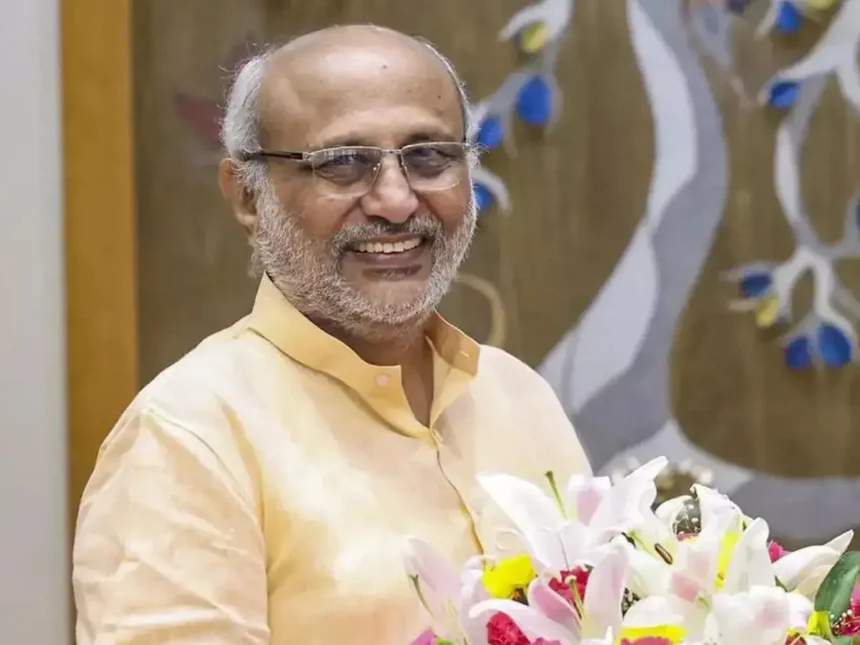
The recently concluded Vice Presidential election in India has underscored a significant political narrative, as CP Radhakrishnan, the National Democratic Alliance’s nominee, emerged victorious with a decisive mandate. Speaking to reporters after the results, Radhakrishnan declared that the “nationalistic ideology” has been the overall winner in the election, despite the opposition framing it as an ideological battle. With 452 votes in his favour against the opposition candidate B Sudershan Reddy’s 300, the election results have offered insights into parliamentary dynamics, cross-voting patterns, and the broader political strategies influencing India’s constitutional processes. The victory also comes at a critical time ahead of state elections, notably in Tamil Nadu, highlighting both political strategy and ideological positioning.
Nationalistic Ideology and Electoral Dynamics
CP Radhakrishnan’s remarks highlighted the dominant presence of nationalistic ideology in the election, positioning it as the guiding principle behind the electoral outcome. He pointed out that while the opposition presented the contest as an ideological fight, the voting patterns clearly demonstrated the broader appeal and acceptance of the nationalistic vision in India’s political landscape. Despite lacking the numerical strength, the opposition compelled a formal election, attempting to frame the outcome as a contest of principles. However, the decisive margin secured by Radhakrishnan reflected not just party support but also strategic cross-voting by legislators, revealing fissures within the opposition ranks.
Radhakrishnan’s margin of 452 votes against 300 for B Sudershan Reddy—15 votes fewer than the Congress party anticipated—illustrates the complexities of political alignment and legislative behaviour in India. Analysts note that the cross-voting, especially from factions of the opposition, highlighted underlying tensions within parties attempting to maintain a unified front publicly. The NDA’s acknowledgment of the cross-voting served as a subtle critique of the opposition’s internal cohesion, demonstrating the party’s strategic advantage in parliamentary manoeuvring. This electoral pattern has further implications for upcoming state elections, particularly in southern states where the BJP has been seeking expansion and consolidation.
Additionally, the election outcome reinforces the importance of ideological positioning in contemporary Indian politics. CP Radhakrishnan’s association with the Rashtriya Swayamsevak Sangh (RSS) and the historical Jan Sangh underscores his deep-rooted links with the ideological foundations of the party. These connections, alongside his personal and political experience, were viewed as instrumental in consolidating the NDA’s ideological appeal and bridging regional political gaps, particularly in Tamil Nadu, where the party continues to navigate complex electoral terrains. The electoral results thus reflect a convergence of ideology, experience, and political strategy, providing the NDA with both a symbolic and practical victory in shaping national narratives.
Rajya Sabha Balance and Institutional Responsibilities
Following the resignation of Jagdeep Dhankhar, known for his confrontations with the opposition, CP Radhakrishnan’s selection was interpreted as a strategic move to foster balance and constructive dialogue in the Rajya Sabha. Radhakrishnan emphasized the importance of recognizing both the ruling party and the opposition as integral components of a functional democracy. He remarked, “In a democracy, both the ruling party and the opposition are important. It is the two sides of the same coin. The interest of the democracy will be taken into account.” This approach signals an intent to maintain institutional stability while ensuring fair and impartial management of legislative proceedings.
Radhakrishnan acknowledged the responsibilities of the office, noting that every post carries unique limitations and expectations. He stressed the importance of working within the framework of constitutional duties, highlighting the need for measured, responsible leadership in the upper house of Parliament. While his victory margin of 150 votes is smaller compared to Jagdeep Dhankhar’s previous 2022 landslide win, it nonetheless represents a decisive mandate and reflects the confidence reposed in him by the members of Parliament. Analysts interpret this outcome as both a validation of his credentials and a recognition of the nuanced political balance required in the Rajya Sabha.
The election result also carries broader implications for governance and legislative oversight. As Vice President and ex-officio Chairperson of the Rajya Sabha, Radhakrishnan is tasked with facilitating debates, ensuring procedural fairness, and managing the complex interplay of regional, party, and ideological interests within the house. His strategic positioning, coupled with historical associations with the RSS and Jan Sangh, signals a dual focus on upholding nationalistic principles while promoting constructive engagement with the opposition. This approach contrasts with the more confrontational style of his predecessor and reflects a commitment to institutional balance and functional leadership.
The timing of the election, ahead of critical state polls, adds further political and strategic significance. Tamil Nadu, Radhakrishnan’s home state, remains a key area for the BJP’s expansion efforts, and his elevation provides both symbolic and practical reinforcement of the party’s ambitions in southern India. By selecting a leader with both ideological alignment and regional influence, the NDA aims to strengthen its presence, enhance organizational credibility, and project unity across diverse political landscapes.
Furthermore, the results underscore the continuing importance of ideological clarity and strategic alliances in shaping parliamentary outcomes. The opposition’s attempt to cast the election as an ideological contest ultimately reinforced the narrative of nationalistic predominance. Radhakrishnan’s victory demonstrates the effectiveness of integrating experience, regional influence, and party ideology to achieve legislative success. The election outcome also highlights the evolving dynamics of Indian parliamentary politics, where cross-party alignments, regional considerations, and ideological positioning collectively influence the functioning and decisions of constitutional offices.
Radhakrishnan’s remarks also provide a broader perspective on governance, institutional responsibility, and democratic norms. By acknowledging the importance of both sides of the parliamentary spectrum, he signals a commitment to fostering dialogue, encouraging constructive debate, and maintaining procedural integrity. His approach aims to ensure that the Vice President’s office serves as a stabilizing force, facilitating legislative business while respecting the diverse viewpoints represented within the Rajya Sabha.
The electoral process, vote distribution, and subsequent statements from Radhakrishnan collectively underscore the layered nature of Indian democracy. From ideological contests and regional strategic considerations to the personal credentials and historical affiliations of officeholders, the Vice Presidential election illustrates how political outcomes are shaped by multiple intersecting factors. Radhakrishnan’s comments about the victory of nationalistic ideology not only frame the electoral outcome but also reinforce the broader narrative of ideological continuity, institutional stability, and strategic foresight.
By maintaining a focus on balance, dialogue, and the constructive role of both ruling and opposition parties, Radhakrishnan positions himself as a Vice President committed to institutional stewardship rather than partisan confrontation. His statements reflect an understanding that effective leadership in the Rajya Sabha requires negotiation, impartiality, and respect for procedural norms, ensuring that the house functions efficiently while upholding democratic values.
In addition, the election outcome reflects the interplay of historical political affiliations and contemporary strategy. Radhakrishnan’s long-standing association with the BJP’s ideological mentors, alongside his regional influence in Tamil Nadu, reinforces the party’s ability to leverage experience and ideology for electoral gains. The result further indicates that ideological alignment, when combined with legislative competence and strategic acumen, can yield decisive outcomes in parliamentary elections, particularly in closely contested scenarios where cross-voting plays a pivotal role.
Overall, CP Radhakrishnan’s election as Vice President exemplifies the convergence of ideology, experience, and political strategy. His comments about the victory of nationalistic ideology signal both an affirmation of the NDA’s guiding principles and a commitment to maintaining institutional balance in the Rajya Sabha. The electoral outcome, margin of victory, and subsequent public statements provide insights into the evolving nature of India’s parliamentary processes, the significance of strategic electoral planning, and the importance of ideological clarity in shaping the governance framework.
By emphasizing inclusivity, respect for opposition perspectives, and adherence to constitutional responsibilities, Radhakrishnan sets a precedent for measured leadership and institutional stability. His remarks also highlight the necessity of balancing party ideology with parliamentary impartiality, ensuring that the Vice President’s office continues to serve as a cornerstone of democratic governance while fostering constructive engagement across political divides.
The election outcome, strategic implications, and public statements collectively reinforce the dual importance of ideology and institutional responsibility in shaping the trajectory of parliamentary leadership. CP Radhakrishnan’s approach, integrating nationalistic principles with a commitment to procedural fairness, offers a blueprint for how high constitutional offices can function effectively, maintaining both political relevance and institutional credibility in India’s evolving democratic landscape.